
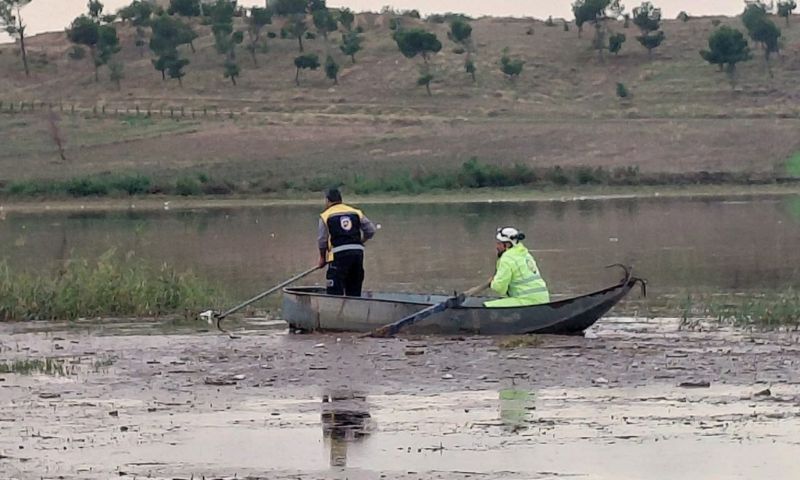

Several areas across Syria have experienced flash floods following heavy rainfall and thunderstorms, causing property damage, particularly in Latakia, Aleppo and Deir Ezzor governorates. No casualties were reported in the latest flooding.
Enab Baladi’s correspondent in Deir Ezzor (eastern Syria) reported on Friday, November 6, that the town of al-Hari, in the al-Bukamal area, was hit by severe flash floods following heavy rainfall, causing floodwaters to enter homes.
The correspondent said Civil Defense teams, security forces, police and road security personnel, supported by residents and the local community, were working to respond to the situation and rescue affected families.
The floods inundated several homes near valleys and temporarily cut off the international road toward Iraq because of damage to the roads, according to the correspondent.
Field teams are continuing to assist residents in flooded neighborhoods and accelerate evacuations, while relocating affected families to safe areas and ensuring the safety of people living in locations most vulnerable to floodwaters.
In Afrin, northern Aleppo (northern Syria), flash floods swept through agricultural and residential areas, damaging soil, particularly in olive groves for which the city is known, during the olive harvest season.
The flooding was concentrated in the village of Dayr Sawwan, in the Sharran subdistrict, as well as other villages and towns, following heavy rainfall across the area, according to the local Afrin Now platform and videos circulating from the region.
In Latakia (western Syria), flooding continued in the town of Kessab, in the northern part of the governorate, from Thursday into Friday. The town experienced severe flash floods following an intense rainstorm accompanied by heavy rainfall and thunderstorms.
The storms caused water to rush down from the mountains surrounding the town, turning several streets into waterways and causing previously dry streambeds to flow again, according to the official al-Wehda newspaper.
Michel Jaghlas, head of Kessab municipality, told al-Wehda that the floods damaged roads and infrastructure because of the force of water flowing down from the surrounding mountains.
Jaghlas said the area experienced ground subsidence approximately 1.5 meters deep, damaging part of a road and sidewalk. Electricity poles were also damaged and are now at risk of collapsing.
According to the municipal head, Civil Defense teams worked with the Water Resources Directorate to clear and clean waterways and the river running through central Kessab, removing sediment and rocks carried by the floodwaters, particularly along al-Samra Road.
Technical services and electricity crews also continued repairing damage to roads, infrastructure and electricity poles, Jaghlas said.
In a related development, Mohammad Khalil, director of the media office at the Latakia Water Resources Directorate, confirmed that Balloran Dam had reached more than 97% of its capacity following the heavy rainfall recorded in the area on Thursday, November 5.
Khalil explained in a statement carried by al-Wehda that once the dam reaches full capacity, its side spillway will accommodate incoming floodwaters. He stressed that the dam and spillway are in good technical condition and that there are no risks to the facility’s operation.
Previous Weather Warnings
Syria’s Ministry of Emergency and Disaster Management had warned residents on November 3 of severe weather conditions, saying their effects would begin on Thursday and continue until the evening of Saturday, November 7.
The ministry said the weather would change significantly, bringing heavy rainfall and strong thunderstorms.
It warned that the most severe conditions would affect coastal areas, which were expected to experience exceptionally heavy rainfall accompanied by thunderstorms. The ministry also warned of significantly higher sea waves and the possibility of waterspouts forming offshore.
According to the ministry, rainfall would extend from the Syrian coast to Idlib, Aleppo, Hama and Homs, with precipitation ranging from moderate to heavy and occasionally accompanied by thunderstorms.
Western Damascus countryside, Quneitra (southwestern Syria), and parts of Daraa and Suwayda (southern Syria) were also expected to experience similar conditions beginning Friday afternoon, with moderate rainfall that could intensify at times.
In a separate statement, the Ministry of Emergency and Disaster Management warned of severe weather affecting al-Hasakah governorate (northeastern Syria), particularly its northern and eastern areas, as well as northern Raqqa, from Thursday evening through Saturday, November 7.
The ministry said the weather system would bring heavy rainfall and thunderstorms, increasing the likelihood of runoff through valleys, flash flooding, and water accumulation in low-lying areas.
It also warned of a noticeable increase in surface wind speeds, urging residents and relevant authorities to exercise caution and take the necessary measures to respond to potential emergencies.
In late October and early November, areas of western Raqqa, Deir Ezzor and eastern Aleppo countryside experienced flooding and severe flash floods caused by a low-pressure weather system. The earlier flooding resulted in deaths and left others missing across several locations in the three governorates.