
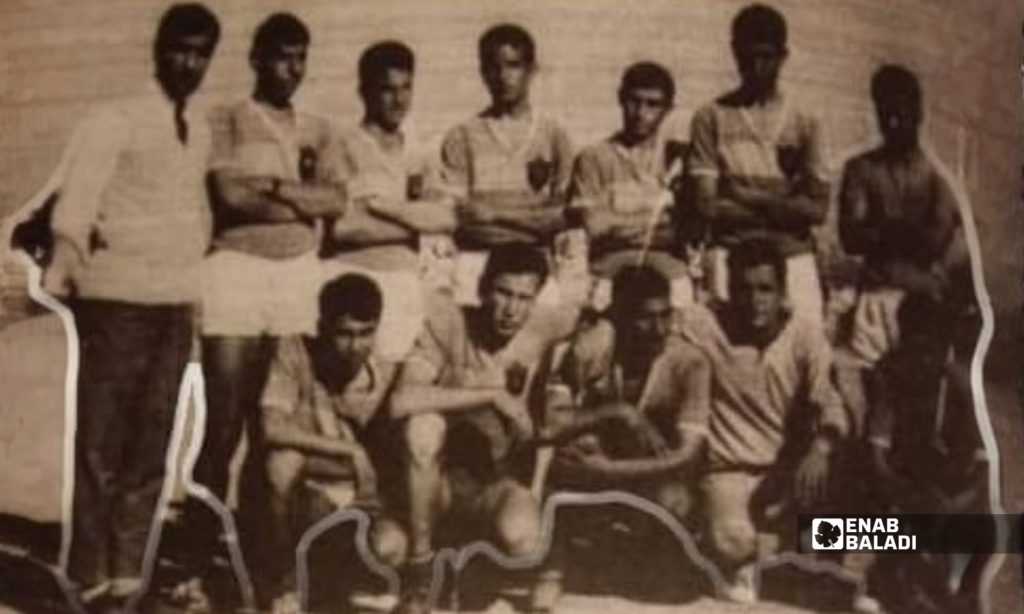

In the mid-1970s, the owner of the land that Darayya Club began using as a football pitch was unhappy that it had been expropriated. He would come at night and plow the ground, especially when the team was due to play an important match the following day.
The players would arrive in the morning to find the ground they had prepared the previous day covered in furrows. Between 20 and 40 players, coaches and administrators would gather with shovels and spades to level it again before the visiting team arrived.
The situation was repeated until young men from the club began guarding the pitch at night, fearing they would wake up on match day to find the ground plowed once again.
This was one of the challenges Darayya Club faced when it moved to its facility on the road to Moadamiyet al-Sham, after years of playing on a piece of land known as al-Mahfara and later on school grounds.
The land itself was not the only thing that needed preparation. Players later helped carry construction materials for the perimeter wall and collected stones from the pitch before grass was planted, while residents provided donations and machinery for some of the work.
Organized football in Darayya had begun roughly a quarter of a century earlier, with two local teams established in the early 1950s, al-Fityan and al-Wafaa. They merged in 1958 to form al-Fityan Darayya Club, which was renamed Darayya Sports Club in 1974.
Enab Baladi revisits the club’s history through interviews with five former players and administrators: Nizar al-Dabbas (Abu Alaa), Hussam Taleb (Abu Alaa), Khaled Habib, Mahmoud al-Sharbaji (Abu Hamed) and Deeb Ghannoum (Abu Ahmad).
Their accounts cover events they experienced at the club, alongside stories passed down from earlier generations, particularly those concerning its founding years.
From al-Fityan and al-Wafaa to Darayya Club
According to accounts passed down by Darayya Club members, organized football in the town dates back to the early 1950s, when two separate teams emerged, al-Fityan and al-Wafaa.
Al-Fityan was associated with Dr. Abdul Majid al-Sharbaji, known as Abd al-Sharbaji, an economics professor who was among the most prominent supporters of football in Darayya at the time. Al-Wafaa was associated with Mohammad al-Masri, who supervised and supported the team.
Neither team had stable financial resources. Abdul Majid al-Sharbaji and several members of his family provided some of the players’ basic needs, including football boots and jerseys.
The al-Sharbaji family had a strong presence in al-Fityan. Among the names associated with that period were Riyad al-Sharbaji, Abdul Majid’s brother, along with Taha al-Sharbaji, Muayyad Hammouda and Fayez Rajeh.
Nizar al-Dabbas emphasizes that his knowledge of this period comes from accounts he heard from members of the previous generation, rather than events he witnessed himself.
In 1958, the two teams merged into a single club named al-Fityan Darayya Club. Accounts passed down through generations describe the merger as a community initiative that brought the teams together with little official support at the time.
Abdul Majid al-Sharbaji occasionally recruited players from al-Jaish Club and the Syrian national team to participate with Darayya in important matches, drawing on his sporting connections and his desire to strengthen the team.
In its early years, the club did not participate in a regular league system. Friendly matches and locally organized competitions were central to its activities.
Even the football used at the time differed from those familiar to later generations.
In the 1960s, footballs had a thick leather outer covering and an inner rubber bladder. Players bought the leather casing and bladder from sports equipment shops in Damascus, inflated the bladder, inserted it into the leather covering, and closed the opening with a wide lace resembling a shoelace.
Because the laced section was more prominent and heavier than the rest of the ball, its movement was not entirely balanced, and it would often come to rest on one side.
Despite limited resources, al-Fityan Darayya participated in Syrian Cup competitions during the 1950s and 1960s.
In one competition, the team reached the round of 16, where it faced Ahli Damascus, later renamed al-Majd Club, at the old municipal stadium on the former Damascus International Fairgrounds. Darayya lost the match 1-0.
During the 1960s, the team also reached a final against Qasioun, which later became al-Wahda Club.
According to Deeb Ghannoum, the match was originally scheduled to take place in Darayya, but the football federation decided to move it to the municipal stadium in Damascus. The club considered the decision biased in favor of the Damascus team and refused to play in protest, resulting in a forfeited match.
From the Threshing Ground to School Pitches
Before Darayya Club moved to its facility on the Moadamiyet al-Sham road, players trained and held matches on land known as Ard al-Baydar, or the Threshing Ground, at the site where al-Muhdatha School was later built.
The name came from residents’ use of the land for threshing and storing harvested crops during the 1940s. It was also known as al-Mahfara, meaning the excavation site, because of pits left by the extraction of white soil used to whitewash houses.
The land gradually became an informal football pitch, but it was not suitable for play throughout the year. In winter, rainwater collected in the pits, preventing players from using the ground until it dried. When matches were held after rainfall, the soil turned into mud that stuck to the players’ boots and made movement difficult.
Al-Mahfara hosted matches between local teams and schools, including a tournament won by Maan bin Zaida School, whose team included Deeb Ghannoum when he was a primary school pupil.
When the pitch flooded, players moved to schoolyards.
Fayez Rajeh would open the gates of Maan bin Zaida School, which later became Darayya Girls’ Secondary School, allowing them to play. The area around the school included a garden, trees, and a water fountain, while some school grounds hosted afternoon football tournaments during Ramadan.
After the Ard al-Baydar pitch disappeared, players continued relying on school grounds for another period.
Nizar al-Dabbas was 14 years old in 1974 and remembers training on one of these grounds. He estimates that this arrangement continued for another three or four years.
That same year, the club underwent a name change as part of the reorganization of Syrian sports clubs, becoming Darayya Sports Club instead of al-Fityan Darayya Club.
The reorganization also brought areas and teams affiliated with the district center under the club, including Moadamiyet al-Sham and Sahnaya.
Fayez Rajeh was among the most prominent administrators of the period, alongside Sobhi Abu Kam, Sobhi Fattash, Muayyad Hammouda, Ghazi Lakkoud and Mohammad Daghmoush (Abu Jihad).
A Football Pitch Built by Players and Residents
In the mid-1970s, Darayya Club moved to a new plot of land at the beginning of the Darayya-Moadamiyet al-Sham road.
The site began to be used around 1975 and 1976, before the land expropriation procedures were fully settled. According to one account, the land belonged to a member of the al-Jabban family, who was unhappy about its conversion into a football pitch.
Players and administrators spent hours leveling the soil, removing stones and preparing the ground, only to discover the following morning that it had been plowed again.
The landowner would come at night to plow it, particularly before important matches when Darayya was hosting a team from Syria’s coastal region, in an attempt to prevent the land from becoming an established football pitch.
In the morning, the players, coaches and administrators would gather to repair the damage.
Nizar al-Dabbas says the number of participants sometimes reached between 20 and 40 people, who carried shovels and spades to remove the furrows and level the pitch before the visiting team arrived.
The incidents continued until young men from the club began taking turns guarding the land at night.
This was one of the problems the club encountered during its move to the new facility. The land itself required extensive work before becoming suitable for matches.
Wooden goalposts were brought to the site, along with a roller to level the soil. Players and administrators worked with hand tools, with Sobhi Fattash and his brother Reda among the club members most actively involved in preparing the site.
According to Deeb Ghannoum, the expropriated land initially covered about 72 dunams. Twelve dunams were later allocated to the Housing Establishment and eight to the Engineers Syndicate, leaving approximately 52 dunams for the sports facility.
The pitch did not immediately settle in its final location. It was first established on land that later became part of the swimming pool, then moved to an area used for six-a-side pitches, before finally reaching the site of the main stadium.
Hussam Taleb trained on a long dirt pitch where the swimming pool was later built, while Khaled Habib began training on a dirt field slightly farther from the final stadium site. Some evening training sessions were held under the lights at Maan bin Zaida School.
Players Carried Materials for the Wall on Their Shoulders
By the early 1980s, the site was beginning to take the shape of a more permanent sports facility.
Darayya Municipal Council built a small stand, while the Sports Federation allocated 350,000 Syrian pounds at the time for the construction of a perimeter wall.
But the allocated funding was not the only contribution to the project.
Players and administrators carried bags of cement, sand and concrete blocks on their shoulders, cleared the land, removed weeds and helped prepare the site alongside construction workers.
Sobhi Fattash and his brother Reda were almost constantly involved in the construction work, helped by the proximity of Sobhi’s home to the pitch.
Some residents provided their machinery to help, including Abu Majed Obeid and members of the al-Dabbas family, who made their bulldozers and front-end loaders available to the club free of charge to level the ground and move soil.
Khaled Habib confirms that workers participated in building the wall and that the Sports Federation financed it. However, he does not know whether the project was assigned to a contractor or organized through another arrangement.
Once the wall was completed, the facility had an official entrance gate, following years in which the pitch had been prepared using whatever resources were available.
Waiting for Grass to Grow by Lighter Light
Work to plant grass on the pitch began in the mid-1980s, around 1985 and 1986.
The club’s president at the time, Amin al-Azab, purchased the grass seeds, while players helped clear and prepare the land for planting.
Sobhi Fattash would ask them to arrive about an hour before training to collect stones from the soil by hand. Once they had cleared a section of the ground, their regular training session would begin.
There was no advanced irrigation network, and water was delivered to the pitch using tankers and agricultural tractors.
Once the seeds were planted, the players began waiting for the grass to appear.
Some were not content to inspect the ground during daylight. They would sometimes visit the pitch at around 2 a.m., lighting a cigarette lighter to examine the soil for the first signs of germination.
The initial planting succeeded, but the pitch did not develop an even covering of grass. Some areas received more water than others, allowing the grass to grow in certain places while struggling in others.
The uneven surface remained until another phase of rehabilitation in the 1990s.
In 1995 and 1996, during Amer al-Hou’s presidency of the club, officials contacted the General Sports Federation to obtain approval for a more modern resurfacing and grass-planting project.
By 1997 and 1998, the pitch had improved to the point that club members considered it one of Syria’s most beautiful football grounds at the time.
It began hosting Arab clubs and national teams for training sessions and friendly matches.
Darayya drew against the Iraqi youth national team, Iraq’s al-Talaba Club and the UAE’s al-Nasr Club, and defeated Kuwait’s al-Nasr Club 2-0.
The pitch was not the only part of the facility developing. In the early years, one of the few rooms on the site housed a water pump motor. It was later converted into a changing room for players.
According to Mahmoud al-Sharbaji, the room existed before the land was expropriated. Players installed a door and began using it, before it later became a space for judo activities.
As the club expanded, additional rooms and facilities were built. A well was also dug within the grounds after 2000 to provide irrigation water.
The facility eventually included a swimming pool, café, park, shops and six-a-side pitches, alongside the main stadium and training facilities.
Playing at the Expense of Work
By the late 1970s, Darayya Club’s resources were insufficient to cover the costs of participating in league competitions.
The administration distributed donation receipt books to players who were well known among residents, asking them to visit shops and workshops to request contributions.
Donations could begin at two or five Syrian pounds, reaching 20 or 50 pounds from wealthier supporters.
According to Deeb Ghannoum, the club sought to raise around 25,000 Syrian pounds to cover an entire season, including bus transportation, travel expenses, and referees’ fees.
The task was not always easy. Some shopkeepers refused to donate, while others directed hurtful remarks at the players because they were unconvinced that spending money on football was worthwhile.
With the construction of the wall and installation of gates, the club was able to begin selling tickets for matches.
Admission cost 15 Syrian pounds per supporter, with the proceeds used to cover part of the club’s expenses.
Players also contributed from their own pockets, buying their boots and clothing and sometimes helping pay for bus fares and meals when traveling to other governorates.
During the 1980s, the club received subsidies from the Sports Federation based on the number of activities officially registered under its name.
Nizar al-Dabbas says the club’s administration sometimes arranged with other clubs, including Tartous Club, to register matches and activities that had not actually taken place, in men’s and youth football, table tennis and volleyball, to increase the number of activities recorded with the Sports Federation and obtain additional subsidies.
He estimates that the amounts generated through these arrangements did not exceed a few thousand Syrian pounds annually.
Eleven Players in Different Colors
Until 1983, Darayya’s football team did not have a standardized kit. Players would enter the pitch wearing different-colored jerseys, one in red, another in green, and a third in blue.
In some matches, the team tried to gather shirts in similar colors, although they were not identical. Two players even occasionally wore the same number.
In 1983, the club received its first matching kit, in red and blue, provided by the mayor of Darayya at the time. It was introduced before a match against al-Wahda Club, which Darayya won 1-0.
The players kept the kit for around four years, washing it after matches and reusing it for official games.
Football boots and training clothes remained the players’ personal responsibility, and some bought secondhand clothing to reduce costs.
From the Workshop to the Football Pitch
Footballers in Darayya could not rely on the sport to make a living. They worked during the day, then attended training sessions or matches after finishing their jobs.
Nizar al-Dabbas worked in carpentry and the timber trade. Jamil Habib and Mohammad Obeid, known as Abu Nabil, worked in tiling, while other players were employed in agriculture, carpentry and the trades common in the town.
Deeb Ghannoum would go to work in the morning, return home at noon for lunch and then head to the pitch.
There were no regular salaries or circumstances that allowed players to devote themselves to football full time.
For most players, football was an activity pursued after securing their livelihoods. Yet some families were not even convinced that this was worthwhile.
Fathers preferred their sons to spend their time studying or learning a trade rather than going to the football pitch.
As a result, some young men grew accustomed to hiding their football clothes at friends’ homes before going to matches without their families knowing.
Nizar al-Dabbas says his father would beat him because of football, while Mahmoud al-Sharbaji’s father demanded that he work on the family’s agricultural land.
On one occasion, Mahmoud completed the required work in the orchard at night and finished it the following morning so he could attend a club match. His father, however, followed him to the pitch on a motorcycle.
Mahmoud recognized the sound of the motorcycle before his father arrived. He left the pitch, changed his clothes and hurried back to the orchard.
In an earlier incident, Sobhi Abu Kam, then around 30 years old, was playing in a friendly match at Ard al-Baydar when his angry father entered the ground and demanded that he stop playing and return to his work transporting crops.
Sobhi fled the pitch wearing his football shorts and ran toward the municipality building, while the match stopped amid laughter from spectators.
Muayyad Hammouda experienced similar situations, with his father coming to the pitch to look for him and take him back home or to work.
Some of these practices continued among later generations.
Mohammad Khoulani, known as Abu Ali or Abu Awja, kept his football clothes in his car and would go to the pitch without telling his family.
However, this attitude was not shared by everyone, and it gradually changed as the club became more established and its fan base expanded.
Goalkeepers Trained with Stones
Goalkeeper training did not rely on specialized equipment.
Khaled Habib began playing as a goalkeeper with the youth teams when training took place on dirt pitches covered with stones.
Zuhair Matar supervised some of his training sessions and was involved in military training in al-Mezzeh at the time.
After one particularly demanding session, Khaled returned home covered in dust and struggling to catch his breath.
To make stopping shots more difficult, coaches sometimes placed stones and pieces of concrete blocks in front of the goal.
When the ball struck them, it changed direction suddenly, forcing the goalkeeper to react to an unpredictable trajectory.
These exercises were not without risk, but they reflected the resources and methods used by the club during that period.
From Youth Teams to the Second Division
Darayya Club relied for many years on players who progressed through its age categories, starting with the youngest teams, then moving through the junior and youth levels before reaching the senior team.
The competition system encouraged clubs to focus on these categories. At one stage, the results of the youngest, junior, youth and senior teams all contributed to the club’s overall points total.
Each age category received two points for a victory, making eight points available in a single round.
A victory by the youngest team therefore earned the club the same number of points as a win by the senior team.
According to Nizar al-Dabbas, the officially recognized clubs in Damascus countryside were initially limited to Darayya, Harasta and Douma, before other clubs were approved in towns such as al-Kiswah and Moadamiyet al-Sham. A Damascus countryside representative team was formed from the best players at these clubs.
At one qualifying tournament for promotion to the second division, held in Daraa (southern Syria), Darayya’s youngest and junior teams performed well and secured full points. Among the players were Nizar al-Dabbas, Nizar Mahrous and Fajr Ibrahim.
Supporters traveled from Darayya to back the team in four or five buses, with Abu Yasser al-Sharbaji among the most prominent fans who accompanied them.
However, the youth team struggled, and the club missed promotion by a single point.
The senior team’s results alone were not enough to determine the club’s fate, making the development of younger age groups an essential part of competitive success.
1987: The Promotion Darayya Had Awaited
After repeated attempts, Darayya Club reached the second division in 1987.
It first had to advance through rural competitions before participating in a qualifying tournament featuring leading teams from other areas.
Abbasiyyin Stadium in Damascus hosted some of these qualifying tournaments, with the group winner earning promotion.
According to Deeb Ghannoum, the final qualifying group in the club’s last attempt included Darayya, Salamiya, Saida and Halfaya. Some rival teams recruited players from first-division clubs to strengthen their squads.
Darayya entered the tournament following a series of good results. Ghannoum had kept nine consecutive clean sheets during the first round of qualification.
In the final qualifying tournament, Darayya won its first three matches, securing promotion before the final round.
A large crowd traveled with the team to Abbasiyyin Stadium. Ghannoum estimates that around 10,000 Darayya supporters attended.
Promotion to the second division did not end the difficulties. In the following season, the team faced stronger and more experienced clubs, including al-Wahda, which had been relegated to the second division.
Darayya’s administration began recruiting coaches and players from outside the city, and some facilities improved, but differences in resources remained evident.
Following promotion, the club began paying some players recruited from elsewhere, while local Darayya players continued for a time without compensation.
The salary and bonus system expanded during the 1990s as the club began generating revenue from investments.
According to Deeb Ghannoum, some local players earned between 1,500 and 2,500 Syrian pounds per month, while players recruited from other clubs received higher salaries.
Nizar al-Dabbas recalls that some players brought in from Aleppo (northern Syria), including those from clubs such as al-Ittihad and al-Hurriya, earned around 16,000 to 17,000 Syrian pounds per month, while a coach recruited from outside Darayya received about 35,000 pounds.
Even players on the same team were not necessarily paid equally. A recruited player might receive a salary while a financially comfortable local player continued playing without pay.
During the 1990s, the system for calculating results across different age categories gradually changed.
The youngest teams’ results were first removed from the overall points calculation. The system then counted only junior, youth and senior results, before eventually limiting the impact on promotion and relegation to the youth and senior teams.
With the introduction of professionalism in the second half of the 1990s, youth team results were no longer tied to the senior team’s fate in the same way. Clubs increasingly relied on recruiting players and paying salaries and bonuses.
Tishreen: Deeb Ghannoum’s Half Against National Team Stars
In the early 1980s, Darayya Club hosted Tishreen in the Republic Cup on its dirt pitch.
Tishreen was among Syria’s leading clubs and included national team players, among them Abdul Qader Kurdghli. Darayya entered the match with limited resources but had eliminated al-Kiswah in the previous round.
Khaled Habib had performed well against al-Kiswah, prompting the coach to select him as the starting goalkeeper against Tishreen.
Tishreen took a 2-0 lead in the first half. In the second half, Deeb Ghannoum replaced Khaled.
Ghannoum made a series of saves against Tishreen’s attacks, and his performance became the most memorable aspect of the match for Darayya supporters.
Ghannoum estimates that he stopped around 40 shots and chances. Despite his efforts, Tishreen won the match 2-1.
Several sports and media figures attended, including Farouk Bouzo and journalist Yasser Ali Deeb. The match also attracted attention from the television program Sports Tuesday.
According to Nizar al-Dabbas, Yasser Ali Deeb praised Ghannoum’s performance, saying that the goalkeeper had not been half the team, as the familiar expression goes, but the entire team in that match.
His performance attracted attention, and Ghannoum was subsequently called up to the Syrian national team.
Four Penalty Saves and Celebrations in Darayya
In 1985 or 1986, Darayya faced Douma Club in the final of the Damascus countryside championship at Tishreen Stadium in Damascus.
The match remained tied until late in the game, when Douma scored to take the lead.
As the final whistle approached, Darayya equalized, sending the match to a penalty shootout.
Samir Obeid and Hussam Taleb scored for Darayya, while Mohammad al-Balsha and Hassan Naffaa missed their attempts. Deeb Ghannoum, meanwhile, saved four penalties from Douma players.
Darayya won the shootout 2-1 and claimed the Damascus countryside championship.
The stands were filled with Darayya supporters, including women from the town. When the match ended, celebratory ululations rang out, joined by women from Damascus who were also in the stands.
During the celebrations, some supporters slipped money into Ghannoum’s pocket as a reward for his saves. He recalls receiving a total of around 1,500 Syrian pounds.
When the team returned late that night, residents were waiting at the roundabout and in the town square.
Rice and sugar were scattered over the players, while ululations rose from the balconies of homes as residents celebrated the team’s return with the Damascus countryside championship title.
Darayya and al-Kiswah: A Rivalry Beyond the Pitch
Matches between Darayya and al-Kiswah carried a particularly intense rivalry among clubs in the Damascus countryside.
Their encounters often involved disputes on the pitch and in the stands, and players remember them as fiercely contested matches played in tense atmospheres.
Among them was a Republic Cup match on Darayya’s dirt pitch, which ended with a home victory and qualification to face Tishreen.
At one stage, al-Kiswah had a prominent player known by the nickname “al-Sayyad,” or “the Hunter,” who later moved to al-Wahda Club.
In another match held in al-Kiswah, tensions after the final whistle escalated to the point that Darayya’s players were unable to leave the stadium.
Khaled Habib was coaching the junior team, which had accompanied the senior squad to the match.
Expecting tensions to rise, Khaled took the junior players to the bus and waited for the senior team’s match to end before returning to Darayya.
The senior players, however, remained trapped inside the stadium for around two hours, according to Deeb Ghannoum, before police and personnel from the First Division intervened to help them leave.
In 1992 or 1993, Darayya hosted al-Jihad Club in the Republic Cup round of 16.
Al-Jihad was among the prominent teams in the Syrian league. Ghannoum recalls that it was the league champion at the time and that its squad included several national team players, among them Qaddafi Ismat and international goalkeeper Haitham al-Nouri.
Darayya faced a team with greater experience and resources but managed to score and maintain its lead until the end.
The match ended in a 1-0 Darayya victory, sending the club into the next round.
Ghannoum was the team’s goalkeeper in that match, which remained among the most notable of his career with the club.
The Team and Its Supporters on the Road
Match days in Darayya were different from other days of the week. Supporters began arriving at the stadium around 10 a.m., and some remained until 5 p.m. The town’s streets lost much of their usual traffic during important matches.
Deeb Ghannoum compared the quiet streets during those hours to a curfew, illustrating the level of public interest in the club.
Because supporters spent long hours at the facility, some would perform Friday prayers together within the grounds.
Large crowds were not limited to matches. According to Ghannoum’s estimate, between 700 and 1,000 people sometimes attended training sessions.
After Darayya began competing in the second division, supporters started traveling with the team to other governorates.
Buses sometimes departed around 5 a.m., while players traveled the previous evening to stay overnight before the match. On some trips, supporters filled between three and five buses.
Fans traveled to Aleppo, Homs, Hama, Daraa and Latakia, using chartered buses or public transportation, including Karnak buses.
These trips were not limited to young men. Families, children and women also participated.
Among the bus drivers associated with these journeys were Abu Sayyah Hammouda, Abu Mazhar al-Arnab, Abu Rashid Deeb al-Jaddi and Mohammad Hmeira, along with a driver from the al-Khoulani family who worked for the municipality, and drivers from the Barghout and al-Hafez families.
The names of supporters from the al-Khoulani family and Abu Ahmad Issa also remained associated with following the team.
Some players became highly popular among children and young people. Dozens of youngsters would follow a player on his way to training, with Ghannoum estimating that the number sometimes exceeded 40. When players visited schools, pupils would ask to take photographs with them.
Four Days in Jordan
In 1974 or 1975, Darayya Club received an official invitation to visit Jordan.
The trip lasted four days and included a visit to Wadi Musa.
The delegation included players recruited from Moadamiyet al-Sham, among them Ahmad Shehadeh Khalil, Jamal Qarqoura and Jamal Natouf.
Nizar al-Dabbas was approximately 14 years old and still playing in the youth categories, but he traveled with the senior team and participated in a match against Madaba Club.
Darayya won 3-1, with al-Dabbas scoring one of the goals.
The visit received coverage in Jordanian newspapers, which described the team as coming from Damascus.
In Baniyas: Two Matches Instead of One
During one of the club’s trips to Baniyas (on Syria’s coast), Darayya was scheduled to play the city’s team, but Baniyas Stadium was undergoing maintenance. The match was therefore moved to a grass pitch belonging to a Romanian company working on the construction of the Baniyas refinery.
The Romanian workers agreed to make the pitch available on the condition that Darayya play two matches, the first against Baniyas and the second against a team of Romanian engineers and technicians.
Darayya won the first match but lost the second 5-0, according to Nizar al-Dabbas, who remembered the Romanian team’s high level of physical fitness.
The stands were filled with Romanian women who had come to watch the match, an unfamiliar sight for Darayya’s players.
The visit later became a source of jokes. Whenever Darayya’s players returned to Baniyas, they would ask the club’s administration to arrange another match against the Romanian team.
Al-Dabbas also remembered a phrase some of the Romanians repeated in broken Arabic: “Damascus not good.”
Marj al-Sultan and Salamiya
In another friendly match, Darayya traveled to Marj al-Sultan in Eastern Ghouta (Damascus countryside), near the helicopter airbase.
The administration rented a bus from the al-Hallaq family to transport the players. A large proportion of Marj al-Sultan’s residents were Circassians, and according to al-Dabbas, the team’s coach was Haitham Barjakli, whose name was associated with coaching the Syrian national team.
For the players, the trip was more than a football match. Some noticed social customs different from those they were accustomed to in Darayya, including the presence of young women at the stadium and their style of dress.
During one incident, player Riyad al-Abbar deliberately kicked the ball behind the goal and then went to retrieve it himself, using the opportunity to look at the young women attending the match.
The incident became one of the humorous stories the players later shared.
On another trip to Salamiya (Hama governorate, central Syria), Darayya’s players stayed as guests of a friend from the Turaid family. Young women from the family welcomed them and asked whether Darayya had a women’s sports team, expressing interest in visiting the town.
The question embarrassed some players. In the social environment where they had grown up, women’s sports and mixed-gender social interaction were not as common as what they had seen in Salamiya.
The players tried to explain this difference to their hosts, using exaggerated expressions to describe how strongly some families in Darayya would object to a young woman appearing in short sportswear.
Al-Dabbas also came away from the trip with an impression of Salamiya’s cultural and literary life, which he later associated with the works of Mohammad al-Maghout and plays featuring Duraid Lahham, including Ghorba, Dayat Tishreen and Kasak Ya Watan.
Darayya also played friendly matches in other parts of Syria, including Palmyra. During one match there, Nizar al-Dabbas received a heavy blow to his back after dribbling past an opposing player, in a game marked by rough play and tension.
The club also held friendly matches against al-Jaish and al-Shorta, through sporting relationships that gave its players opportunities to compete against teams of different levels.
The Abbasiyyin Surface That Injured Players
Abbasiyyin Stadium in Damascus hosted several of Darayya’s matches and qualifying tournaments, but its hard synthetic tartan surface caused repeated injuries.
When players fell or slid, friction between their skin and the surface caused wounds resembling burns.
Maan al-Sharbaji was injured in one match after sliding on the surface, leaving a visible mark on his skin. Hussam Taleb and Nizar al-Dabbas experienced similar injuries.
According to al-Dabbas, some injuries took two or three months to heal, making falls on the Abbasiyyin pitch something players feared.
The Club Beyond Football Matches
Football was not the club’s only activity, although it remained the most prominent. During the 1960s, the club had premises near the municipality building that included a table tennis table.
Nizar al-Dabbas, Samir Obeid, Saeed al-Zaawit and Ayman al-Hamdouni participated in table tennis competitions held at al-Jalaa Sports City in Damascus, and some played both sports.
Samir Obeid, for example, played table tennis as well as football and scored one of Darayya’s penalties in the Damascus countryside championship final against Douma.
The club also had limited chess activities and occasional participation in other tournaments or races.
These activities, however, remained seasonal compared with football, which consumed most of the club’s resources and attracted the greatest interest from its supporters.
Club News in the Newspaper
Before the emergence of modern local media, club members attempted to document and publish its news using their own limited resources.
In the late 1970s and early 1980s, Sobhi Abu Kam produced a local sports bulletin, writing its news and preparing it for printing on white paper.
Its contents were written or drawn on sheets designed for duplication, then printed and distributed according to available resources.
Abu Kam also worked as an agent and correspondent for al-Mawqif al-Riyadi newspaper, sending news about Darayya Club that appeared in a small section dedicated to the team.
During the 1990s, the club published a periodical magazine called Sawt Darayya (Voice of Darayya). The magazine carried club news and interviews with players, reaching Damascus and parts of its countryside, but it did not continue for long.
Newspaper clippings and photographs formed an important part of the players’ memories. Nizar al-Dabbas kept a newspaper clipping containing an interview with him for more than 20 years, before losing it along with other papers and documents during his displacement to Jordan.
Mohammad Manawi was among the photographers who documented periods of the club’s history using traditional cameras, with the film later developed in studios.
From Players to Referees
Some Darayya Club members moved from playing and coaching into refereeing.
Fayez Rajeh and Muayyad Hammouda attended refereeing courses, but their experience did not last long. According to Nizar al-Dabbas, they were beaten by troublemakers inside the stadium during the first official match they refereed in Douma.
The incident prompted them to abandon refereeing rather than continue work that could expose them to similar situations.
Among the referees associated with Darayya were Zafer Alyan, Adel Namoura, Mohammad Daghmoush (Abu Jihad), Abu Samaha al-Hou and Hassan Badr.
Mahmoud al-Sharbaji also tried refereeing after leaving football and continued refereeing for about four years while living in Libya.
Zafer Alyan, the brother of administrator Nadim Alyan, had a longer career.
He initially practiced sports as a hobby before seriously studying refereeing. According to Deeb Ghannoum, his career lasted from 1987 to 2002, and he reached the nomination stage for an international refereeing badge, although he never obtained it.
Alyan was tall and strongly built, with al-Dabbas estimating his height at around two meters. During one match, some spectators verbally abused him, so he stopped play and approached them with a warning. They backed down, and the abuse stopped.
Anecdotes the Players Remember
During a youth tournament in Daraa, Darayya was awarded a direct free kick near the penalty area.
Coach Muayyad Hammouda instructed his players to take free kicks quickly without waiting for the referee’s whistle.
While the referee was measuring the distance for the defensive wall, Nizar al-Dabbas rushed toward the ball and struck it powerfully. Instead of reaching the goal, the ball hit the back of the referee’s head.
The referee fell to the ground and rolled from the force of the blow, sending his whistle flying from his mouth. When he got up, he began chasing al-Dabbas around the pitch while the player fled amid the laughter and applause of spectators.
During one of Darayya’s matches against al-Tadamon in Latakia, coach Marwan al-Sharbaji (Abu Tareq) brought pills from Lebanon and gave them to the players, describing them as vitamins that would boost their energy.
Several players took the pills before the match but felt sluggish and sleepy during play, contrary to what they had expected.
Darayya lost the match 4-0.
In a match against Al-Nabk, player Muhannad Jumaa suffered a bruise to his face. Coach Jamil Habib rushed to help him with a local anesthetic spray but sprayed it onto the player’s face and eyes.
Jumaa lost his concentration and began staggering and spinning around before his teammates realized what had happened.
During a friendly match against a team from Hama, Deeb Ghannoum saved four consecutive attempts by opposing attackers.
The ball then reached defender Mohammad Khoulani, who tried to pass it back to his goalkeeper. It rolled slowly toward the goal and crossed the line, becoming an own goal after the series of saves.
In Baniyas, supporters of the home team brought in a drum band to cheer their players.
But the drummers did not know which players belonged to which team, so they beat their drums whenever any player received the ball, whether he was from Baniyas or Darayya.
Some Baniyas supporters objected to the band cheering a Darayya player. According to al-Dabbas, the drummers replied: “We don’t know Baniyas or Darayya. We just cheer for whoever gets the ball.”
Muslims and Christians on the Same Team
Darayya Club included Muslim and Christian players from its earliest generations. Jirjis Fanouni was among the most prominent Christian players in the 1960s, followed in later generations by Issa Qabbani and the brothers Wahib, Philip and Cesar al-Lahham.
According to the players interviewed by Enab Baladi, religious differences did not divide them during training, matches or trips. They attended one another’s weddings and celebrations and maintained friendships both inside and outside the club.
During some matches, when time was running out and Darayya needed a victory, players would recite Surat al-Fatiha, the opening chapter of the Quran, in the hope of achieving the desired result. Issa Qabbani would be among them and join in the recitation.
In one match against al-Kiswah, several Darayya players arrived late because they had gone to Friday prayers, forcing the team to begin the match with fewer players.
When the late arrivals reached the pitch, the coach reprimanded them for missing the start. They stood by their decision, responding with a phrase Nizar al-Dabbas still remembers: “Even if our heads were cut off, we would not abandon Friday prayers.”
Club Administrations Between Community Work and Party Interference
Many local figures served in Darayya Club’s administration over the years. Abdul Majid al-Sharbaji was among the leading supporters of al-Fityan in the 1950s, while Mohammad al-Masri supervised al-Wafaa.
In later periods, administrative responsibilities were held by Amin al-Azab, Muayyad Hammouda, Sobhi Fattash, Ghazi Lakkoud, Sobhi Abu Kam, Barakat al-Hou, Fayez Rajeh, Fayez al-Hou and others. Some combined administrative duties with coaching and playing.
Working full time for the club did not necessarily mean receiving a salary from it. Some administrators remained employees of their original institutions, which continued paying their salaries, while their daily work was transferred to the club.
Examples included Muayyad Hammouda, who was affiliated with the electricity establishment, Sobhi Abu Kam, who worked for the Education Ministry, and Sobhi Fattash, who worked for the Khumasiya Company.
Nadim Alyan (Abu Nidal) was among the figures who supported the team, accompanied it on trips and photographed its matches and activities.
In later periods, former players moved into administration. Among them was Khaled Habib, who ended his playing career around the mid-1990s and subsequently oversaw football activities at the club for about 12 years.
However, the composition of administrative boards was not always left entirely to club members. According to the testimonies of Nizar al-Dabbas and Hussam Taleb, political party and organizational considerations influenced the selection of some members.
Al-Dabbas cites an incident during the counting of votes in a board election in the 1980s as an example.
There was an effort to secure a seat for a party-affiliated individual. During the vote count, the official reading one ballot announced a name different from the one written on it.
Sobhi Fattash objected and requested to see the ballot. According to al-Dabbas, it became clear that the written name was indeed different from the one announced.
Al-Dabbas believes the incident was an attempt to ensure the intended person’s election to the board.
In another incident, Abu Issam al-Balsha criticized the club administration, prompting one administrator to respond by reminding him that he was his parents’ only son. Hussam Taleb understood the remark, in the context of that period, as a threat intended to silence him and discourage further interference.
Mahmoud al-Sharbaji, however, cautions against interpreting every administrative dispute as direct security interference. While acknowledging that party membership was effectively required for official positions in sports institutions, he believes some disputes were also driven by personal rivalries and individuals seeking prominence within the administration.
Rural Talents Had Limited Opportunities
Not all the talented players who emerged in Darayya were able to reach first-division clubs or the Syrian national team.
Nizar al-Dabbas believes rural players were denied their fair share of opportunities and that moving to a club in the capital gave them a better chance of gaining recognition.
He cites Nizar Mahrous, who played in Darayya’s youngest age category before moving to al-Wahda and continuing his career at higher levels.
Khaled Habib, however, believes the problem was not limited to selection opportunities. Clubs in major cities had greater financial resources from investments, supporters, and businesspeople, allowing them to spend more on players, attract talent and provide better training conditions.
Darayya relied for many years on donations, ticket revenue and limited subsidies before its finances improved through investments.
Mahmoud al-Sharbaji points to another factor related to the players’ lives. Most rural footballers had jobs and trades and could not devote themselves to football without a stable income.
Hussam Taleb believes Darayya Club had players who could have reached higher levels, and perhaps the national team, had they moved to first-division clubs, but remaining at Darayya limited their opportunities.
Names Preserved in the Club’s Memory
Many generations passed through Darayya Club. Some names remained associated with matches and championships, while others survived through photographs and oral memories.
Among the early generation were Taha al-Sharbaji, Riyad al-Sharbaji, Mahmoud al-Abbar, Jirjis Fanouni, Sobhi Fattash, Muayyad Hammouda, Fayez Rajeh, Reda Fattash, Ghazi Lakkoud, Kamal Kashka, Abu Eid Daghmoush and Adnan Awda Zakhour.
During the 1970s and 1980s, prominent names included Nizar al-Dabbas, Mahmoud al-Sharbaji, Deeb Ghannoum, Imad al-Abbar, Mohammad al-Balsha, Samir Obeid, Jamil Habib, Mohammad Khoulani (Abu Ali), Anwar Habib, Hassan Abaza, Hussein Kamel, Mohammad Kamel (Abu Abdo), Riyad al-Abbar, Mohammad Obeid (Abu Nabil), Fouad al-Azab, Hussam al-Azab, Mohammad Ghabash, Saeed al-Zaawit, Ayman al-Hamdouni, Abdul Aziz Sayyed Ahmad, Ahmad Jaber, Boutros al-Hajj Hassan, Hussein Jumaa, Muhannad Jumaa and Yanal Abaza.
The 1980s squad included Khaled Habib and Deeb Ghannoum as goalkeepers, Marwan al-Sharbaji in defense, Mohammad al-Balsha, Ghazi Lakkoud and Habib Hourani in midfield, and Hussam Taleb in attack, alongside Issa Qabbani, Shafiq Moadamani and others.
Names associated with the period of promotion to the second division and the surrounding years included Omar Salehani, Jamal Qarqoura, Ghassan al-Dabbas, Zuhair Fattash, Muhannad al-Hou, Maher Rajab, Omar Kamel, Shafiq al-Samman, Bassam al-Dahli, Rami al-Dahli, Ghiyath Hammoudi, Amjad Ghannoum, Khair Mdawwar, Maan al-Sharbaji, Hussam al-Abbar, Jihad al-Abbar, Hassan Naffaa and Ahmad Ghannoum.
The club’s teams were not made up exclusively of Darayya residents. According to Nizar al-Dabbas, players from Kafr Sousa who joined its youth categories included Nizar Mahrous, Fajr Ibrahim, Hussam Nassour, Tawfiq Nassar and Zuhair Jashi.
Players from Moadamiyet al-Sham included Ahmad Shehadeh Khalil, Jamal Qarqoura, Jamal Natouf, Fayez Ghannam and Turki Khayyat.
Abdul Nabi Sadaqa and Marwan Jaaiti, from the al-Shaghour neighborhood of Damascus, also played for Darayya’s youngest team before later moving to al-Wahda Club.
The Old-Timers: A Friday Tradition That Never Changed
Former Darayya players did not end their relationship with football after retirement. They formed a veterans’ team known as al-Khtayra, or “the Old-Timers,” and also as al-Tarkasat, or “the Bulldozers.”
The second nickname came from the work of several participants who operated heavy machinery and excavation equipment, including Adnan Obeid.
According to Nizar al-Dabbas, the team included around 42 men from different professional backgrounds. Among them were Hussein Jumaa, who later became a district director and then head of the Damascus countryside Traffic Branch, dentists Mohammad Khair al-Abbar and Mahmoud Ziyadeh, Dr. Hamed Ziyadeh, Abu Taysir Murad and Ammar al-Sharbaji.
They met on Friday mornings after dawn prayers, beginning play around 6 a.m. and continuing until 9 or 9:30 a.m. After roughly two hours of football, they would sit together for breakfast before each returned to work or other responsibilities.
The weekly gathering became more of an opportunity to maintain friendships among former players than a sporting competition. Their commitment to the tradition was so strong that the senior team sometimes had to wait for the Old-Timers to finish before beginning its training session.
Some of these men had spent their youth playing on dirt pitches, collecting donations, preparing the club’s land and helping build its facilities, before returning after retirement to play alongside their old friends.
What Match Records Left Out
Match records do not mention the names of those who carried cement bags to build the stadium wall, or the players who spent nights guarding the pitch for fear that the landowner would plow the soil before a match.
Championship results do not record the fathers who chased their sons onto the pitch to send them back to work, or the supporters who accompanied the team by bus to other governorates.
These details survived in the memories of the players and administrators interviewed by Enab Baladi, alongside the names of their teammates, coaches and volunteers, and stories of matches and journeys that do not appear in official results or championship records. Some of their recollections concern events they experienced firsthand, while others were passed down by players from earlier generations.
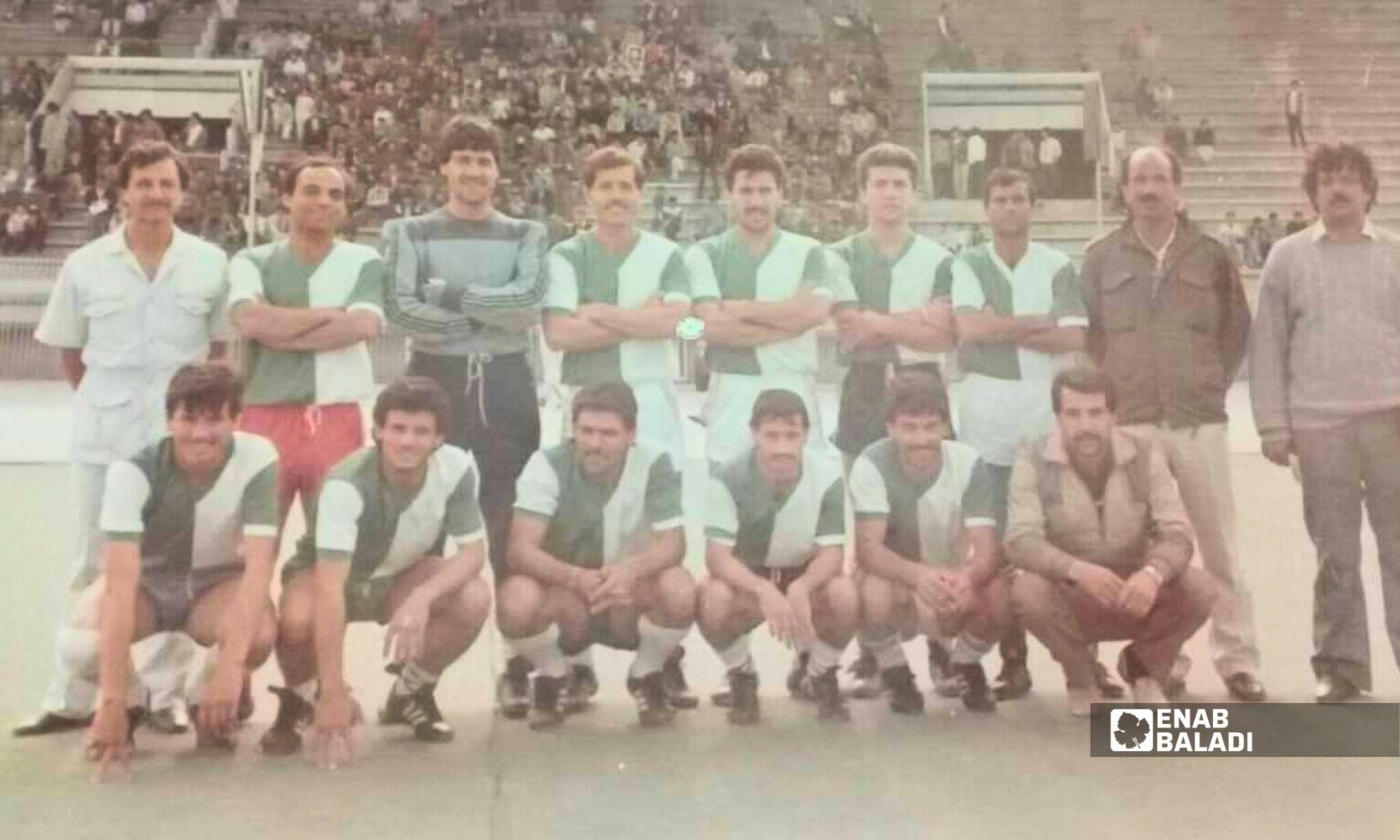
Darayya Club in the 1970s and 1980s
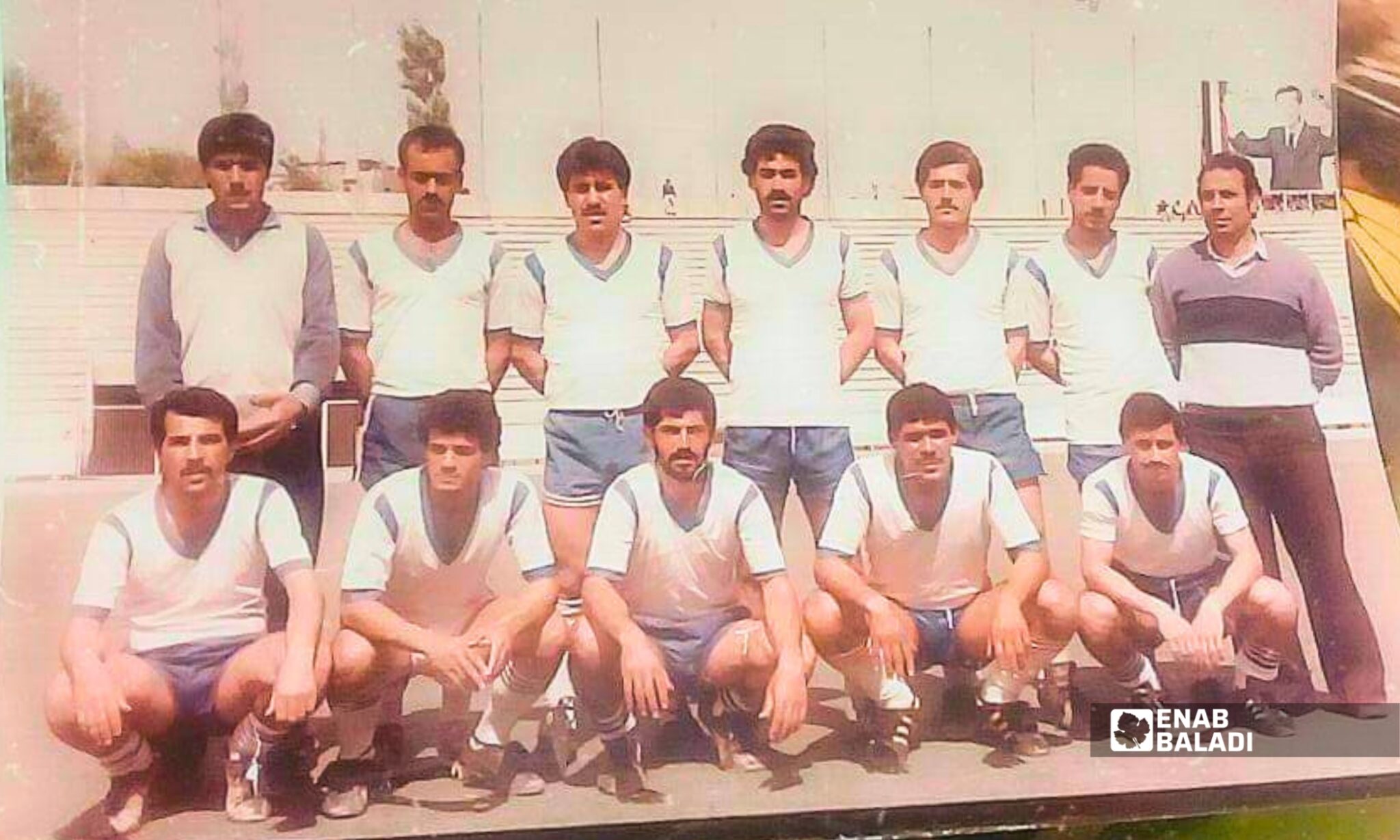
Darayya Club in the 1970s and 1980s
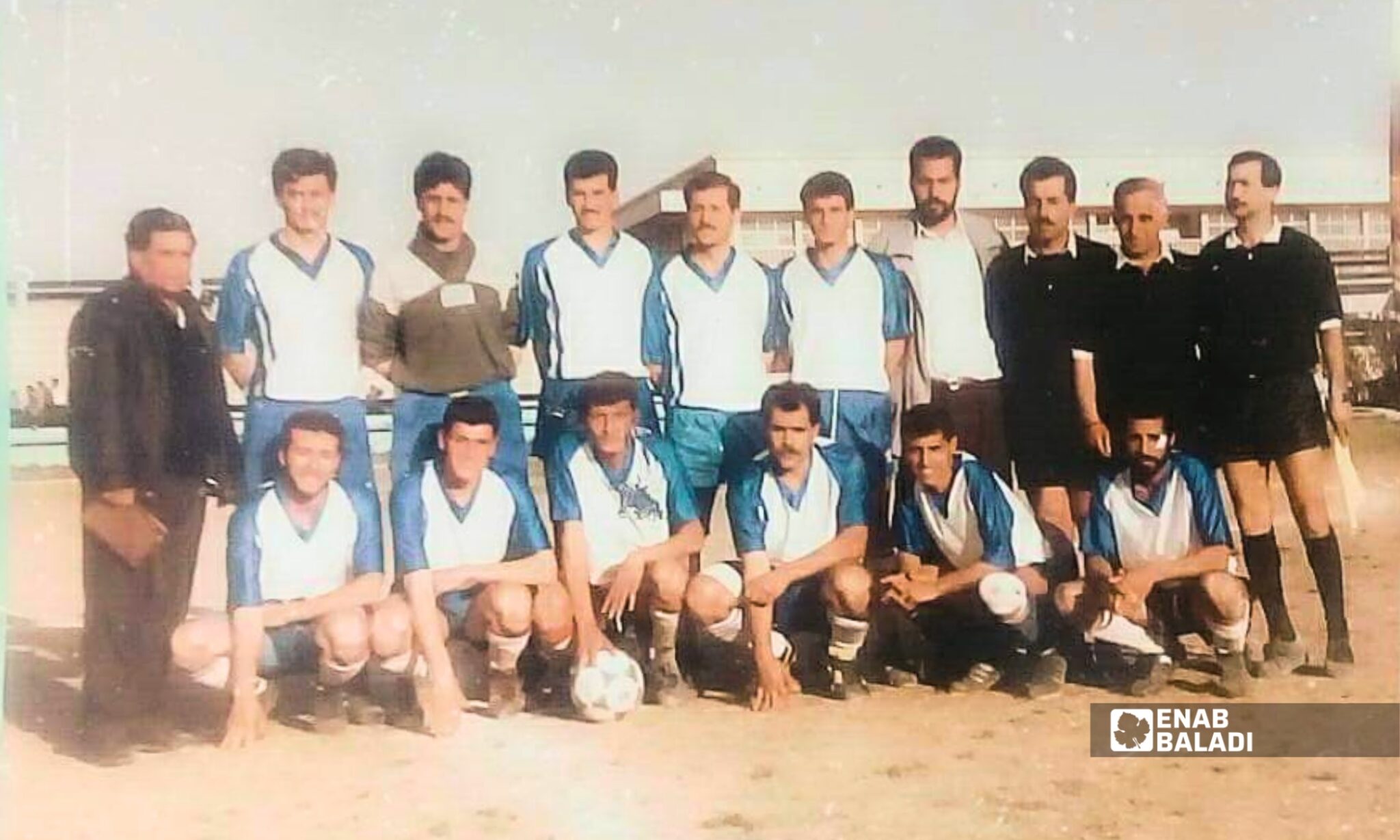
Darayya Club in the 1970s and 1980s
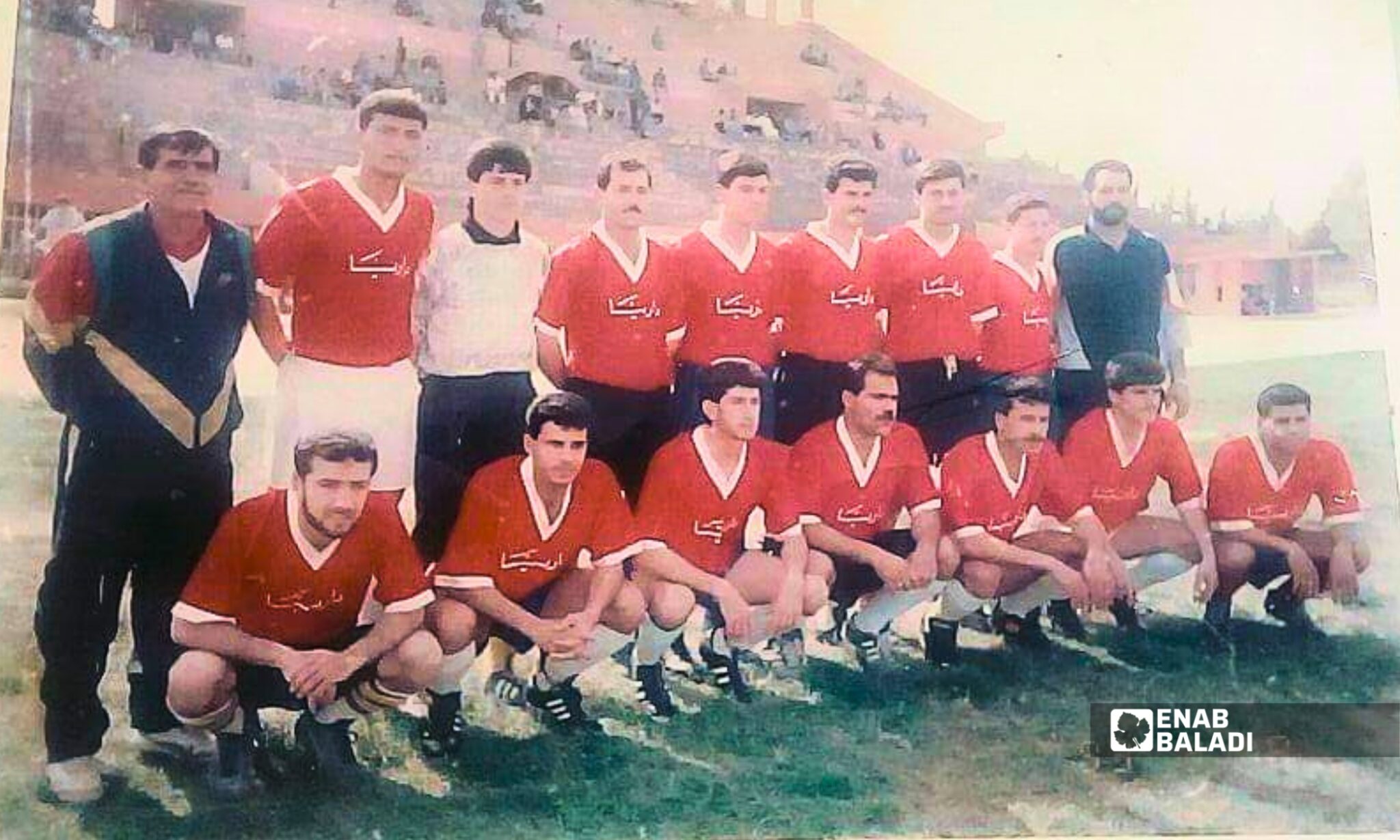
Darayya Club in the 1970s and 1980s
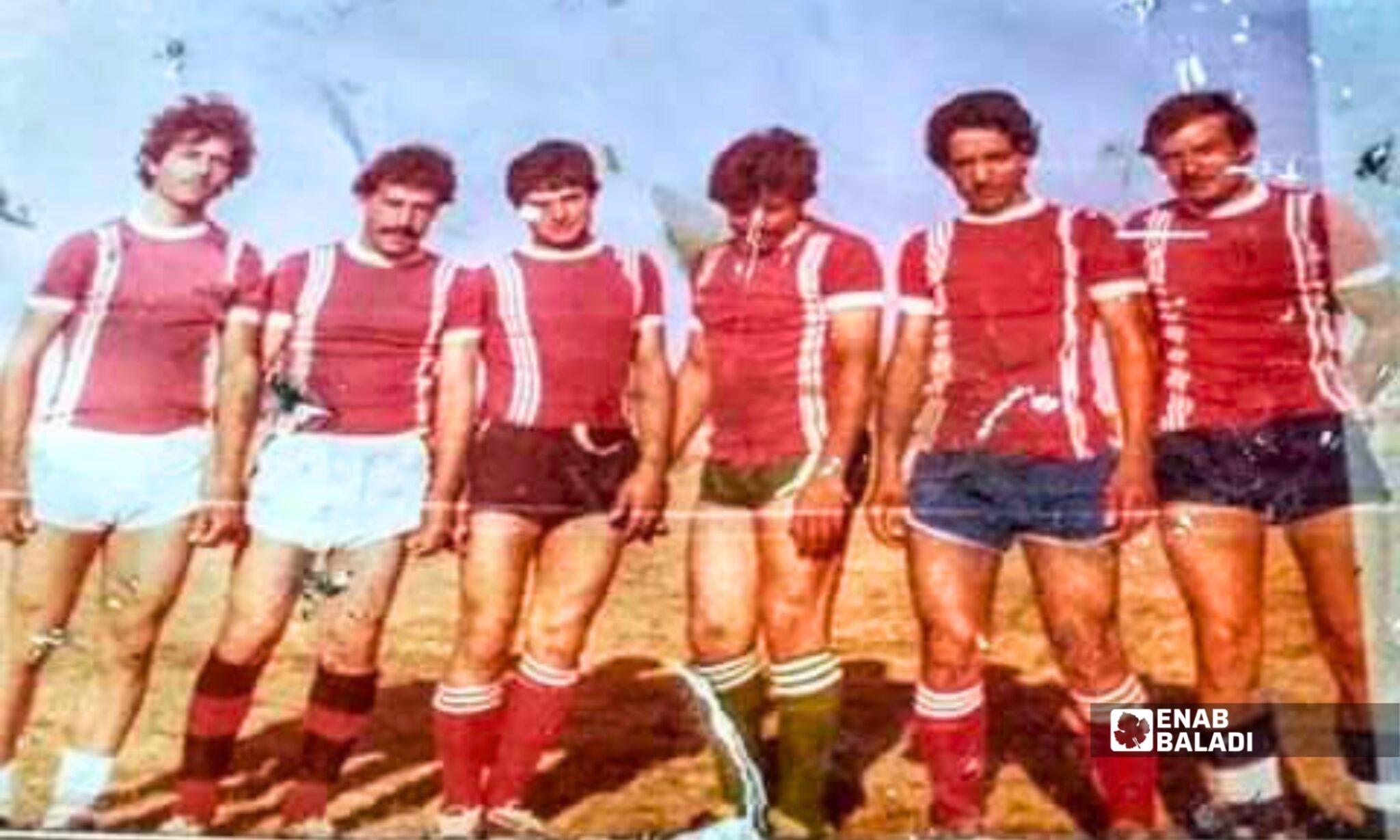
Darayya Club in the 1970s and 1980s