
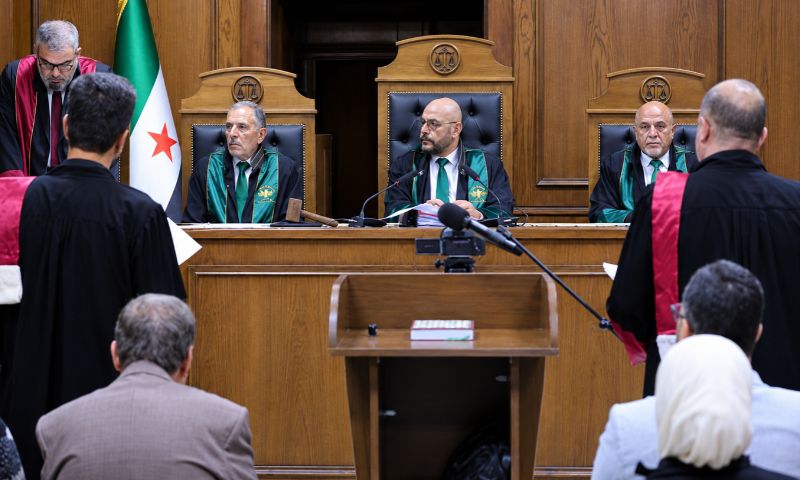

Damascus’s Fourth Criminal Court held eight hearings in trials of members of the former Syrian regime on Tuesday, November 3, as part of the transitional justice process. The hearings included new trials and the continuation of earlier proceedings.
Some hearings were held with the defendants present, while others took place in absentia, according to statements published on the National Commission for Transitional Justice’s official accounts.
Among the main developments was the start of the trial of Tariq Baniyat, who served as deputy head of the Military Public Prosecution in Damascus with the rank of first lieutenant from 2013 to 2018.
Baniyat faces charges of complicity in premeditated murder, torture resulting in death, and enforced disappearance, as well as committing war crimes and crimes against humanity, according to a press statement by lawyer Radif Mustafa, a commission member and director of its Accountability Department.
According to the statement, published by the commission on Wednesday, November 4, the case records indicate that the defendant headed a committee responsible for examining the bodies of detainees who died under torture. He allegedly participated in examining more than 67 bodies and signed the corresponding examination reports.
The charges center on the committee’s role in examining and handling the bodies, including its alleged failure to follow legal procedures for identifying victims, documenting signs of torture, and returning the bodies to their families.
The lawyer described these as “facts that raise the issue of the defendant’s responsibility for his possible role in facilitating enforced disappearance, alongside the other crimes attributed to him.”
Baniyat denied the charges during the hearing, saying his actions fell within his official duties. The court adjourned proceedings until November 17 to continue the trial and hear the prosecution’s submissions and the defendant’s defense, according to Mustafa.
Seven Other Hearings
According to the commission, the court postponed sentencing hearings for three defendants, with verdicts in absentia scheduled for Wednesday, November 4. The defendants are Abdul Hafiz Bashir al-Mawaldi, Ahmed Hassan Ibrahim , and Hikmat Najib al-Hammam.
The three face charges relating to joining the former regime’s army and taking up arms to kill civilians.
The court also held a new sentencing hearing for Mustafa Khaled Adas, who appeared in person on a charge of making a false criminal accusation. It adjourned the hearing until November 17 to summon prosecution witnesses.
According to the commission, the prosecution submitted a three-page memorandum containing its allegations and a list of prosecution witnesses. Adas denied the charges and retracted his initial statements.
The court continued proceedings against Johnny Qabalan and Firas Mansour, as well as fugitives Ahmed Hussein Jumaa and Mohammed Hussein Jumaa, before adjourning until November 18.
In his press statement, Mustafa said the importance of these trials extended beyond holding direct perpetrators accountable to examining the official and institutional roles that contributed to crimes, concealed them, or enabled them to continue.
He stressed that criminal responsibility is determined by acts, roles, and evidence established under the law, rather than by a person’s official position alone.
He said the accountability process aims to uncover the full truth, establish individual responsibility, and ensure victims and their families have access to justice.
Achieving meaningful accountability requires public trials based on evidence that respect fair trial guarantees and defense rights, without selective prosecution or impunity, he added.
61 Cases
Courts in Syria regularly hold hearings in cases involving members or affiliates of the former regime accused of crimes against civilians, war crimes, and crimes against humanity.
Judge Fakhr al-Din al-Aryan, presiding judge of the Fourth Criminal Court, which specializes in transitional justice cases, said the court was examining around 61 cases involving serious violations. He said it had ruled on four cases, including cases involving leading figures from the former regime, among them ousted president Bashar al-Assad and his brother Maher.
Speaking to the Syrian Arab News Agency (SANA) on October 22, al-Aryan said the court forms part of Syria’s judicial system and falls under the Supreme Judicial Council. He said it is neither a special nor an exceptional court, but consists of Syrian judges applying Syrian law.
He said cases before the court proceed in accordance with established legal procedures, as part of efforts to hold those responsible for serious violations during the former regime’s rule accountable.
Public sentencing hearings have been held for leading figures from the former regime, including Atef Najib and Wassim al-Assad, who were sentenced to death, and former Grand Mufti Ahmad Hassoun, who received a life sentence.
Bashar and Maher al-Assad were also sentenced to death in absentia in earlier hearings.