


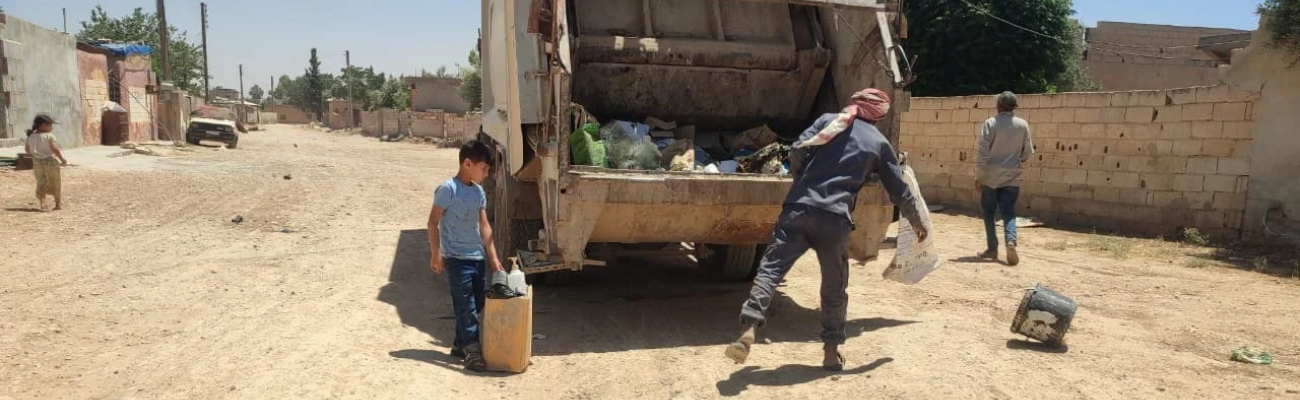
 Vehicles transport waste in the Raqqa countryside (northern Syria), July 7, 2026 (Enab Baladi).


 A
A
A
Amir Hakouk | Mohammad Deeb Bazzet | Shaaban Chamieh
Syria’s waste problem extends beyond the garbage piling up around bins. Conditions in its cities and towns reveal uneven collection and removal services and a growing number of uncontrolled dumps, alongside local efforts to address shortages of vehicles, workers, and fuel. The situation varies from one area to another, but the common challenge is whether sanitation systems can keep pace with the volume of waste and manage it after collection.
This places direct responsibility for providing sanitation services on municipalities and local administrative units, at a time when parts of their sanitation fleets are aging and breaking down. Some areas also face shortages of workers, bins, and fuel, while treatment facilities and landfills need rehabilitation and investment.
The Ministry of Local Administration and Environment, meanwhile, says it is working to move beyond treating waste collection as a daily service toward building a more integrated system encompassing legislation, planning, oversight, investment, sorting, and recycling.
This investigation examines sanitation and waste conditions across several governorates, municipal resources, and the government’s role in managing the sector. It also explores proposed solutions for waste and uncontrolled dumps, infrastructure rehabilitation costs, and options for sorting, recycling, and turning waste into resources or energy, asking whether current plans can move the sector from clearing accumulated garbage to sustainable waste management.
A Look Across the Governorates
Collection Falls Short of Waste Volumes, With Uneven Service
Sanitation conditions differ across Syrian governorates, but accumulated garbage and irregular collection and removal remain recurring service problems, with varying severity from one area to another.
While some city centers have seen relative improvements or campaigns to clean streets and remove garbage piles, waste remains in other neighborhoods for days. Bins overflow, and informal disposal points gradually turn into uncontrolled dumps.
The problem does not always stem from an absence of cleaning work. In several areas, collection and removal operations fall short of the volume of accumulated waste, alongside disparities in service between neighborhoods, city centers, and rural areas.
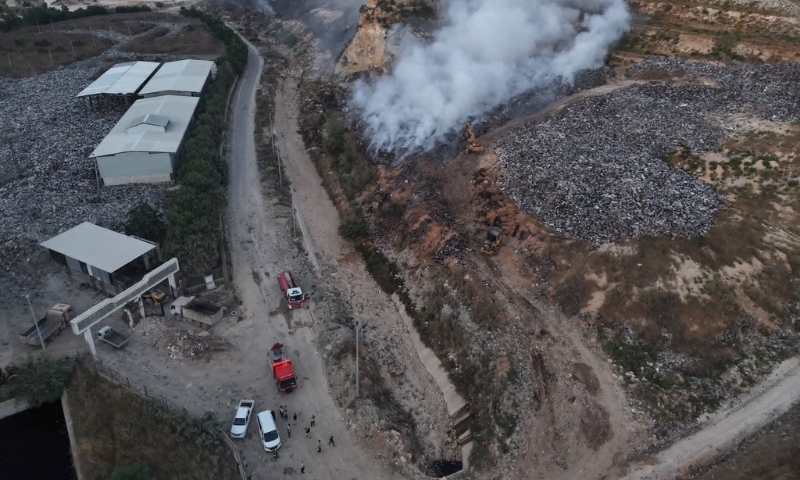
Civil Defense teams from the Tartus Emergency and Disaster Management Directorate respond to a fire at the Wadi al-Hada waste dump (Tartus governorate, on Syria’s coast), June 16, 2026 (Emergency and Disaster Management Directorate/Facebook).
Uneven Service
In Damascus, sanitation standards have declined in some neighborhoods, with garbage accumulating for several days, particularly in densely populated areas, markets, and neighborhoods with many shops. Enab Baladi’s observations show differences between areas, with collection and removal appearing more regular in neighborhoods such as al-Malki, Abu Rummaneh, and al-Tijara than elsewhere.
Ghaith al-Homsi, a Damascus resident, said garbage piles sometimes remain for several days before being removed, while dirt spreads through the streets. He said the problem had persisted for months and called for addressing the reasons behind inadequate service rather than simply removing waste after it accumulates.
Conditions also vary in Damascus countryside, with worsening problems in parts of Ghouta and Jaramana, where waste accumulates around bins. Some bins are now emptied every two or three days instead of daily.
The situation appears better in parts of Qalamoun (Damascus countryside), including Yabroud and Deir Atiyah, where community involvement helps maintain higher sanitation standards.
In Jaramana, resident Wahiba al-Mousa described waste conditions as “appalling,” pointing to garbage accumulating for days and the accompanying spread of insects and dogs.
In Aleppo, the problem is concentrated in several neighborhoods, particularly in the east, where garbage piles up around bins and along roadsides, turning some disposal points into uncontrolled dumps.
Despite campaigns to remove piles and clean various locations across the city, waste returns to some sites shortly afterward, particularly when bins fill up or residents have none nearby.
Ahmed Kaakeh, a resident of Aleppo’s Salah al-Din neighborhood, told Enab Baladi that bags and other waste are thrown around bins and along roadsides. Garbage remains at some locations for extended periods before removal, allowing piles to grow and encouraging further dumping.
The governorate had previously reported hundreds of uncontrolled waste disposal sites within the city. In September, it said their number had declined after more bins were provided, although some sites still required attention. That same month, the governorate received 110 municipal service vehicles, including sanitation vehicles.
In Raqqa, the city center and public squares have seen noticeable improvement recently, but the same does not apply to some neighborhoods and side streets.
Mohammad al-Addad, a Raqqa resident, said he still sees garbage accumulating near a building despite complaints requesting a bin. He called for sanitation efforts to extend beyond squares and public spaces.
In Deir Ezzor (eastern Syria), garbage is scattered across several areas, including around the vegetable market, where accumulated waste produces foul odors. In one location, residents throw garbage on the ground because there are no bins, while the low-lying terrain has caused rainwater to collect and mix with the waste.
Suwayda (southern Syria) also faces difficulties securing fuel and maintaining vehicles. These prompted the city council to launch a community initiative in late July to help keep services running. Cleaning resumed after a brief suspension in early September caused by fuel shortages. Residents were divided between appreciating the continuation of services and objecting to the financial contributions requested amid difficult living conditions.
In Tartus, conditions vary between areas, with worsening problems in several rural communities and difficulties transporting waste. Dumps are often located on the outskirts of cities and towns, where waste burning produces smoke and increases pollution.
In Daraa (southern Syria), municipalities struggle to collect and remove waste because of deteriorating vehicles and shortages of workers, equipment, and fuel. Some rely on old vehicles that frequently break down and worn-out bins, limiting their ability to keep pace with waste volumes, particularly in larger cities and towns.
Uncontrolled Dumps: More Than a Garbage Collection Problem
The problem goes beyond delayed collection, as some disposal points become permanent dumps when waste continues to accumulate.
These dumps appear on the outskirts of cities and towns or on vacant land, where properly equipped sites are unavailable or authorized dumps are difficult to reach.
In Damascus and its countryside, uncontrolled disposal sites are scattered around the outskirts of several cities and towns. Some residents burn waste, adding smoke, odors, and pollution to the accumulation problem.
In Aleppo, some disposal points become permanent sites, while waste piles appear on vacant land in Deir Ezzor.
In Suwayda, a location beneath a bridge near the city center has become an uncontrolled dump, with chicken and meat scraps continually discarded there. Residents have called for dumping to be prohibited and oversight tightened because of odors and health and environmental risks.
In Tartus, burning waste at dumps on the outskirts of cities and towns adds pollution to the accumulation problem.
In Daraa, uncontrolled dumps are found in areas including Dael, Jasim, and al-Shajara, and on the outskirts of towns such as Tafas, al-Yadudah, and Jasim. Municipal heads who spoke to Enab Baladi linked their spread to the distance of some authorized dumps and high fuel costs, which encourage disposal at closer, unequipped sites.
Residents Want Regular Services Before Cleanup Campaigns
Residents’ complaints across the governorates converge on several basic demands, particularly regular collection and removal, more bins that are cleaned consistently, and action against uncontrolled dumps rather than simply removing garbage after it accumulates.
Residents also want more field monitoring, tighter oversight of disposal sites, and action to address disparities between neighborhoods and areas so that sanitation work is not confined to city centers and public squares. Some areas are calling for the vehicles and fuel needed to keep services running, while others have turned to community initiatives to cover part of the shortfall.
The overall picture suggests that the waste problem is not limited to collection. It also concerns the sanitation system’s ability to keep pace with waste volumes, maintain regular removal, and provide bins, vehicles, and fuel, while preventing temporary disposal points from becoming permanent dumps and sustaining oversight after cleanup campaigns.
Closing About 1,400 Uncontrolled Dumps
A draft national solid waste management strategy being developed by the Ministry of Local Administration and Environment outlines a long-term plan to close about 1,400 uncontrolled dumps across Syria.
According to the draft, which was discussed in January 2026 in cooperation with the World Bank, the ministry aims to move from emergency waste handling toward a more integrated and sustainable system. This includes improving collection, removal, and treatment, supplying local administrative units with the necessary vehicles and equipment, and progressing toward sorting and recycling.
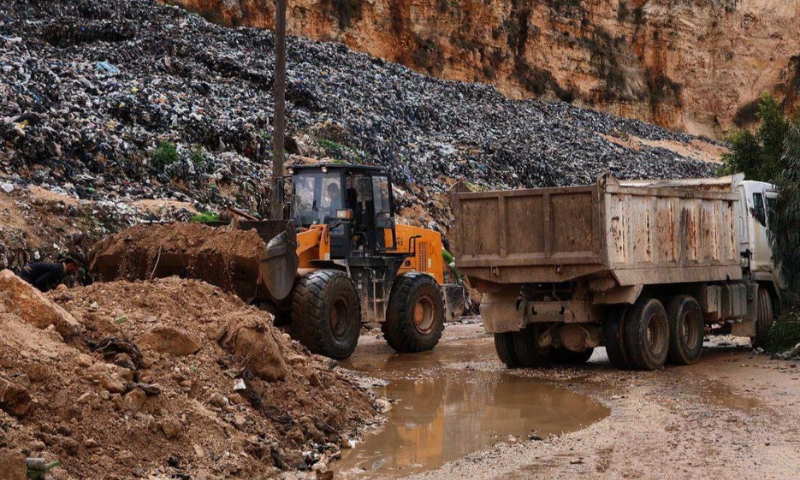
Clearing debris from the Wadi al-Hada waste dump that had blocked drains and culverts following heavy rainfall in Tartus, to limit worsening leachate problems caused by the weather conditions, January 30, 2026 (Tartus Governorate/Telegram).
Local Administrative Units With Limited Resources
What Are the Government’s Waste Management Plans?
Municipalities and local administrative units are directly responsible for collecting, removing, and handling waste. Their ability to perform these tasks, however, depends on the workers, vehicles, and financial and logistical resources available to them.
The government’s role in the waste sector centers on these units’ ability to carry out their duties with available resources, the support provided by the Ministry of Local Administration and Environment, and arrangements for overseeing their work and assigning responsibilities among government and local authorities.
Conditions at dumps also raise questions about how sites are selected, managed, and monitored, and whether uniform waste disposal standards exist, as some areas turn to uncontrolled dumps because they have few alternatives.
The use of private companies to collect and remove waste also raises the question of whether this is a temporary response to municipal resource shortages or part of a broader government approach to managing the sector.
With multiple authorities involved, the broader question remains whether there is a national waste management plan that identifies municipal needs, funding mechanisms, dump regulation, the private sector’s role, and arrangements for monitoring implementation across the governorates.
Limited Resources
Asaad Olabi, director of sanitation and waste management at the Ministry of Local Administration and Environment, said municipalities’ limited capacity does not stem from a single factor. Rather, it reflects years of underinvestment, an aging sanitation fleet, shortages of bins, workers, and drivers, and difficulties securing spare parts, maintenance, and fuel.
Olabi told Enab Baladi that several transfer stations, treatment centers, and landfills had been vandalized, destroyed, or shut down over the past years. Some completed facilities remain unused, while others operate at only part of their designed capacity.
“Municipalities’ problem is not limited to a shortage of garbage collection vehicles. The service requires an integrated system encompassing bins, workers, maintenance, transfer stations, and suitable treatment facilities or landfills, alongside sustainable financing and sound management.”
Asaad Olabi
director of sanitation and waste management at the Ministry of Local Administration and Environment
According to Olabi, municipalities’ difficulties extend beyond shortages of collection vehicles. The service requires an integrated system encompassing bins, workers, maintenance, transfer stations, and suitable treatment facilities or landfills, alongside sustainable financing and effective management of these resources.
Worker and Vehicle Shortages Are Major Obstacles
Municipalities face three main challenges involving human resources, vehicles, and sustainable financing, according to Olabi.
On staffing, data collected by the ministry from the governorates showed shortages of sanitation workers, drivers, and technicians, particularly mechanical and electrical maintenance personnel. In some cities, part of the service depends on temporary workers, while additional staffing needs remain.
Regarding vehicles, the ministry conducted an inventory this year of those held by governorates and local administrative units. It identified operational vehicles, those that could be repaired, and those requiring replacement, as well as additional needs.
The inventory showed that aging vehicles, low operational readiness, and spare parts shortages were among the most frequently reported problems across the governorates.
Service costs are not limited to purchasing vehicles, Olabi said. Transport costs rise when dumps or landfills are far from collection areas, alongside spending on fuel, maintenance, tires, and spare parts.
Addressing this requires preventive maintenance, improved collection and transport routes, and vehicle allocation based on actual needs, rather than simply buying new vehicles, according to Olabi.
“The Ministry of Local Administration has asked governorates to identify their actual priorities for 2027, to link vehicle purchases to real needs and service volumes rather than distributing them arbitrarily.”
Asaad Olabi, director of sanitation and waste management at the Ministry of Local Administration and Environment
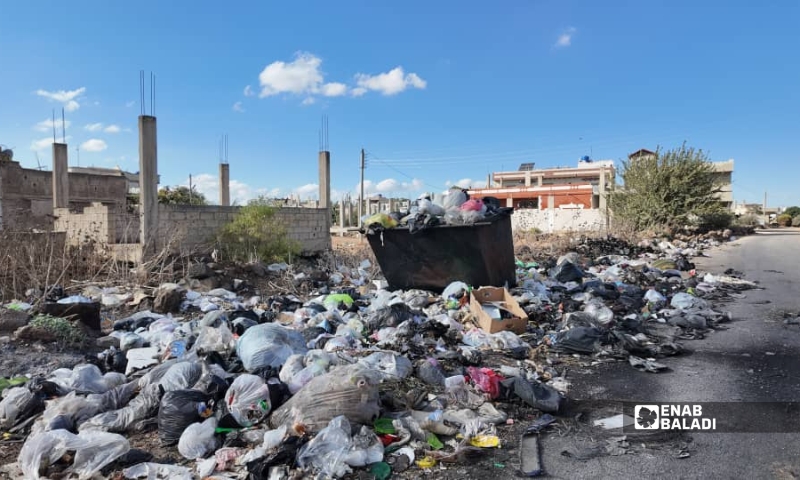
Uncontrolled garbage dumps in Jasim (northern Daraa countryside, southern Syria), October 6, 2026 (Enab Baladi/Mahjoub al-Hashish).
Involving the Private Sector
Several governorates have experimented with using contractors and private companies to collect, transport, and remove waste or operate facilities. The ministry is also studying investment proposals for waste management in different governorates.
Olabi said investment in the sector must be based on detailed studies covering waste quantities, collection, sorting and treatment methods, technologies, costs, financing arrangements, outputs, and environmental obligations.
The ministry is gradually moving from contracts limited to “transporting a quantity of waste” toward contracts tied to service standards and performance, according to Olabi. These cover regular collection, area cleanliness, vehicle readiness, adherence to collection routes and schedules, preventing uncontrolled dumps, and compliance with environmental requirements.
The new draft waste management and sanitation law, awaiting presentation and debate in the People’s Assembly, includes a chapter on investment. It allows local administrative units to assign certain waste management activities to service providers under specified conditions and contractual models, while permitting resource and energy recovery from waste under defined rules.
Dumps and Oversight
Olabi said final waste disposal in Syria “is not at the level we aspire to.” Although authorized landfills and treatment centers operate in some governorates, other completed facilities are closed, unused, or stalled, while uncontrolled disposal continues in various areas.
The problem is not only the use of dumps instead of sanitary landfills, according to Olabi. Some sites also lack environmental safeguards, including management of waste liquids, gas collection, regular covering, water and soil monitoring, and controls on access and incoming waste quantities.
On oversight, Olabi distinguished between daily operations and technical authority and supervision. He explained that collection services and direct operation of dumps or landfills fall under local administrative units and governorates, while the ministry sets technical and environmental standards, monitors compliance, and assesses performance.
“The ministry is developing standardized oversight tools, performance indicators, and assessment forms for municipalities and facilities, so that supervision relies on verifiable data and indicators rather than visits or correspondence alone.”
Asaad Olabi
director of sanitation and waste management at the Ministry of Local Administration and Environment
From the Absence of a Plan to Building a New System
Responding to criticism about the absence of a clear waste management plan, Olabi said Syria had lacked a modern, integrated national plan in recent years, grounded in updated data and containing clear indicators, priorities, and financing. He described current sector conditions as one consequence of that gap.
He added that saying the ministry currently has no clear activity or direction “is inaccurate,” explaining that work had begun on several parallel tracks, some completed and others still underway.
On legislation, the ministry prepared a new draft waste management and sanitation law during 2026.
He said the draft redefines waste management from generation through treatment and final disposal. It embeds sorting, recycling, and the circular economy; regulates service providers, investment, and the private sector; addresses producers’ responsibility for waste from their products and the recovery of energy and biogas; and establishes a national waste management information system.
On national planning, the ministry included preparation of a modern national waste management strategy in its 2027 investment budget, alongside a detailed national master plan.
Olabi explained that the strategy would set policies on recycling, financing, governance, and private sector partnerships. The master plan would identify governorates’ needs for landfills, transfer stations, and sorting plants, as well as required capacities and investment priorities.
The waste sector was also included in the ministry’s strategic plan for 2026 to 2030, with the goal of establishing an integrated, sustainable waste management system. This covers sanitation fleet readiness, regular service, sorting and recycling, infrastructure rehabilitation, and improvements in oversight, data, and public awareness.
In parallel, the ministry is building a sector database covering population figures, workers, vehicles, bins, dumps, landfills, transfer stations, treatment centers, waste quantities, and needs. It distinguishes between operational vehicles, repairable vehicles, those requiring replacement, and additional requirements.
According to Olabi, the ministry has begun developing a standardized inspection framework using indicators covering planning, workers, vehicles, collection, transport, bins, dumps, treatment, sorting, and specific waste streams. The aim is to make inspections measurable, comparable, and suitable for follow-up, alongside updating technical specifications and procurement requirements for sanitation vehicles.
Investment in Waste Management
On investment, Olabi said the ministry had spent recent months studying offers and proposals for waste management in Aleppo, Damascus, Damascus countryside, Tartus, and elsewhere, alongside evaluating a waste-to-energy study submitted by the Ministry of Energy.
He said the ministry neither rejects nor accepts proposed technologies in advance. Instead, it assesses each project according to waste quantity and composition and economic and environmental feasibility, while maintaining the priority of sorting and recycling before energy recovery.
The ministry does not directly collect waste in cities, as this task falls to local administrative units and governorates. Its responsibilities are to establish national policies, plans, and standards; set priorities; build the data system; monitor performance; develop legislation; assess projects and technologies; provide technical support to governorates; and attract financing and investment.
According to Olabi, waste management and sanitation responsibilities in the ministry’s new organizational structure were designed on this basis.
The process includes improving sanitation fleet readiness, making collection more regular, reducing uncontrolled dumps, increasing the volume of waste sorted and recycled, and improving treatment and final disposal facilities.
“It is unrealistic to say the waste problem has been solved. The ministry has moved from managing the crisis day by day toward trying to build an institutional framework for the sector, with success to be measured through tangible indicators.”
Asaad Olabi
director of sanitation and waste management at the Ministry of Local Administration and Environment
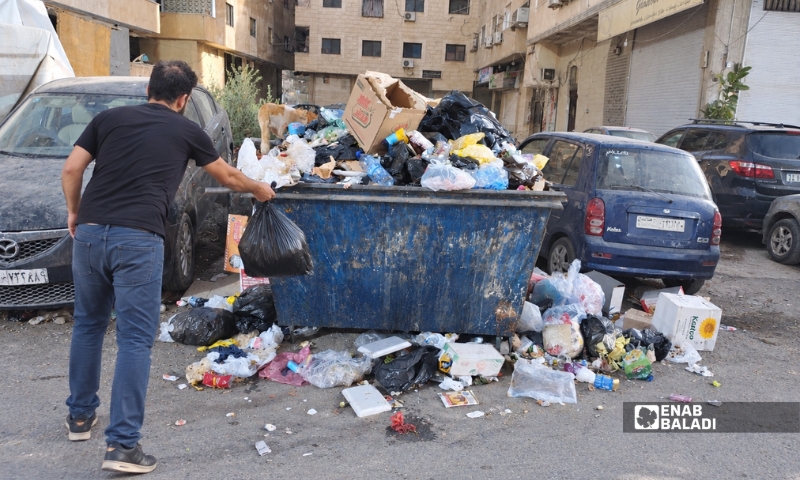
Garbage accumulates around a bin in Damascus’s al-Sinaa district, October 5, 2026 (Enab Baladi).
A Heavy Environmental and Health Toll
What About Costs and Solutions?
Syria faces a critical environmental and health crisis as uncontrolled dumps spread and sanitation services deteriorate, turning solid waste into a direct threat to public health and a drain on natural resources.
Monitoring or describing the problem is no longer sufficient. Practical, sustainable solutions are urgently needed to address this multifaceted challenge. Municipal waste is particularly difficult to manage because it is unsorted, contains high moisture levels, and includes black plastic bags, toxic pollutants, and heavy metals. Uncontrolled burning releases a complex mixture of hazardous emissions.
In an effort to outline a response, a specialist examines available environmental options, from solid waste sorting and recycling to the environmental engineering of sanitary landfills, seeking practical measures to halt environmental deterioration and reduce health risks.
Learning From Regional Experience
Dr. Hussein Jneidi, an environmental impact assessment expert, reviewed examples from countries with economic and technical conditions comparable to Syria’s. He explained that community initiatives in Jordan sought to reduce waste management costs, while initiatives in Lebanon focused on easing the burden on waste management directorates by helping sort large quantities of waste. In Egypt, an initiative emphasized financial incentives to encourage sorting.
Jneidi told Enab Baladi that these approaches could be adapted to Syria. However, he said the lack of long-term sustainability in those initiatives limits their effectiveness unless they are incorporated into a clear, sustainable framework.
Making Sorting at Source Work
On introducing household waste sorting, Jneidi said achieving this goal requires an integrated system combining economic incentives with awareness campaigns to establish lasting environmental practices.
The proposed approach includes several practical measures, particularly reductions in sanitation fees for households that sort waste, technical and financial support and tax incentives for recycling projects, and expanded community awareness campaigns through media outlets and digital platforms.
The environmental impact assessment expert said none of these measures would achieve its goals without the basic physical resources needed to make initiatives successful and sustainable. He identified these as:
- – A “two-bag” system, or more:Distribute differently colored bags free of charge to participating households, such as transparent bags for dry waste and another type for wet waste, to standardize sorting at source.
- Dedicated bins: Install public bins in two different colors at collection points, such as yellow for dry recyclables and black for wet waste, to facilitate separate collection.
- Separate collection vehicles: Allocate vehicles to collect dry waste separately from wet waste, ensuring the two are not mixed again.
- Initial sorting centers: Establish neighborhood collection and preliminary sorting points to facilitate transporting recyclable materials to recycling plants.
Several Syrian governorates have recently adopted pilot projects for sorting waste at source. After Idlib governorate (northwestern Syria) launched a two-bag trial in early July 2026 to separate wet organic material from recyclable solids such as plastic and paper, Homs (central Syria) followed on July 22 with a similar trial covering residential complexes in the New al-Waer neighborhood.
These initiatives, which the Damascus Environment Directorate has joined ahead of possible expansion, aim to reduce waste sent to landfills, cut fuel consumption, and extend landfill operating life through pretreatment and recycling.
Estimated Costs of Rehabilitating Sanitary Landfills
On the cost of rehabilitating existing dumps and converting them into engineered sanitary landfills, Jneidi said there is no standard figure, as costs depend on a dump’s size, location, technologies, and degree of contamination.
He said budget estimates depend on technical infrastructure such as lining systems, sorting and composting plants, and facilities for treating leachate and medical and hazardous waste, which are essential to comprehensive solutions.
Differences in the technological sophistication of this equipment can push costs to very high levels, he added. However, where funding is limited, the scope can be scaled back to bring costs to between $5 million and $7 million by using simpler technologies suited to available resources.
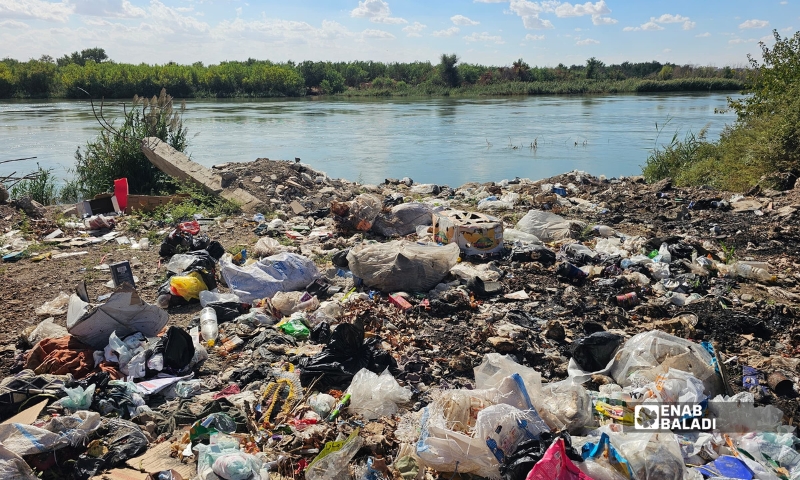
Waste dumps on the Euphrates riverbank in al-Husseiniyah, north of Deir Ezzor city, October 3, 2026 (Enab Baladi)
Delayed Intervention Costs More Than Prevention
According to the environmental expert, uncontrolled waste burning releases toxic and carcinogenic gases, including dioxins and furans, and contributes about 8% of global fine particulate emissions.
Wind also carries dust containing heavy metals, contaminating soil and crops and affecting residents’ health through cancers, acute respiratory inflammation, and eye and skin irritation.
Jneidi also warned about leaking leachate, the toxic liquid produced by waste. He said it causes biological and chemical contamination that threatens Syria’s groundwater because most dumps lack lining systems.
He stressed that prevention is essential, explaining that delayed rehabilitation of these sites and unlined dumps can cost more than ten times as much as establishing them properly in the first place.
The waste sorting plant in Wadi al-Hada, in Syria’s coastal region, had become one of the country’s most dangerous pollution hotspots because it lacked sanitary safeguards and was built on permeable limestone terrain.
According to researchers, this engineering and geological error polluted the air and caused environmental damage to spread into groundwater, contaminating an area extending approximately 10 kilometers north and west of the uncontrolled dump.
Different Prospects for Compost and Energy Production
On the feasibility of investing in recycling and converting waste into energy or organic fertilizer in Syria, the environmental expert said there is a clear economic case for investment, although prospects differ between the two fields.
While organic fertilizer projects have demonstrated practical viability and generate profits, waste-to-energy faces greater challenges because of high initial costs, despite promising strategic potential.
He said converting organic waste into energy requires several measures, including separating toxic materials such as batteries, heavy metals, and medicines from organic waste. In practice, however, waste contains sources of heavy metals, including batteries, energy-saving light bulbs, and electronic waste, alongside expired medicines, making conversion into organic fertilizer complicated as well.
He also noted that high moisture levels and these contaminants mean burning waste for energy requires a careful feasibility study. High moisture reduces its energy content, while the pollutants require strict controls on hazardous gaseous emissions.
“Separating contaminants from organic waste is the real key to opening promising investment opportunities, from incineration and electricity generation to the production of organic fertilizer, or compost.”
Hussein Jneidi
academic and researcher specializing in environmental impact assessment
Current Treatment Facilities and Future Plans
Jneidi said there is a substantial gap between current conditions and ambitions for Syria’s waste treatment facilities. He pointed to the absence of advanced facilities for converting waste into high-quality compost or energy, while reliance on uncontrolled dumps continues. More than 80% of waste is disposed of through uncontrolled burning or burial without treatment, he said.
Identifying weaknesses in existing projects, he said the Wadi al-Hada sorting and recycling plant in Tartus suffers from limited technical and financial resources, frequent breakdowns, and high fuel and spare parts costs. Damascus’s composting facility, meanwhile, operates at low capacity and relies on solar evaporation that is insufficient to treat leachate.
“Syria’s environmental sector faces numerous obstacles. On legislation, despite environmental and technical standards such as drinking water specifications and landfill environmental impact assessment guidelines, implementation and compliance remain entirely absent in practice, requiring immediate action.”
Hussein Jneidi
academic and researcher specializing in environmental impact assessment
Regarding future solutions, Jneidi said serious plans exist to develop and modernize landfill infrastructure in Latakia (on Syria’s Mediterranean coast), Daraa, and Homs governorates, but they face complex funding and implementation challenges.
Based on these conditions, Jneidi called for clear, direct strategies to secure financing and immediately begin implementing the necessary environmental solutions. He warned that leaving conditions unchanged would impose astronomical costs in the future because of environmental deterioration and its catastrophic consequences.
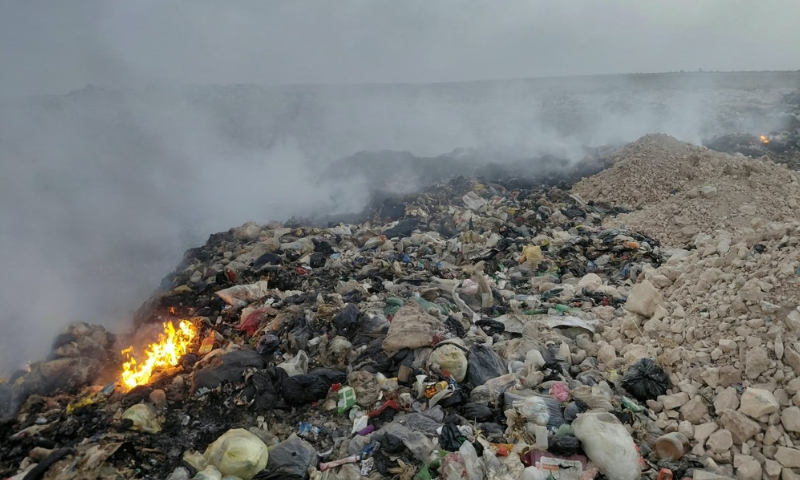
Waste spontaneously ignites at a garbage dump in central Syria because of inadequate landfilling practices and the absence of leachate and gas drainage systems, October 9, 2026 (Environmental impact assessment expert Hussein Jneidi).
if you think the article contain wrong information or you have additional details Send Correction
النسخة العربية من المقال
-
Follow us :




 More In-Depth