

Enab Baladi, Wasim al-Adawi
Syria’s return to the international financial system depends on more than lifting economic sanctions or restoring diplomatic relations. It also requires Syrian banks to regain the trust of global financial institutions, which need assurances that they can verify customers’ identities and sources of funds, detect suspicious transfers, and prevent money laundering and terrorist financing.
The Financial Action Task Force’s (FATF) “grey list” is one factor shaping foreign banks’ perceptions of the risks of dealing with Syria, which remains on the list. This comes as the Finance Ministry and the Central Bank of Syria seek to establish contact with US and international financial institutions and reconnect Syria’s banking system to cross-border transfer and settlement networks.
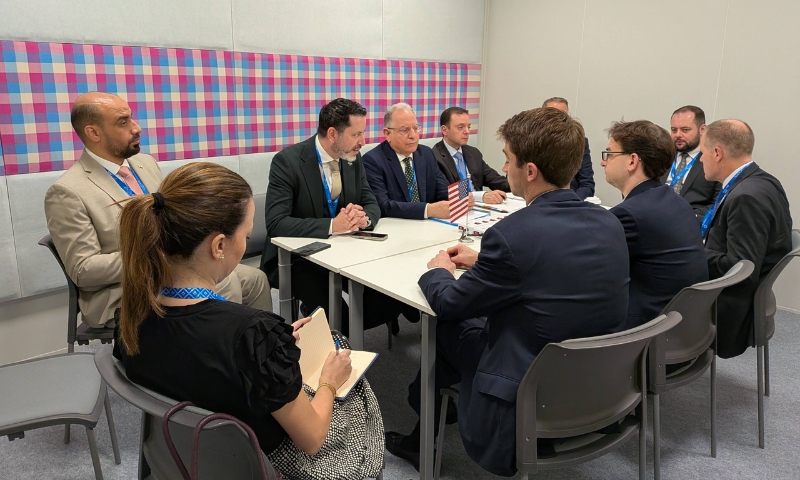
Syrian outreach has extended beyond US government agencies. A Central Bank delegation recently met representatives of US banks J.P. Morgan and Citibank to discuss strengthening banking ties and developing international payment and transfer channels, as part of broader efforts to rebuild correspondent banking relationships with global financial institutions.
What Is the Grey List?
The Financial Action Task Force, known as FATF, places countries it identifies as having strategic deficiencies in their systems for combating money laundering, terrorist financing, and proliferation financing under “increased monitoring,” commonly known as the “grey list.”
This differs from the “black list,” which includes countries against which FATF calls for countermeasures because of more serious financial risks.
A country’s inclusion on the grey list means it is working with FATF to address deficiencies under an action plan, with its progress subject to monitoring. It does not automatically prohibit financial dealings with that country or mean that all its banks are accused of violations. FATF also stresses that its standards do not require cutting ties with entire categories of customers, but rather adopting a risk-based approach.
Listing Is Not a Sanction Against Syria
Syria’s banking problems neither begin with sanctions alone nor end with their removal, Syrian economic and banking expert Mahmoud Abdul Karim told Enab Baladi.
He sees another barrier that is less apparent to the public but affects people’s ability to transfer money, finance trade, and attract investment: Syria’s presence on FATF’s grey list. The body sets global standards for combating money laundering, terrorist financing, and proliferation financing.
Syria’s listing has a history. It is not a recent addition:
– In February 2010, Syria committed to working with FATF and the Middle East and North Africa Financial Action Task Force (MENAFATF) to address its deficiencies.
– In June 2014, FATF acknowledged that Syria had substantially addressed its agreed action plan at a technical level. However, the security situation prevented an on-site visit to verify that the reforms were being implemented and sustained.
– Syria remains on the list, which includes 22 countries and territories according to the data cited.
“The grey list is not a financial sanction, does not mean that a country is accused of money laundering, and does not impose an automatic ban on dealing with it,” Abdul Karim said. It means that a country has strategic deficiencies in its systems for combating financial crime and has committed to a plan to address them. The problem, however, is that a foreign bank may hesitate to deal with a Syrian bank, even when doing so is legal, if it considers the compliance and reputational risks greater than the expected return.
An Added Cost to Banking Trust
Abdul Karim described the grey list’s effect as “raising the cost of trust.” A foreign bank wants to know:
– Where the money comes from.
– Who ultimately owns or controls the companies involved.
– The purpose of the transfers.
– How capable the Syrian bank is of detecting suspicious transactions.
These requirements may lengthen transfer procedures, increase the cost of letters of credit and trade finance, or lead a bank to reject a banking relationship altogether.
The grey list therefore affects a bank’s risk assessment, Abdul Karim explained. US law may permit a banking relationship with a Syrian entity, but a bank remains free to reject it if it is unconvinced of that entity’s ability to comply with the rules.
The result is an economy that may offer trade and investment opportunities but faces limited financial channels. Investors ask not only whether they can establish a business in Syria, but also:
– How will I transfer my money?
– How will I pay suppliers?
– Can I repatriate profits?
These are banking questions, but they directly affect investment and economic recovery.
The UAE’s Exit: More Than a Question of Time
The United Arab Emirates offers an important lesson, according to Abdul Karim, who has firsthand experience of its banking sector. It was added to the grey list in March 2022 and removed in February 2024 after completing its action plan and undergoing an on-site visit to verify the reforms.
The broader reform process, however, began before its listing. A distinction must therefore be made between roughly two years on the list and about five years of work and assessment.
According to Dr. Mahmoud Abdul Karim, the UAE did more than amend its laws. It worked to:
– Improve the performance of its financial intelligence unit.
– Raise the quality of suspicious transaction reports.
– Strengthen supervision of high-risk sectors.
– Improve transparency over company ownership.
– Increase money laundering investigations and prosecutions.
The international body does not simply ask whether a law exists, he added. It wants to know how many violations were detected, how many reports were analyzed, how many investigations were opened, and how much money was frozen or confiscated.
Abdul Karim does not believe Syria can replicate the UAE’s experience. The UAE is a global financial and trading hub with advanced banking and supervisory infrastructure. Syria, by contrast, is rebuilding its banking sector while facing widespread reliance on cash and extensive currency exchange and money transfer activity outside formal channels.
What Syria Has Done and What Remains
According to Abdul Karim, Syria has taken important steps this year, including:
– Launching a national strategy to combat money laundering, terrorist financing, and proliferation financing in cooperation with the United Nations Development Programme.
– Preparing for a mutual evaluation in cooperation with MENAFATF.
– Government and supervisory efforts to improve procedures.
Abdul Karim distinguishes between two concepts: “technical compliance” and “effectiveness.” Technical compliance means having the required laws, regulations, and institutions. Effectiveness means that these tools produce tangible results: good-quality reports are analyzed and, where sufficient evidence exists, lead to investigations and judicial proceedings, while illicit funds are frozen or confiscated in accordance with the law.
In Abdul Karim’s assessment, Syria needs to make simultaneous progress in several core areas, particularly:
- Updating its national assessment of money laundering and terrorist financing risks.
- Developing know-your-customer procedures and verifying sources of funds according to the level of risk.
- Establishing an accurate beneficial ownership register identifying the individuals who ultimately own or control companies.
- Regulating banks, currency exchange and money transfer companies, and electronic payment service providers.
- Strengthening financial investigations, prosecutions, and the confiscation of illicit proceeds.
- Improving information exchange and cooperation with supervisory and judicial authorities abroad.
Sham Cash and Money Transfers
The issue with electronic payment platforms such as Sham Cash is not that they are digital, Abdul Karim explained. It is whether they are licensed and supervised, apply know-your-customer rules, monitor transactions, and report suspicious activity.
Digital payments can be easier to trace than cash, provided effective oversight systems and reliable data are in place.
This does not mean that the Central Bank must manually review every transfer or that every citizen must prove the source of every sum, however small, Abdul Karim said. Rather, systems should automatically monitor transactions for unusual patterns, with specialists then analyzing cases that warrant scrutiny.
A distinction must also be made between the source of funds used in a particular transaction and the source of a person’s wealth accumulated over the years. Each has requirements proportionate to the nature of the transaction and the level of risk.
The Syrian economic and banking expert warned against excessive procedures. Requiring dozens of documents for a small, routine transfer could push people toward cash or informal transfers, channels that are harder to trace.
Abdul Karim concluded that what is needed is a system that applies simplified procedures to low-risk transactions and closer scrutiny to large or unusual ones. A large transaction is not automatically suspicious, just as splitting money into smaller transfers does not necessarily make it legitimate.
In Abdul Karim’s assessment, the timing of Syria’s removal from the list depends on the evaluation results and Syrian institutions’ ability to provide data demonstrating the system’s effectiveness. If additional strategic deficiencies emerge, Syria may need a new action plan and more time to secure its removal.