
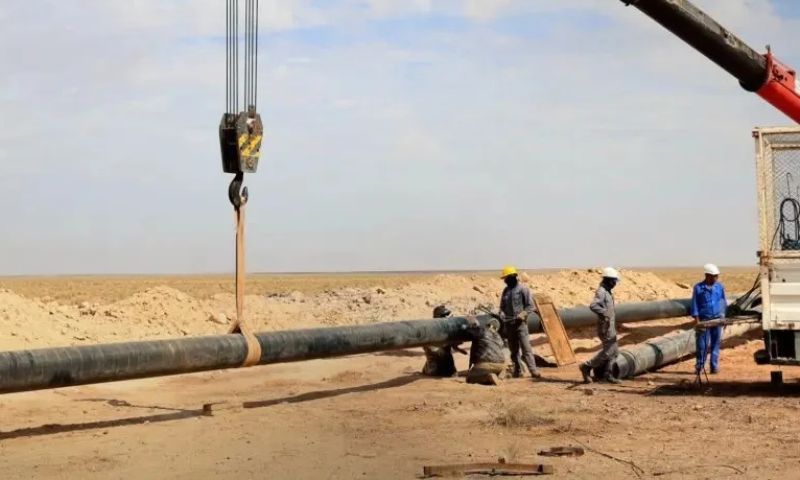

A gas export pipeline from the al-Jabsa plant in al-Hasakah countryside (northeastern Syria) exploded in the al-Arabidi area on Thursday evening, October 15, causing a fire along the pipeline, according to the Syrian Petroleum Company.
The incident is part of a series of attacks and explosions affecting oil and gas pipelines and energy facilities across Syria in recent months.
The Syrian Petroleum Company said in a statement that the explosion occurred at 5:15 p.m. on a 16-inch-diameter gas export pipeline in the al-Arabidi area, approximately 60 kilometers from the city of al-Shaddadi in al-Hasakah countryside.
The company added that response teams immediately began emergency procedures after receiving reports of the incident. They worked to isolate the sectional valves at both ends of the damaged section, at the al-Jabsa Gas Plant and the Deir Ezzor Gas Station in the al-Baghiliya area. Meanwhile, firefighting, security, and safety teams headed to the site to secure the area and contain the fire.
The Syrian Arab News Agency (SANA) quoted Uday al-Satouf, director of the Syrian Petroleum Company’s media office, as saying that teams were working to extinguish the flames before beginning repairs. He expected the work to be completed by the beginning of next week, allowing pumping operations and supplies to return to normal.
Al-Satouf explained that the company would arrange alternative gas supplies for power generation plants during the repair period to ensure their continued operation without interruption. He stressed that the incident would not affect household gas supplies.
Two Incidents in One Day
The al-Jabsa gas pipeline explosion occurred on the same day that the Syrian Petroleum Company announced that a petroleum products pipeline extending from Baniyas to Homs had been sabotaged near the village of Hadideh in western Homs countryside, allegedly in an attempt to steal fuel, according to the company’s statement.
The attack involved puncturing the pipeline, causing gasoline to leak. This prompted teams to close valves on both sides of the damaged section to stop the flow of fuel and limit the spread of the spill, while company personnel and Civil Defense teams began repairs.
The leak also forced the closure of the Homs-Tartous highway in both directions, with traffic diverted to alternative routes, according to information released about the incident.
The official accounts of the two incidents differ. While the company said the Baniyas-Homs pipeline was targeted for theft, it did not identify the cause of the al-Jabsa gas pipeline explosion or announce any investigation findings by the time of publication.
Series of Incidents Affecting Energy Pipelines
The al-Jabsa gas pipeline explosion follows repeated incidents involving oil and gas pipelines in Syria since August, including an explosion on the same pipeline on August 18.
At the time, the Syrian Petroleum Company announced that gas pumping through the pipeline had stopped, while preliminary investigation findings suggested that the explosion resulted from an act of deliberate sabotage.
Following that incident, wells were isolated, safety valves were closed, and repair teams began addressing the damage. The company announced the following day that the pipeline had been repaired and returned to service. It explained that the pipeline supplied gas needed to operate power generation plants.
On September 28, the gas pipeline extending between the al-Shoula area and the city of Deir Ezzor was targeted in an act of sabotage, causing one of its sectional valves to explode and a fire to break out, resulting in the suspension of gas pumping through the pipeline.
Technical teams began repairing the damage and replacing an affected section measuring 18 meters in length and 16 inches in diameter before completing the work required to return the pipeline to service.
On September 30, an explosion occurred in a gas pipeline at the Tishreen Thermal Power Plant in Eastern Ghouta (Damascus countryside, southern Syria). The resulting fire forced the Deir Ali, al-Nasiriyah, and Tishreen power generation plants completely out of service, according to the Syrian Electricity Company at the time.
The interruption of gas supplies needed to operate the plants reduced available electricity generation capacity, amid expectations of a temporary increase in power rationing hours.
On October 7, an oil pipeline near the Tel Hamees area in al-Hasakah countryside was targeted in an attack described by the Syrian Petroleum Company as an act of sabotage. The attack damaged the pipeline, prompting maintenance and emergency teams to isolate the affected section and carry out repairs.
The company said at the time that the relevant authorities had identified and arrested those responsible for the attack, without disclosing their number or identities. It added that the suspects had been handed over to the competent authorities to complete legal procedures and refer them to the judiciary.
Accordingly, the al-Jabsa gas pipeline explosion and the attack on the Baniyas-Homs pipeline on the same day represent the fifth and sixth incidents in a series of six involving oil and gas pipelines and energy facilities since August, based on the chronology of previously reported incidents.
Implications for Energy Supplies
Incidents affecting gas pipelines are particularly significant because of their connection to electricity generation. Interruptions in pumping operations or damage to parts of the network can disrupt the gas supplies needed to operate power plants, depending on the affected pipeline and the availability of alternatives.
Following the latest al-Jabsa incident, the Syrian Petroleum Company said it would rely on alternative arrangements to supply gas to power generation plants during repairs, while confirming that household gas supplies would not be affected.
The company did not specify the volume of gas supplies interrupted by the explosion or the extent of the technical damage to the pipeline. It also did not announce additional measures to protect the infrastructure against similar incidents.
Syria’s oil and gas production facilities depend on a network of pipelines connecting fields and processing plants to treatment and power generation facilities, making pipeline safety a key factor in maintaining uninterrupted supplies.