


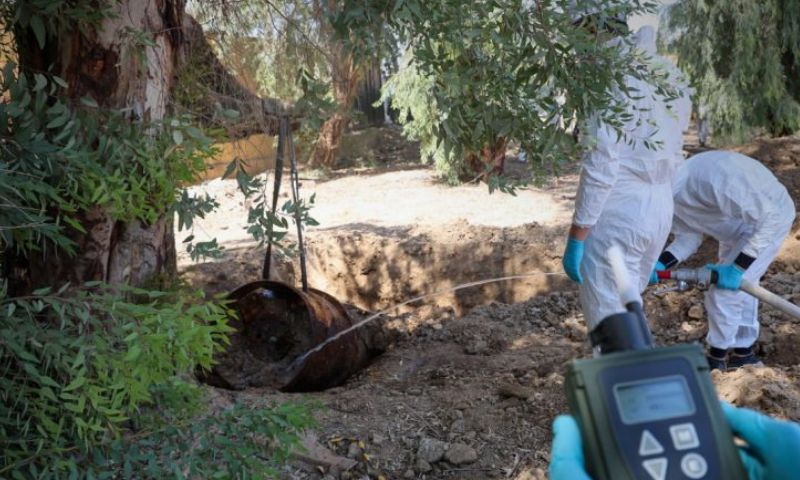
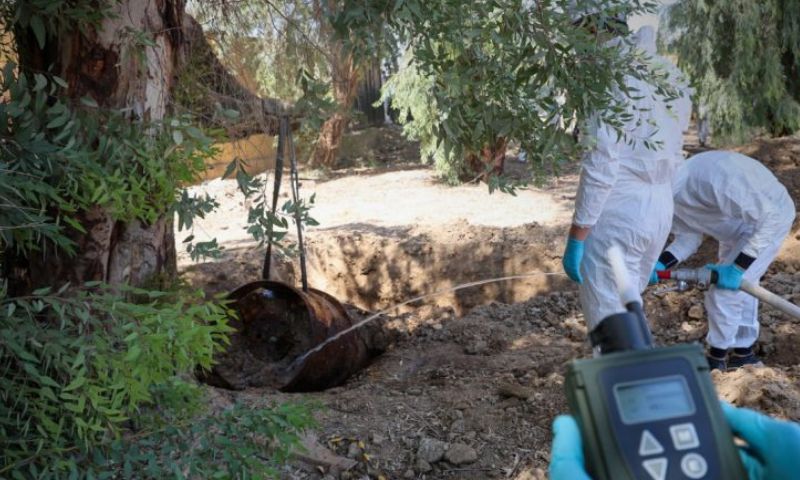
 Identifying sites linked to the former Syrian regime's chemical weapons program, October 14, 2026 (SANA)
Identifying sites linked to the former Syrian regime's chemical weapons program, October 14, 2026 (SANA)
Nidal Shikhani, director of the Chemical Violations Documentation Center of Syria, said the 100,000 documents handed over to the Organisation for the Prohibition of Chemical Weapons (OPCW) reveal how the former regime’s chemical weapons program operated, including manufacturing, storage, transportation, the roles of personnel at research centers and educational institutions, and the individuals who ordered the use of chemical weapons.
Speaking to the official Syrian al-Ikhbariya TV channel on Tuesday evening, October 13, Shikhani said more than 135 chemical attacks in Syria have been recorded by the Fact-Finding Mission and remain under follow-up and investigation.
He explained that cooperation with the OPCW included identifying previously concealed chemical facilities, precursor materials, remnants of weapons, missile warheads, and manufacturing and storage equipment, as well as providing lists of witnesses requested by specialized units, particularly the Investigation and Identification Team (IIT).
According to Shikhani, handing over approximately 100,000 documents related to the chemical weapons program and granting OPCW teams access to sites and facilities represent significant steps toward identifying those responsible for the attacks and advancing transitional justice.
He announced that the center would work with the OPCW during October to investigate a previous chemical attack in Damascus.
Chemical attacks in Syria caused more than 14,000 injuries and 3,234 deaths, in addition to fetal abnormalities, neurological seizures, and lasting psychological effects among some victims, according to Nidal Shikhani, director of the Chemical Violations Documentation Center of Syria.
The center carried out more than 65 projects documenting chemical attacks and collected samples from victims, soil, trees, and water, which were sent to OPCW laboratories in The Hague, he said.
Shikhani stated that chemical attacks began with the targeting of Khan al-Assal (western Aleppo countryside, northern Syria) in 2013 and ended with the targeting of Kabani Hill (Latakia countryside, western Syria) in 2019.
He noted that sarin gas was used in several attacks, including those in Eastern Ghouta (Damascus countryside), Khan Sheikhoun (Idlib governorate, northwestern Syria), and al-Lataminah (Hama countryside, central Syria) in 2017. Mustard gas was used in attacks attributed to the Islamic State (IS), including those targeting the towns of Marea and Umm Hawsh (Aleppo countryside) in 2015.
He added that the former regime declared approximately 1,200 tons of toxic substances in 2014 under arrangements to dismantle its chemical weapons program. However, it concealed materials and facilities and subsequently resorted to repeatedly using chlorine gas in several areas, including Aleppo, Tell Mannas, Jarjanaz, and Eastern Ghouta.
Shikhani pointed to the establishment of networks and front companies in various countries to import precursor materials and circumvent international monitoring and sanctions.
He explained that the Joint Investigative Mechanism established by the UN Security Council in 2015 issued five reports in 2017 indicating that the former regime’s warplanes were responsible for the use of chemical weapons. He added that the center worked with the Investigation and Identification Team to identify six attacks attributed to the former regime and IS.
He stressed that securing remaining munitions and comparing them with evidence from previous attacks, including yellow barrels and M4000 bombs, would help identify the types of weapons used and those responsible for manufacturing, storing, and transporting them.
Shikhani called for stronger international cooperation to pursue those involved, enhanced coordination with Interpol, and accession to the Rome Statute of the International Criminal Court and the International Partnership against Impunity for the Use of Chemical Weapons.
He emphasized that crimes committed by the former regime are not subject to statutes of limitations and that continued investigations are essential to identify those responsible and secure justice for victims and their families.
Syrian Foreign Minister Asaad al-Shaibani warned of challenges facing Damascus’s plans to eliminate chemical weapons, including landmines, damaged sites, and records concealed or destroyed by the former regime.
His remarks came during a press conference in Damascus on October 13 with Sabrina Dallafior, director-general of the Organisation for the Prohibition of Chemical Weapons.
The Syrian foreign minister said the two sides discussed a roadmap to move from the progress achieved on the chemical weapons issue toward its final resolution, along with a proposed joint plan whose stages would be measured against concrete achievements.
He noted that these challenges require sustained efforts to complete the available information and uncover the full extent of the chemical weapons program.
The Syrian foreign minister said that resolving the chemical weapons file must begin with securing justice for victims, ensuring that such atrocities are never repeated, and holding those responsible for the Assad regime’s chemical massacres accountable.
He pointed to the arrest of 18 suspects accused of using chemical weapons, including senior officers, who remain subject to proceedings before the competent courts.
He added that Syria had joined the International Partnership against Impunity for the Use of Chemical Weapons, based on its conviction that holding perpetrators of these crimes accountable is a fundamental right that cannot be extinguished by statutes of limitations.
Al-Shaibani noted that Syria had provided the OPCW with more than 100,000 official documents and granted it access to records and witnesses.
Sabrina Dallafior, director-general of the Organisation for the Prohibition of Chemical Weapons, said the organization continues to investigate previous attacks and identify those responsible, to prevent chemical weapons from being used again, amid strong international support for addressing this legacy.
Dallafior added that visiting sites in Syria is a priority from a non-proliferation perspective, to secure any remnants of the Assad-era chemical weapons program and help protect the Syrian people and the wider region.
She explained that visiting Damascus had been a priority since taking office two months earlier, allowing her to assess conditions on the ground, hold discussions with her Syrian counterparts, meet victims, and visit sites across Syria.
if you think the article contain wrong information or you have additional details Send Correction


 A
A
A
A
A
A




 More Politics