


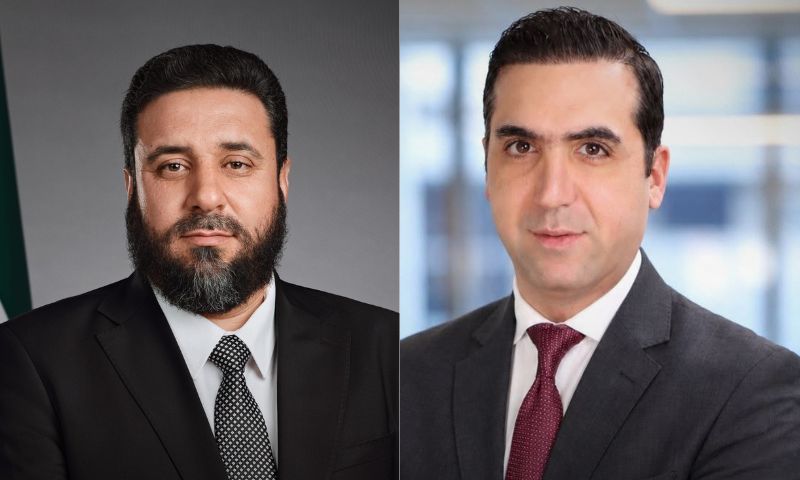
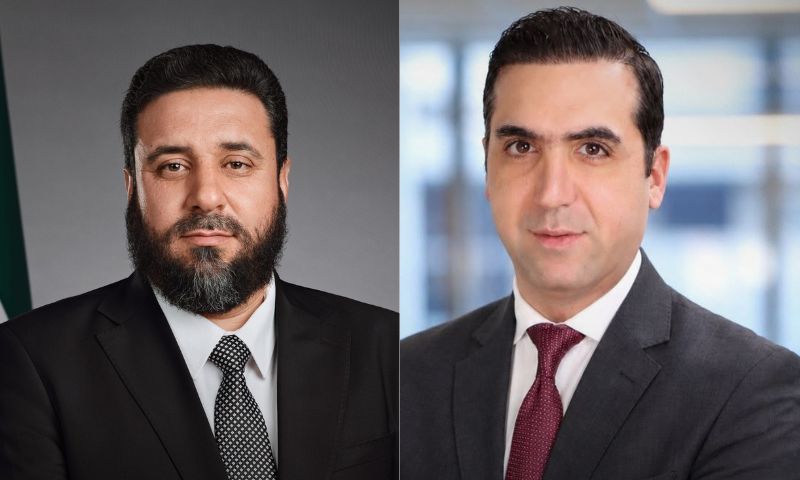
 Omar Samer al-Halabi (right), the newly appointed chairman of the Syrian Sovereign Fund’s board, and Maher Khalil al-Hassan, the newly appointed CEO of the Syrian Petroleum Company (Image edited by Enab Baladi)


 A
A
A
Syrian President Ahmed al-Sharaa issued Decrees No. 190 and 191 of 2026 on Sunday, October 18, appointing Maher Khalil al-Hassan as CEO of the Syrian Petroleum Company, replacing Youssef Qablawi, and Omar Samer al-Halabi as chairman of the Sovereign Fund’s board, replacing Mazen al-Salhani.
Qablawi’s handling of fuel supplies had drawn repeated criticism, most recently over a contaminated gasoline crisis that damaged vehicles across Syria’s governorates.
Al-Halabi’s appointment comes as Australia’s Department of Foreign Affairs and Trade renewed the sanctions listing of the fund’s director-general, Abraham Succarieh, previously known as Abu Maryam al-Australi.
Presidential Decree No. 191 of 2026 provides for:
– Appointing engineer Omar Samer al-Halabi as an adviser on economic affairs to the Syrian presidency.
– Adding al-Halabi to the membership of the Supreme Council for Economic Development, established under Decree No. 115 of 2025.
– Naming al-Halabi chairman of the Sovereign Fund’s board, established under Decree No. 250 of 2025, alongside his other duties, while retaining the remaining board members without changes.
The previous chairman of the Syrian Sovereign Fund’s board was Mazen al-Salhani, who currently serves as minister of tourism.
Born in Hama (central Syria) in 1986 , al-Hassan earned a bachelor’s degree in petroleum engineering from the Faculty of Petrochemical Engineering at Homs University in 2010.
He specializes in managing supply operations, companies, and domestic trade.
He worked in production operations management at the Hayyan Petroleum Company between 2011 and 2013.
He supervised oil fields in opposition-held areas east of Homs (central Syria) and oversaw public services in the southern region until late 2016.
In 2017, he served as director of the authority responsible for managing the affairs of international and local organizations.
He served as deputy minister of economy and resources in the Syrian Salvation Government from 2018 until the fall of the former regime.
He previously served as minister of internal trade and consumer protection in Mohammad al-Bashir’s caretaker government.
He had served as deputy minister of economy and industry for internal trade and consumer protection since April 2025 [CHECK ORIGINAL: appointment date].
Al-Halabi holds an MBA with distinction from IE Business School.
He has completed specialized programs in public policy, macroeconomics, strategy, and innovation at:
– Harvard University.
– Massachusetts Institute of Technology (MIT).
– Fudan Business School.
– London School of Economics and Political Science (LSE).
He is a partner and head of Economics and Public Policy Advisory at KPMG Middle East, part of the global KPMG network, one of the world’s Big Four professional services and accounting firms.
He leads the firm’s enterprise strategy and policy advisory work to develop public policy, advance economic reform, and support sustainable industrial growth in the region.
He has more than 20 years of experience advising government and private sector organizations on economic development, trade facilitation, investment attraction, industrial localization, and socioeconomic impact analysis.
He previously worked with Saudi Arabia’s Public Investment Fund and spent about a decade at Johnson Controls.
if you think the article contain wrong information or you have additional details Send Correction




 More Economic Reports