
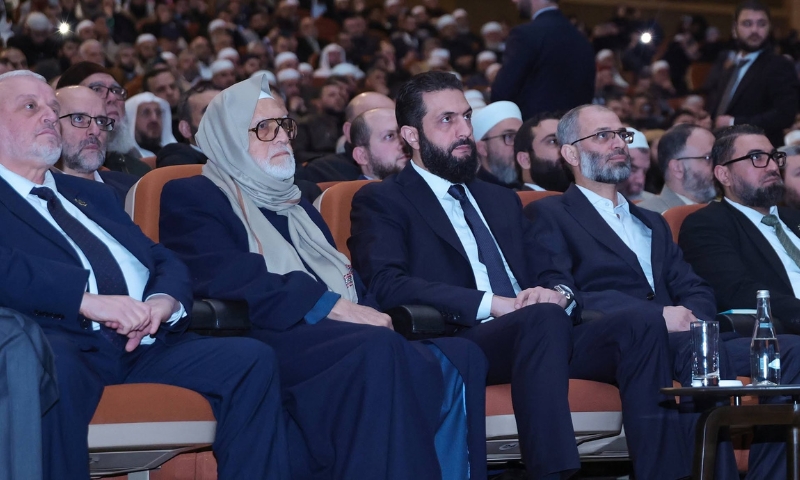

Mowaffak al-Khouja | Mohammed Jaffal
“The current government and the brothers who carried out this movement, the Deterrence of Aggression battle, are from the Wahhabi school. In fact, years ago they were among the hardliners, even among the takfiris. They used to declare others unbelievers, and there was hostility between us and them.”
These were the opening remarks in a leaked recording of Syria’s Grand Mufti Osama al-Rifai, in which he discussed the religious doctrine of Syrian President Ahmed al-Sharaa and how it had changed during the Syrian revolution, triggering a wave of criticism and anger among supporters of the Salafi current.
The criticism was not limited to his characterization of al-Sharaa’s doctrine. It also extended to al-Rifai’s definition of the term “Ahl al-Sunna wal-Jama’a,” or Sunnis, as the recording was understood to suggest that the mufti intended to exclude the Salafi current from the broader Sunni community.
Despite a statement issued by al-Rifai, followed by a nearly half-hour video recording, the debate among Islamic currents has continued, focusing on the remarks of Syria’s highest religious authority.
In this report, Enab Baladi examines the dispute among Islamic currents in Syria, particularly between the two most visible poles on the scene today, Salafism and Asharism, in an effort to assess where the dispute may lead and whether it could spread into society.
Enab Baladi also explores, with experts and researchers, the future of Syria’s religious landscape and the measures the government has taken, or should take, to regulate religious discourse and prevent it from fueling political and social polarization.
The Leak That Sparked the “Storm”
On September 21, al-Rifai issued a statement explaining the circumstances surrounding the leaked recording from his meeting with an Indonesian delegation. He said that, because of the exceptional circumstances prevailing during years of exile and residence in Istanbul, conflicting reports had circulated about Hayat Tahrir al-Sham (HTS) and conditions inside Syria, creating a degree of caution and reservation at the time.
According to al-Rifai, subsequent developments showed that allegations of extremism and takfir were false, adding that they had observed a reality in which religious rituals could be practiced according to the recognized Sunni schools of thought.
Despite the Grand Mufti’s statement, he did not stop there. He later released a video explaining his position on the controversy and discussing the ideological revisions that HTS underwent over the course of its development.
He referred to “conflicting reports” and “rumors” circulating on social media containing claims in which “truth and falsehood were mixed,” even before the Deterrence of Aggression battle.
He said members of the now-dissolved Syrian Islamic Council traveled to Idlib shortly before the fall of the regime, met with HTS leadership, and returned with a different outlook from the one they had held before the visit.
Regarding his use of the term “Wahhabism,” named after Muhammad ibn Abd al-Wahhab, one of the most prominent thinkers associated with the Salafi current, al-Rifai said he had never previously used the term in his lessons or gatherings.
Explaining why he used the terminology before the Indonesian delegation, al-Rifai said the Indonesian government had previously coordinated with deposed Syrian President Bashar al-Assad and had been convinced that the Syrian revolution was a “revolution of terrorists,” and that those who revolted against al-Assad were “Wahhabis.”
He added that the Indonesians were unfamiliar with the terms “Salafis,” “Ahl al-Athar,” or “Ahl al-Hadith,” and that he could not use a term other than “Wahhabism” because it was the one they understood.
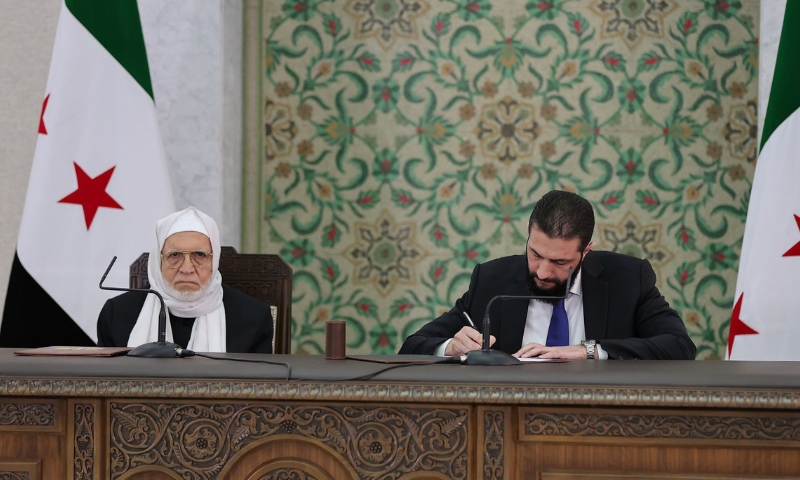
Syrian President Ahmed al-Sharaa alongside Sheikh Osama al-Rifai during the announcement of the formation of the Supreme Fatwa Council, March 28, 2025 (Syrian Presidency)
“No Good Is Intended by It”
Nidal Hasan, known as Abu Mohammad al-Sadeq, a former religious official in Ahrar al-Sham, said the leaked recording of al-Rifai was something from which “no good is intended,” suggesting that its purpose may have been “to inflame disputes, stir sedition, and draw society into a cycle of intellectual turmoil for political purposes.”
At the same time, Abu Mohammad al-Sadeq told Enab Baladi that al-Rifai’s remarks in his subsequent statement and video were “useful in warding off sedition and reducing tensions and exploitation, whatever its form or motives.”
Dr. Abdulkader al-Housien, from the Ihya Ulum al-Din Center and one of the most prominent defenders of the Ashari current, said in a video recording that al-Rifai’s comments had not been intended for the media and were made during a restricted, closed session. He described leaking the conversation as “a betrayal of private gatherings.”
“The scholars of al-Sham stand as one, despite their different orientations. Among them are Salafis, Sufis, Asharis, and Maturidis, and all their hearts are united. We do not feel this division.”
Sheikh Osama al-Rifai
Grand Mufti of Syria, in a video recording
“Private-sphere Salafism”
In the video, al-Housien said discussion of al-Sharaa’s changing intellectual and doctrinal background was not new. He said the Syrian president’s departure from Salafi doctrine should be discussed only within the bounds of academic and objective debate.
He added that the issue was a personal matter and did not concern the affairs of the country, noting that throughout its history Syria had been governed by presidents and rulers from different sects and doctrines.
Ahmed Zaidan, media adviser to the Syrian president, previously said in a televised interview that the experience in Idlib and northern Syria, and in what had been known as the “liberated areas,” had moved beyond all factions and ideologies toward integration around the idea of the homeland.
“I am fully confident that he, al-Sharaa, will adopt the Levantine experience, Private-sphere Salafism, over the next five years,” Zaidan added.
Al-Sharaa was not the only one to change his approach over the previous years. The faction he led during the Syrian revolution also underwent changes in its intellectual and doctrinal structure, as well as in its name and organization, from its formation as Jabhat al-Nusra, through its renaming as Jabhat Fatah al-Sham, and finally to Hayat Tahrir al-Sham. HTS was later dissolved into the institutions of the new state, particularly the military and security establishments.
Al-Housien said al-Rifai portrayed al-Sharaa in the leaked recording as an “open-minded and rational” man and did not intend to disparage him. Rather, he said al-Sharaa was pursuing the country’s interests and that the recording showed he had once been placed in the category of extremism, which was how he had been portrayed in many places.
“When al-Sharaa sought to eliminate extremism and made clear that the country would not be forced, through coercion, to follow one opinion, we supported him,” al-Housien added.
Salafism, From Prisons to the Centers of Power
Salafism, in its different forms and under its various labels, was confined to narrow circles under the former Syrian regime. Its adherents were persecuted and imprisoned, their books were banned, and “Salafi thought” itself became an accusation that could land someone in prison.
After the Syrian revolution broke out in March 2011, Salafism became active again in what were known as the “liberated areas,” which were controlled by opposition factions.
Opposition factions, particularly Islamist ones, were predominantly Salafi in character, especially in Idlib and areas under the influence of HTS.
Dr. Abdul Rahman al-Haj, a researcher specializing in Islamic groups, told Enab Baladi that religion constituted a major element in the war, while the battle against the Assad regime took precedence over sectarian considerations. Religious currents nevertheless became distributed across areas controlled by armed factions according to the orientation of each faction.
In opposition and Free Syrian Army-controlled areas in the north, the traditional current, which was largely Ashari, school-based in jurisprudence, and Sufi, rebuilt its institutions, formed the Syrian Islamic Council, and appointed a Grand Mufti of the Republic as an alternative to the regime’s mufti. At the same time, however, the council also included moderate Salafis.
Revivalist Salafis, followers of what is known as scholarly Salafism, were meanwhile active in areas controlled by Salafi jihadist factions, such as Douma, rural Homs, and later Idlib and the western Aleppo countryside.
What changed in the religious landscape, according to al-Haj, was the intense and growing Salafi presence during the years of war. The events altered the religious map, placing Salafism at the center after it had previously existed mainly on society’s margins.
After the Fall of the Regime, Opposites Meet
After the fall of the regime, different parts of the country opened up to one another, and Salafism spread throughout Syria after previously being concentrated in the “liberated areas.” By contrast, the traditional clerical current, with its Sufi character, had been the only current permitted to operate in regime-held areas, and even then only to a limited degree.
Hossam Jazmati, a researcher specializing in jihadist groups, told Enab Baladi that the debate, which can broadly be described as one between Sufis and Asharis on one side and Salafi currents on the other, had become highly active in Arab countries and emerged to a significant degree from the Gulf region.
Syria, however, was under tight security control during the rule of Hafez al-Assad and later his son, meaning such debates did not reach it with the same intensity seen elsewhere in the Arab and Islamic worlds.
Abu Mohammad al-Sadeq, the former religious official in opposition factions, said disagreements among Islamic theological schools in general were old and date back to the earliest period of Islam, while the dispute between Salafis and Asharis in Syria is one branch of that broader disagreement.
He added that Salafism and Salafis had been present in Syria before the revolution but faced restrictions and bans under the former regime. Historically, their disagreements with Asharis had remained confined to dialogue, discussion, and scholarly rebuttals.
Jazmati noted that most religious Syrians do not know that they are Ashari. It is the doctrine they encountered in mosques, Islamic education textbooks, and schools, but most do not know that the doctrine is called Asharism, that it originates from this particular theological current, or that it is in disagreement with Salafism.
Those familiar with such details are usually sheikhs, specialists, students at Islamic secondary schools, and students at faculties of Sharia.
What is happening today, therefore, represents a resumption of a debate that had been suspended for many years because of the former regime’s strict control over the religious sphere through the Ministry of Religious Endowments and security agencies.
Following the regime’s fall, the Salafi current emerged with the image that it had resisted the regime and ultimately defeated it. Jazmati said this perception is “not necessarily entirely accurate,” although it has become the general image associated with the current.
Could the Dispute Lead to Social Conflict?
Abu Mohammad al-Sadeq believes that as long as the disagreement remains within the framework of legitimate diversity, it is “acceptable.” But when it reaches the level of conflict, it becomes “reprehensible.” He said recognized interpretive matters in Islamic law are open to consideration and choice and should not involve coercion or compulsion.
Disagreement among Islamic schools should not turn into inflammatory social polarization or negative political polarization, according to Abu Mohammad al-Sadeq, because this “deepens divisions, stirs sedition in society, pushes the country toward instability and disorder, and opens it to regional and international exploitation.”
Jazmati, however, believes that in practice the issue does become one of social and political polarization, accompanied by disagreements over practical questions that emerge in everyday religious life, such as the controversy over celebrating the Prophet Mohammad’s birthday.
Al-Haj, meanwhile, sees the possibility of intellectual and doctrinal differences spreading into society as real. In his view, the Salafi current has the capacity to raise the most divisive issues without sufficient consideration of the appropriate time, place, or social context.
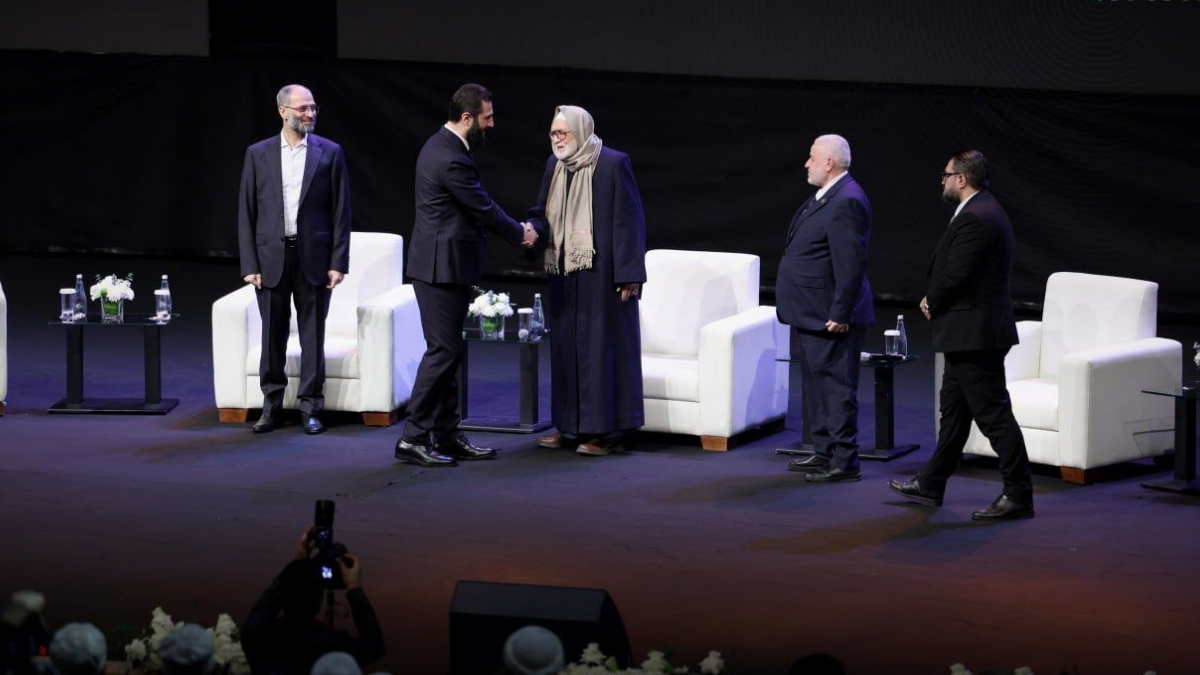
Syrian President Ahmed al-Sharaa shakes hands with Grand Mufti Sheikh Osama al-Rifai during the Conference for the Unity of Islamic Discourse, February 16, 2026 (SANA)
The Charter and Supreme Council: Are They Enough to Prevent a Clash?
Since the fall of the former Syrian regime, the Syrian government has sought to institutionalize the religious landscape and organize it through bodies bringing together Syria’s major religious currents, particularly the Salafi current that had spread in what were known as the “liberated areas,” especially Idlib, and the traditional Ashari current.
This began with the establishment of the Supreme Fatwa Council on March 28, 2025, and the appointment of Osama al-Rifai as Syria’s Grand Mufti. Al-Rifai had been a member of the now-dissolved Syrian Islamic Council, which was associated with the Ashari current. The council also included Abdul Rahim Atoun, a former religious official in HTS, which had embraced Salafi thought.
On February 16, the Ministry of Religious Endowments announced a charter during the “Unity of Islamic Discourse” conference, attended by hundreds of Muslim clerics and Syrian President Ahmed al-Sharaa.
According to the charter, it was the result of scholarly and dialogue workshops involving different academic and religious outreach schools, with the participation of more than 1,500 Syrian Muslim scholars and clerics.
As defined in the document, the charter constitutes an inclusive national covenant for scholars and preachers from among Syria’s Sunnis and their various schools, seeking to unify their position on public issues under the Quranic verse: “The believers are but brothers, so make peace between your brothers and fear God that you may receive mercy.”
The Ministry of Religious Endowments established the Charter for the Unity of Islamic Discourse to set ethical rules governing religious activity in Syria, where diversity has emerged after years of absence due to the entry of previously banned schools and an unprecedented opening of the religious sphere.
In the same context, the ministry is also attempting to balance its discourse among different Islamic currents, without favoring one over another, according to its statements and the circulars it sends to mosque preachers.
Questions nevertheless remain about how effective the government’s measures will be in regulating religious discourse, promoting dialogue among different currents, and preventing clashes, particularly through the establishment of the Supreme Fatwa Council and the announcement of the Charter for the Unity of Islamic Discourse.
A Social Reference Point
The former religious official in Ahrar al-Sham, who belongs to the Salafi current, believes that the existence of religious institutions and general charters is highly important for preserving Syria’s diverse Muslim social fabric.
Every society needs a reference authority that represents its members, “guides them, and clarifies what is right and true in matters of uncertainty,” according to Abu Mohammad al-Sadeq.
He noted, however, that the Supreme Fatwa Council should play a larger role in guiding religious discourse and society and should not limit its work to issuing statements on religious occasions.
He considers the Charter for the Unity of Islamic Discourse, produced by the Supreme Fatwa Council and the Ministry of Religious Endowments, a positive step toward preserving moderation, accommodating the various religious components of Syria’s diverse society, and moving away from religious extremism.
“What emerged from the Supreme Fatwa Council and the Ministry of Religious Endowments through the Charter for the Unity of Islamic Discourse is a positive step toward preserving moderation and accommodating the religious components of Syria’s diverse society, away from extremism in religion.”
Abu Mohammad al-Sadeq
Former religious official in Ahrar al-Sham
A Difference Between the Council and the Charter
Jazmati distinguishes between the role of the Supreme Fatwa Council and that of the Charter for the Unity of Islamic Discourse, saying each represents a different attempt.
He sees the Supreme Fatwa Council as an attempt by the “authorities” to create a religious structure that maintains a balance between the two currents.
Jazmati said balance is one of the mechanisms used by the “authorities,” noting that the council includes representatives of Salafi currents previously centered in Idlib alongside Syria’s traditional clerical establishment, which is Ashari and has a Sufi dimension.
There was an attempt to establish a balanced higher religious regulatory structure, and it can be described as “successful so far,” although the Supreme Fatwa Council is not particularly active, according to Jazmati.
As for the Charter for the Unity of Islamic Discourse, he sees it as an attempt to regulate Salafism and bring currents that could become hardline into line with a moderate form of Islam very close to traditional Syrian Islam, which is Ashari.
“The Charter for the Unity of Islamic Discourse is an attempt to regulate Salafism and bring currents that could become hardline into line with a moderate Islam very close to traditional Syrian, Ashari Islam.”
Hossam Jazmati
Researcher specializing in jihadist groups
Under this understanding, the charter was created to serve as the religious framework operating within the Ministry of Religious Endowments and therefore binding ministry employees, including preachers, teachers, and imams.
If these employees depart from this moderate line, they would be violating the rules of the institution employing them, allowing the ministry to hold them accountable, dismiss them, or take other measures against them.
Jazmati believes the Charter for the Unity of Islamic Discourse could help reduce discourse involving takfir, accusations of religious innovation, and exclusion because it provides a means of regulating and maintaining control over the Sunni Muslim religious class through the positions in which its members are employed.
He said members of this class need these jobs both to have platforms from which they can speak and to earn a living.
As a result, the authorities can regulate members of the clerical and religious establishment, Sunni Muslim scholars, and Sunni students of religious knowledge through the boundaries established by the charter, according to Jazmati.
What Role Should the Government Play?
Abu Mohammad al-Sadeq believes the government should intensify its efforts to promote an understanding of the jurisprudence of disagreement, including its rules and limits, and should emphasize consideration of objectives and consequences in public spaces. It should also draw on “mature figures” who embrace such thinking and demonstrate moderation.
At the same time, the government should avoid promoting figures who “suffer from intellectual and behavioral crises,” he said.
He also called on the government to avoid bias and marginalization while taking into account “those who were early to act and made sacrifices,” saying this would help build trust among Islamic currents despite their differences.
Jazmati, meanwhile, said there are “inciting” individuals who publicly threaten civil peace, as the government itself says, and who often rely on Salafi and sectarian discourse involving accusations of religious innovation, immorality, and unbelief.
Jazmati said the government either takes no action against such individuals or does not take measures sufficient to regulate this type of discourse.
If these people were held accountable with a convincing degree of seriousness, people could begin exercising greater restraint, prompting individuals to think before speaking, recognize that there are limits to what they can say or do, and act within the framework of the law, according to Jazmati.
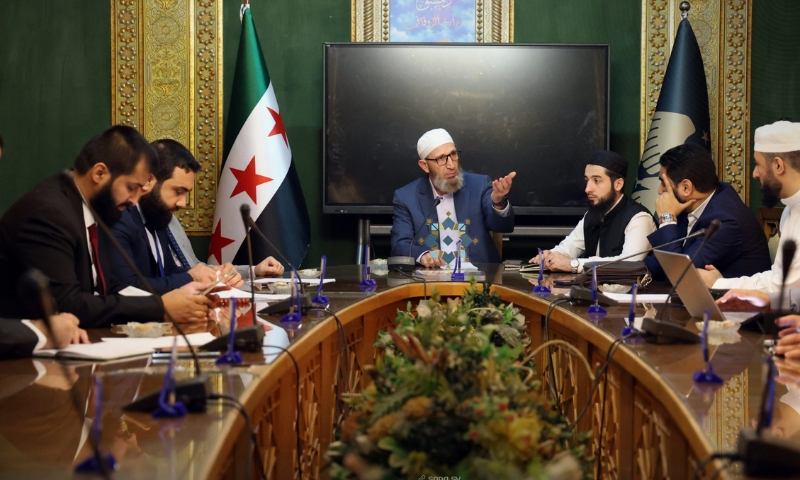
The committee responsible for following up on implementation of the Charter for the Unity of Islamic Discourse discusses mechanisms for activating its provisions, August 10, 2026 (SANA)
The Future of Syria’s Religious Landscape
Syria’s religious landscape does not appear likely to return to the form it had before the war, given the changes in the presence of different religious currents and in their relationships with one another over recent years.
As religious discussions move from limited circles within specialized institutions into the public sphere, questions are emerging about the relationship that will develop among different currents, whether they can preserve space for coexistence, or whether doctrinal and sectarian disagreements will develop into broader social polarization.
Jazmati believes the coming period will see continued debate among the various currents, now that disagreements largely kept under control over previous decades have reemerged more clearly.
He noted, however, that part of this dispute does not reach the general public as a direct theological disagreement. Instead, it appears through religious and social issues that are more visible in everyday life.
Jazmati said most religious Syrians do not necessarily understand themselves according to the theological classifications used by specialists. Many people inherited the dominant religious tradition through mosques, schools, and religious institutes without being concerned with identifying themselves as Ashari or Salafi.
Accordingly, relations among different currents in the coming period may depend on their ability to keep disagreements within religious boundaries and prevent them from spreading into the social sphere. The problem is not the existence of differences in doctrine or jurisprudence itself, but rather when those differences become a means of categorizing society or stripping the other side of religious legitimacy.
A Relationship Taking Shape Under Pressure
Abdul Rahman al-Haj, an expert on Islamic groups, believes the current religious landscape remains unstable and that different currents are testing the limits of their presence and their ability to influence the public sphere.
Al-Haj pointed to two main trends clearly visible within Syria’s Sunni religious landscape. The first is a reformist or scholarly Salafi current whose references draw on the school of Nasir al-Din al-Albani and his students and which does not adhere to the traditional schools of Islamic jurisprudence. The second is the traditional current, which is linked to the four schools of jurisprudence, is predominantly Ashari or Maturidi in doctrine, and has a Sufi orientation in religious practice.
This division does not mean the Syrian religious landscape consists of two entirely homogeneous blocs. Each current contains internal trends and variations in positions and methods. Yet continued interaction between these currents will make their relationship one of the factors shaping Syria’s religious landscape in the coming years.
Al-Haj believes the landscape may not change dramatically in the short term, but he raises the possibility that a new form of reformist Salafism could emerge, particularly following the fragmentation of Salafi jihadist currents and the movement of a number of figures previously associated with them into the political and institutional spheres.
He compares this possibility to the potential reemergence of a form of reformist Salafism resembling the experiences of figures who appeared in the late 19th and early 20th centuries, including Rashid Rida, Jamal al-Din al-Qasimi, Tahir al-Jazairi, and Abdul Rahman al-Kawakibi.
If this trend develops, it could add another layer to Syria’s religious landscape, distinct from the image associated with jihadist Salafism during the war years and, at the same time, from the traditional Salafism that existed before the war.
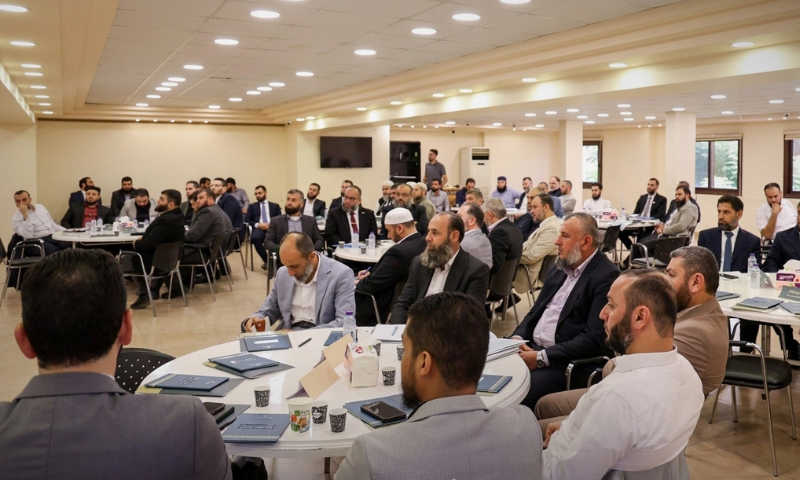
Members of the committee responsible for following up on implementation of the Charter for the Unity of Islamic Discourse during a meeting to discuss mechanisms for activating its provisions, August 10, 2026 (SANA)
Between Coexistence and Polarization
The future relationship among religious currents does not depend solely on the nature of scholarly disagreements, but also on how those disagreements are managed in the public sphere.
Al-Haj said disagreements can move from the scholarly sphere into society, particularly when contentious issues are raised at times or in places that fail to take into account the nature, diversity, and sensitivities of the community.
According to al-Haj, some controversial religious questions can become a means of attracting attention or spreading ideas rather than remaining subjects of scholarly debate among specialists. When that happens, disagreement can shift from a discussion among religious schools into polarization between social groups.
This creates two possible futures for relations among the currents. The first is continued coexistence within religious institutions and organized channels that allow each current to express itself and conduct its activities within a legal framework. The second is an expansion of the disagreement into the social sphere, with religious questions becoming part of broader alignments.
The existence of disagreements does not necessarily lead to polarization, just as shared institutions do not eliminate differences. The central issue, according to the arguments presented by the two experts, is the ability of institutions and society to keep differences within their religious and scholarly context and prevent them from becoming a dispute over the identity of society or descending into mutual accusations of exclusion, religious innovation, or unbelief.
Jazmati also stressed the importance of addressing rhetoric that threatens social peace, arguing that regulating discourse cannot depend solely on documents and religious institutions. It also requires addressing cases of incitement and threats when they go beyond the boundaries of religious disagreement.
Managing Diversity Within the State
The current landscape presents the state with a task that goes beyond choosing one religious current over another. Diversity within Syrian society means managing disagreement is itself part of regulating the religious sphere rather than merely resolving a dispute between two schools.
Al-Haj believes the state’s role should be to establish balance among the currents and prevent disagreements from turning into social confrontation while preserving room for scholarly and religious differences. From this perspective, managing diversity does not mean eliminating disagreement but establishing rules that allow it to exist without becoming a source of tension among different segments of society.
According to this view, this requires a clear distinction between scholarly disagreement, which can remain within educational and religious institutions, and discourse that turns into social incitement or an attempt to impose a single religious understanding on society.
Religious and educational institutions will also be important in the coming period, not as tools for eliminating disagreement but as spaces for organizing it. Clear channels for religious education and scholarly discussion could allow different currents to express their ideas within an established framework rather than allowing debate to shift to public platforms in ways that may intensify polarization.
Jazmati noted that Syrian society includes a broad public that does not treat theological classifications as political or social identities. This, in principle, leaves substantial room for coexistence among different schools and religious orientations, but that space could narrow if religious disagreements become tools for classification and exclusion.
Al-Haj, meanwhile, believes the nature of the coming period will be shaped by the ability of religious currents themselves to deal with Syrian society as a diverse society rather than a homogeneous environment on which a single discourse can be imposed.
The future relationship between Salafis and Asharis, and among different religious orientations more broadly, will therefore not be determined by theological disagreements alone, but also by the ability of each side to operate within a diverse religious and social space.
In this context, institutional coexistence may provide one framework that allows differences to continue without developing into social conflict, provided that institutions recognize diversity as an existing reality, guarantee room for religious and scholarly discussion, and simultaneously prevent incitement that could threaten social peace.
The future of Syria’s religious landscape will ultimately remain tied to the ability of these currents to move from the stage of rebuilding their presence after years of war toward establishing stable relationships with one another, and to the ability of the state, society, and religious institutions to manage this diversity without allowing theological disagreements to develop into social polarization.