
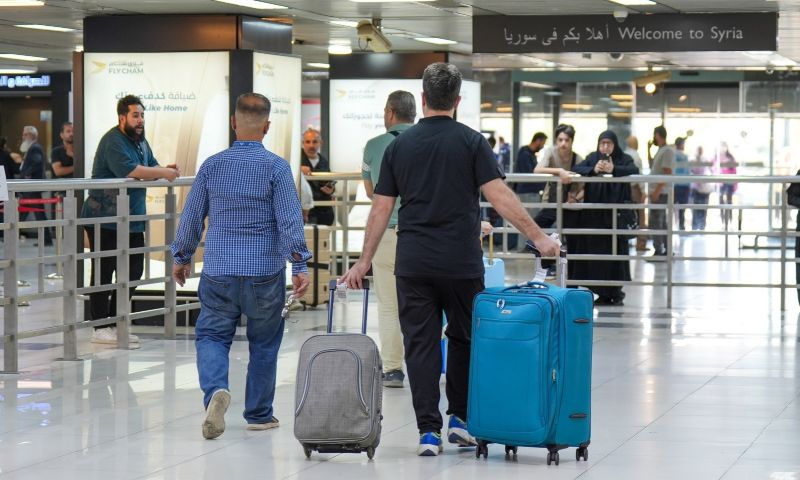
Omar Hosari, head of Syria’s General Authority of Civil Aviation and Air Transport, said the International Civil Aviation Organization (ICAO) has withdrawn its previous warning concerning Syrian airspace, describing the move as a significant step toward reintegrating Syrian airspace into the international aviation network and ending an advisory that had remained in effect for more than 13 years.
Hosari told the Syrian Arab News Agency (SANA) on Monday, October 26, that ICAO had confirmed its previous advisory would no longer serve as a basis for operational decisions concerning Syrian airspace. Risk assessments would instead rely on updated international frameworks and standards adopted in the aviation sector.
He added that the development would allow countries, civil aviation authorities and international airlines to reassess their decisions regarding the use of Syrian airspace, whether for overflights or flights arriving at and departing from Syrian airports. This could help increase overflight traffic and encourage additional airlines to consider resuming services to Syria.
Does Not Mean All Operational Restrictions Are Lifted
Hosari stressed that withdrawing the warning does not automatically lift all operational restrictions imposed by certain countries or regulatory authorities. However, the move supports technical and diplomatic efforts to address those restrictions based on internationally recognized aviation safety and security assessments.
He noted that the authority continues to coordinate with ICAO and international civil aviation authorities to strengthen confidence in the safety of flight operations in Syrian airspace and meet the technical and operational requirements needed to expand air connectivity with regional and international markets.
Hosari emphasized that restoring Syrian airspace’s normal role in international air navigation is a strategic priority for the authority, given its potential to strengthen air connectivity, increase passenger and transit traffic, and support economic activity and investment in Syria’s civil aviation sector.
The warning issued by ICAO concerning the safety of civilian aircraft operating within the Damascus Flight Information Region dates back to March 22, 2013, according to a document listed among Syria-related materials on the website of the US Federal Aviation Administration (FAA). The advisory remained in effect for more than 13 years.
At the time, the advisory warned of potential risks to the safety of civilian flights within the Damascus Flight Information Region amid the war in Syria.
It also cited reports of incidents in which civilian aircraft crossing Syrian airspace had been exposed to risks from flying near locations where munitions and missiles were being launched.
Reviving the Aviation Sector
Syria has recently witnessed a notable shift in air traffic, with a significant increase in overflights and flights operating at its domestic airports. This development reflects a new phase in Syria’s regional aviation position, as its airspace is increasingly viewed as a strategic corridor connecting Europe, Asia and the Gulf states.
Economic expert Majdi al-Jamous told Enab Baladi in a previous report that Syria is currently seeking to revitalize its aviation sector amid growing regional, Arab and international engagement, following years of decline during the war.
Al-Jamous explained that aviation and overflight traffic are important economic activities, making their revival a national and economic priority. He noted that recent regional developments have contributed to increased use of Syrian airspace as an aviation corridor due to changes in flight routes.
He added that these developments, alongside regional circumstances, including the situation involving Iran, have led to a significant increase in flights crossing Syrian airspace. He estimated that overflight traffic had risen by approximately 400% compared with last year, while efforts continue to gradually rebuild Syria’s civil aviation sector.
Al-Jamous noted that the relevant authority is working to develop the sector. However, he said its current contribution to the economy cannot yet be considered significant, particularly compared with countries and aviation hubs with extensive infrastructure, such as the United States and Dubai.
According to al-Jamous, estimated monthly revenues of approximately $6 million to $7 million remain limited and do not have a substantial impact on the national economy.
He explained that overflight traffic remains directly linked to political and regional conditions, noting that potential understandings between the United States and Iran could prompt airlines to return to their previous routes through Iranian airspace, reducing traffic over Syria.
According to al-Jamous, developing Syria’s aviation sector depends on regional and security stability, alongside international agreements that could help transform the country into an attractive aviation corridor. He noted that Syria’s geographic location provides a strategic advantage, but the country remains less competitive than Egypt and Türkiye, which play major roles in connecting continents.
Al-Jamous concluded by emphasizing that developing the sector requires advanced infrastructure, expanded agreements with international airlines, and improvements to aircraft fleets and airports. He said achieving domestic and regional stability could eventually allow Syria to compete in the overflight sector alongside regional countries, including Türkiye, Egypt, the Gulf states and Iraq.