
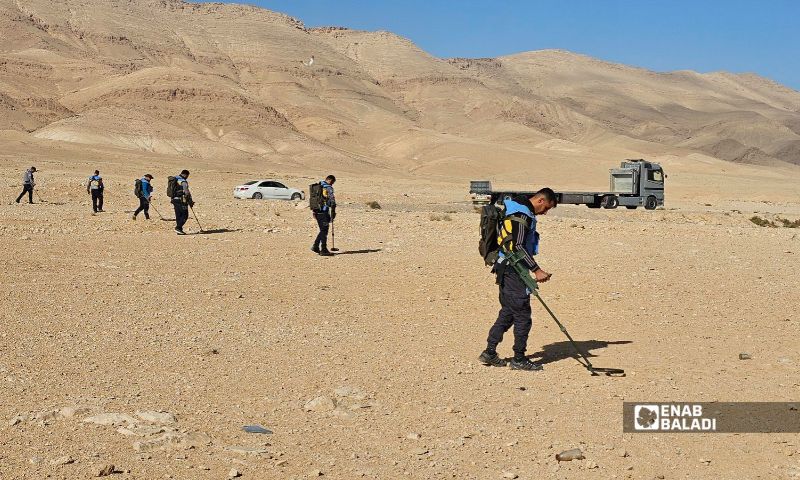

War remnants clearance and demining teams are continuing survey work along the Damascus-Palmyra-Deir Ezzor road to secure both sides and facilitate vehicle movement, amid widespread explosive remnants of war and unexploded ordnance in the area.
The main challenges facing the teams include the high concentration of munitions, particularly cluster munitions and hand grenades, as well as flash floods that have carried some remnants to other locations and buried others deeper underground, making detection and clearance more difficult.
The war remnants clearance and demining team at Syria’s Ministry of Emergency and Disaster Management said cluster munitions and hand grenades accounted for the largest share of the war remnants found so far along the Damascus-Palmyra-Deir Ezzor road.
Speaking to Enab Baladi, the team outlined its assignment in the area, explaining that the work is being coordinated between the Ministry of Emergency and Disaster Management and the Ministry of Transport.
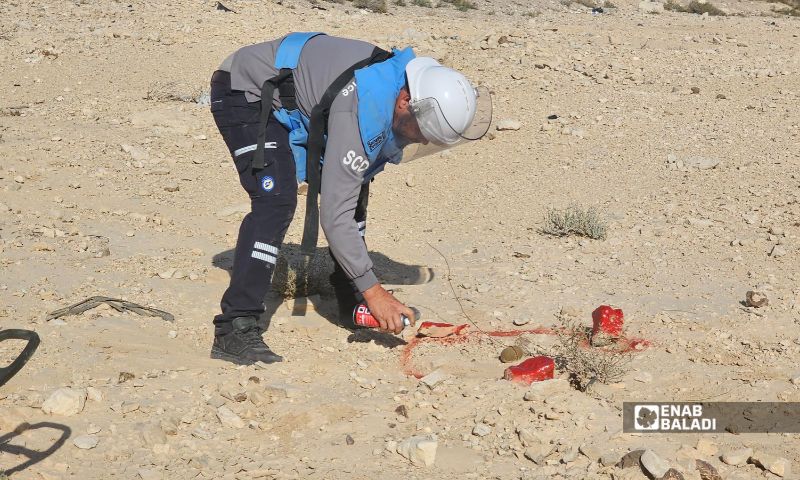
Explosive ordnance disposal teams survey the Damascus-Palmyra-Deir Ezzor road, November 15, 2026 (Enab Baladi/Ahmad Maslamani)
Hassan al-Talfah, director of the explosive ordnance disposal center serving Damascus and the Damascus countryside, told Enab Baladi that the survey aims to secure both sides of the Damascus-Palmyra-Deir Ezzor road to facilitate vehicle movement
He added that the work involves surveying a strip extending 100 meters on each side of the road, to a depth of 15 centimeters, to ensure it is free of munitions and explosives.
Al-Talfah explained that ordnance disposal teams may cover two to three kilometers a day, and sometimes five kilometers, depending on the concentration of munitions.
He said teams had spent three days surveying some stretches no longer than 450 meters because of the high concentration of munitions, noting that the Palmyra-Deir Ezzor road, which runs through central and eastern Syria, is heavily contaminated with minefields.
Al-Talfah said one of the greatest challenges facing the teams is working in areas affected by flash floods, which have swept large quantities of munitions from one location to another and buried some mines deeper than they had previously been.
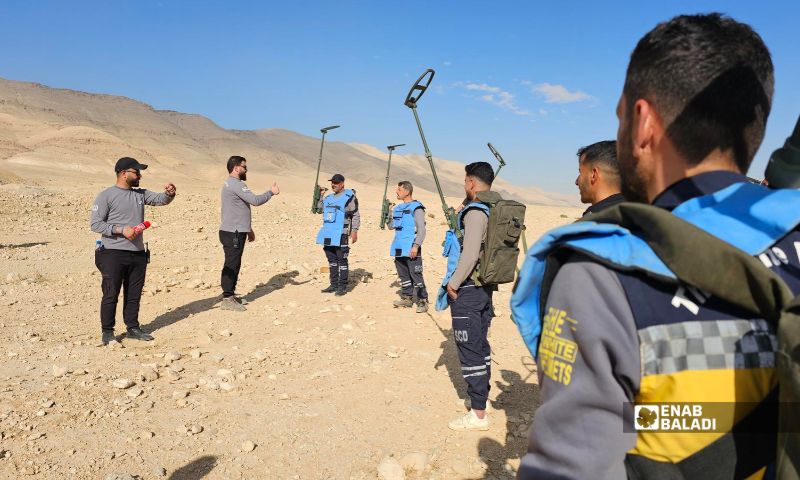
Explosive ordnance disposal teams survey the Damascus-Palmyra-Deir Ezzor road, November 15, 2026 (Enab Baladi/Ahmad Maslamani)
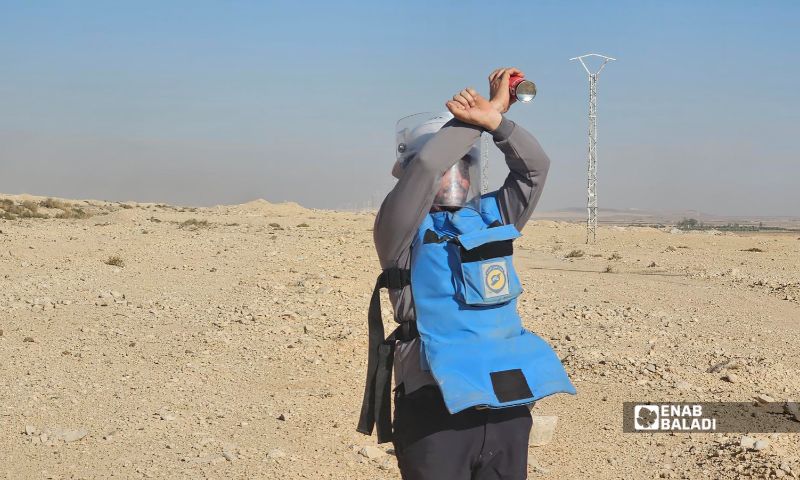
Explosive ordnance disposal teams survey the Damascus-Palmyra-Deir Ezzor road, November 15, 2026 (Enab Baladi/Ahmad Maslamani)
How the Work Is Organized
Anas Ramadan, leader of the demining team serving Damascus and the Damascus countryside, explained that the team is surveying the Deir Ezzor-Damascus road, beginning by preparing its personnel and all the necessary equipment.
He added that the second step involves assigning team members to ensure their tasks do not interfere with one another. The team leader’s role includes instructing personnel to report any unfamiliar object they spot.
Ramadan explained that all team members stop work completely when a suspicious object is located so the team leader can identify it. The team then continues surveying up to a designated point before returning to deal with the object.
Regarding the types of ordnance discovered, Ramadan said the team had found artillery shells, hand grenades and cluster munitions, describing the latter as the most dangerous.
He added that the team had not found any mines so far, but information from residents indicated that many might be present elsewhere along the road. He noted that work begins by consulting residents and studying the area to understand the types of munitions used to strike it and determine how to handle them.
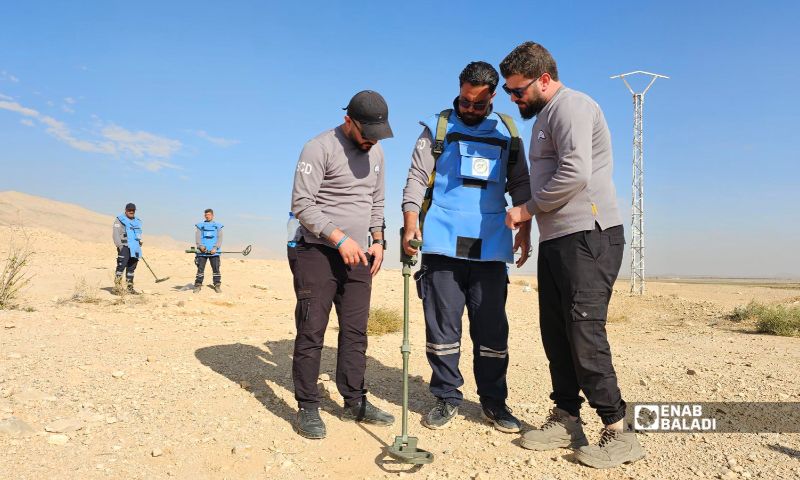
Explosive ordnance disposal teams survey the Damascus-Palmyra-Deir Ezzor road, November 15, 2026 (Enab Baladi/Ahmad Maslamani)
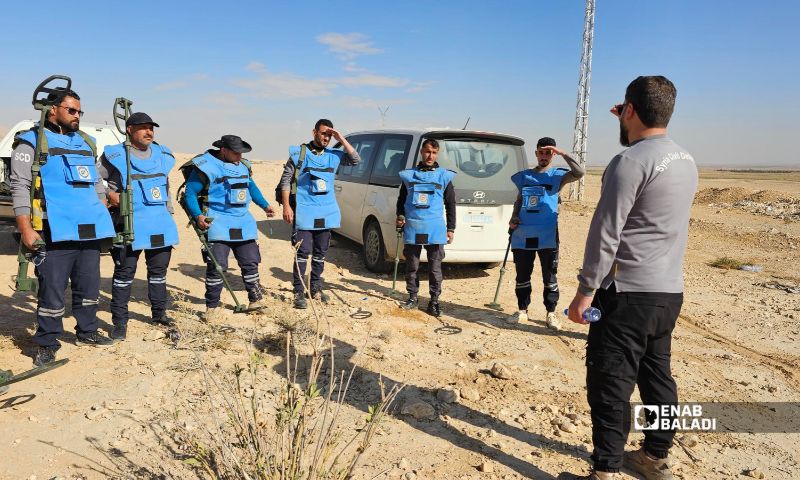
Explosive ordnance disposal teams survey the Damascus-Palmyra-Deir Ezzor road, November 15, 2026 (Enab Baladi/Ahmad Maslamani)
Defense Ministry Reports Clearing Over 315,000 Explosive Items
Syria’s Defense Ministry announced that its Engineering Directorate had detected and dealt with more than 315,000 mines and unexploded munitions left behind by the former regime in various parts of Syria.
The ministry’s Media and Communication Department told the Syrian Arab News Agency (SANA) on November 11 that its teams were continuing survey and clearance operations in residential areas, agricultural land, roads and vital facilities to address the dangers posed by mines and unexploded ordnance that continue to threaten civilians’ lives.
The department explained that detecting mines and unexploded ordnance, identifying contaminated areas and dealing with dangerous objects are carried out according to field priorities and available technical capabilities.
According to the department, survey and clearance operations cover Syria’s Jazira region (northeastern Syria), Damascus and the Damascus countryside, Aleppo and Idlib and their surrounding countryside (northern and northwestern Syria), as well as rural areas of Homs and Hama (central Syria) and Latakia (western Syria).
It added that priority is given to residential areas, agricultural land, roads and service facilities, particularly locations where residents are returning after years of displacement, based on the level of danger, population density and reports from residents and the relevant authorities.