
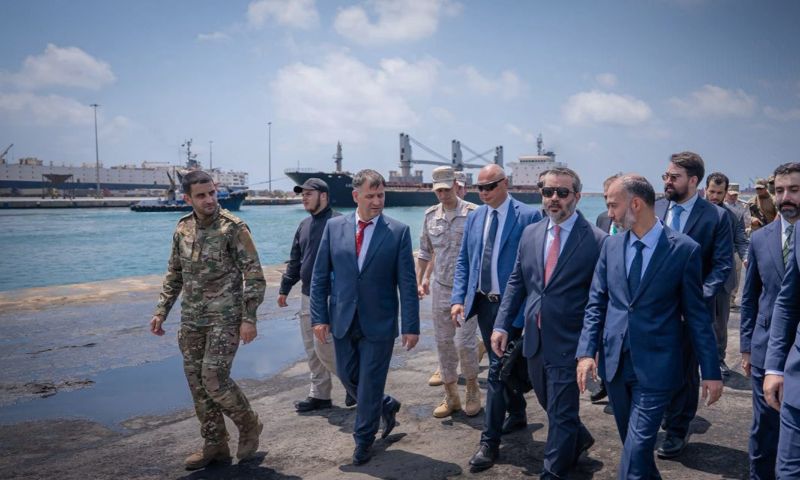

Russian Deputy Foreign Minister Georgy Borisenko said Moscow and Damascus are working on intergovernmental agreements that will definitively determine the future status of Russian military bases in Syria.
In an interview with Russian television channel RTVI, published on Wednesday, October 14, Borisenko said he expected the final agreement to be signed before the end of 2026.
He noted that Russian military facilities in Syria would be used partly on a joint basis by the two countries, including for training Syrian military personnel and providing logistical support.
He explained that the new arrangements are being developed based on an interim memorandum of understanding signed by the two countries last August, aimed at converting Russian military facilities in Syria into joint Russian-Syrian training and logistical support centers.
On August 9, the Syrian Foreign Ministry announced that it had reached an understanding with the Russian government under which Damascus would assume control of civilian facilities previously operated by Russia along the Syrian coast.
The ministry explained that the two sides had agreed to transform Russian military bases into joint training and rehabilitation centers that would preserve their mutual interests.
The memorandum of understanding also established a three-month deadline to complete the transition and bring the new arrangements into effect.
Key Facilities Handed Over to Syria
The General Authority for Border Crossings and Customs said the Syrian side had taken control of commercial facilities previously operated by Russia at the Port of Tartous (western Syria), including Berth No. 4 and its associated warehouses and facilities.
The General Authority of Civil Aviation and Air Transport said Syrian Foreign Minister Asaad al-Shaibani visited Latakia International Airport, accompanied by the authority’s head, Omar Hosari.
The authority added that the visit followed the signing of the Syrian-Russian memorandum of understanding, which paved the way for the airport’s management to return to Syrian control.
On September 27, the authority announced the start of rehabilitation and restoration work on the airport building and its facilities in preparation for resuming operations and receiving passengers.
Russia’s military presence in Syria began changing rapidly with the launch of the “Deterrence of Aggression” offensive in late November 2024, which culminated in the fall of the Assad regime on December 8 of the same year. The country subsequently entered a new phase that reshaped the balance of power.
During 2025, the number of Russian military bases in Syria decreased to just three. Russia’s presence contracted further following developments in early 2026, when Russian forces withdrew from Qamishli International Airport in Hasakah governorate (northeastern Syria) in January, amid changes in territorial control across the northeast.
By February, Russia’s military presence had been reduced to just two locations along the Syrian coast: Hmeimim Air Base and the Tartous Naval Base.
Syria’s new government has maintained good relations with Russia despite Moscow’s longstanding support for the former regime throughout the years of the Syrian war.
Syrian President Ahmed al-Sharaa has also made two visits to Moscow in recent months, meeting Russian President Vladimir Putin on both occasions. Other Syrian officials have also visited Russia for political and military discussions.
Hmeimim, Tartus “Understanding”: From Protection to Contractual Relations