


Wasim al-Adawi| Ghina Jabr | Odai al-Haj Hussin
Signs of exhaustion are clear on Syrian streets following government adjustments to fuel prices. Behind the daily strain of energy bills lies the oil sector, an intractable problem governed by hard numbers, as the Syrian Ministry of Energy tries to manage a widening gap between weak domestic production and a market consuming tens of millions of barrels of oil.
The latest increase in petroleum product prices, exceeding 40% in some cases, was more than a routine adjustment to a periodic price bulletin, particularly as it triggered a wave of public questions, criticism, and angry demonstrations against higher fuel prices amid the crushing living conditions facing Syrians.
Repeated discrepancies and sharp contradictions in statements by government officials, particularly Energy Minister Mohammed al-Bashir, over oil and gas production figures and the scale of actual demand have fueled frustration and eroded public trust.
While some data and statements depict a picture of a “massive deficit and import bills worth millions,” contradictory figures have been presented on other occasions, suggesting that available fields and production could cover basic needs. This has created a widespread public impression that conflicting figures are being used as ready-made arguments and justifications for harsh decisions, particularly increases in fuel and basic commodity prices.
A Wide Gap and Contradictory Statements
Government Tries to Absorb Anger
After protests over new fuel prices spread across most Syrian provinces for more than two weeks, Syrian Energy Minister Mohammed al-Bashir held a press conference in which he laid out the details of the oil sector before the public.
The minister did not resort to rhetoric or vague justifications, instead defining the problem through stark, direct, and striking figures:
- Required consumption: Syria currently needs between 300,000 and 350,000 barrels per day to ensure that the economy, power plants, and service sectors operate at full capacity.
- Actual domestic production: Domestic production does not exceed 108,000 barrels per day.
- The gap and reliance on imports: Imports cover around 60% of the domestic market’s diesel needs, at a total cost of up to $831 million per month for purchasing oil and petroleum products from abroad.
Al-Bashir described the decision to raise prices as “an imposed and tactical option to secure supplies, not a luxury.” He attributed part of the shortages and delays in imported shipments in previous weeks to difficulties and delays in securing the foreign currency needed to pay bills, in addition to the announced periodic maintenance of the Banias refinery.
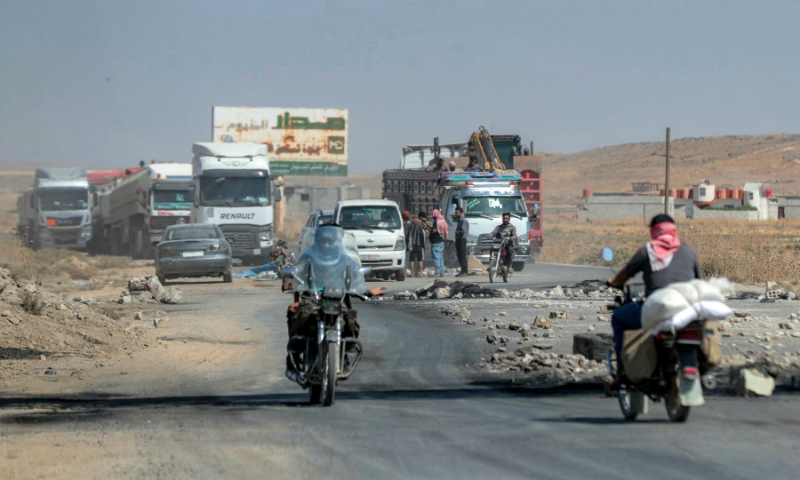
Protesters prevent oil tankers from reaching refineries on the M4 highway in Tell Tamer, Hasakah, during a protest against higher fuel prices, September 16, 2026 (AFP).
Fuel Prices After the Latest Increase
– Diesel: 175 Syrian pounds per liter (about $1.43), up from 125 pounds (about $1.02), a 40% increase.
– 90-octane gasoline: 185 Syrian pounds per liter (about $1.52), up from 147 pounds (about $1.20).
– 95-octane gasoline: 195 Syrian pounds per liter (about $1.60), up from 152 pounds (about $1.25), an increase of about 28%.
– Household gas cylinder: 1,600 Syrian pounds (about $13.11), up from 1,470 pounds (about $12.05).
Initial and Final Measures: Three Diesel Price Tiers
To prevent the full impact of the price increase from falling on the most vulnerable groups, al-Bashir simultaneously announced a package of measures that included restructuring diesel prices into three official tiers:
– Subsidized diesel, 115 Syrian pounds (about $0.94) per liter: Allocated to vulnerable social groups and for food supply purposes.
– Service and production diesel, 150 Syrian pounds (about $1.23) per liter: Allocated to industrial, agricultural, and service sectors.
– Standard diesel, 175 Syrian pounds (about $1.43) per liter: The targeted commercial price for general consumption.
At a later hearing before the People’s Assembly in Damascus, held at the request of the Assembly’s Energy Committee, the minister said a liter of diesel sold for 175 Syrian pounds (about $1.43) actually costs the state around 206 pounds (about $1.69), meaning the government continues to provide a subsidy estimated at 31 pounds (about $0.25) per liter, according to him.
Syrians are now watching the mechanism the Ministry of Energy and the Syrian Petroleum Company will adopt to address the oil supply gap. While Energy Ministry statements say the goal is to achieve “self-sufficiency” by 2028 and enter negotiations with international companies for exploration and drilling, Syrians, according to Enab Baladi‘s reporting across the country’s provinces, face unstable living conditions in which their purchasing power fluctuates with every sudden adjustment to fuel price bulletins.
From 150,000 to 350,000 Barrels
Syrian Energy Minister Mohammed al-Bashir has made several official statements containing differing estimates of Syria’s daily and annual crude oil requirements:
– In February 2026, the minister said domestic consumption required 150,000 barrels per day, while domestic production at the time covered less than a quarter of that amount, forcing the government to import oil. He said Syria would need around three years to achieve oil self-sufficiency.
– On September 12, 2026, al-Bashir said estimated domestic demand reached 350,000 barrels per day to operate all development and industrial sectors and power plants at full capacity. He said domestic production at the time stood at around 100,000 barrels per day, leaving a large gap covered by imports.
– At the People’s Assembly hearing, he said daily demand ranged between 300,000 and 325,000 barrels, requiring a monthly purchasing bill of $831 million.
Al-Bashir later explained the differences between the stated demand figures:
– The previous figure of 150,000 barrels covered only areas under government control, while the new figure covers all provinces.
– Consumption fluctuates between 270,000 and 280,000 barrels in spring and peaks at between 325,000 and 350,000 barrels in winter because of heating demand.
– The calculation shifted from considering only “refinery processing capacity” to “total consumption, including imported finished products.”
The “Jump in Domestic Consumption” Is Attributed To:
– An increase in the number of vehicles from 2.5 million to 3.6 million.
– Reliance on private generators to compensate for the electricity shortage.
– Power plant consumption rising to 8,500 tons of fuel oil and 24 million cubic meters of gas per day.
– The resumption of industrial and agricultural activity and the resulting pressure on demand.
Price Hikes Do Not Address the Root of the Crisis
Syrian economist and banking expert Dr. Mahmoud Abdul Karim, in his detailed analysis of the complex situation surrounding petroleum products, said the financial picture should be viewed “without cosmetic cover.” The issue, he said, is not simply the price of a liter of diesel paid by citizens from their “exhausted pockets,” but rather “begins with the shocking figure” announced by Energy Minister Mohammed al-Bashir, a monthly oil and petroleum product import bill of $831 million.
“We are facing a suffocating production gap estimated at around 200,000 barrels per day between what we produce and what we consume. In cold numbers, this means an annual hemorrhage approaching $10 billion merely to keep the state’s basic arteries alive,” the Syrian expert told Enab Baladi.
According to Abdul Karim, the latest decision to raise fuel prices is merely an “accounting trick to transfer the financial burden from the treasury to the consumer.” This may reduce some of the energy sector’s accounting losses, but it does not eliminate the need for the dollars required each month to finance imports.
The Real Danger, a “Budget Pressure Scenario”
The Syrian economist said actual revenues in the first half of 2026 amounted to around $2.7 billion, compared with expenditures of approximately $3.7 billion, leaving an actual deficit of $1.005 billion.
Under what Abdul Karim called a “pressure scenario,” he assumes continued pressure on revenues because of weak purchasing power, a possible decline in fees associated with imports, and the inability of the oil and energy sector to transfer revenues to the treasury at targeted levels.
Under this scenario, estimated annual revenues would reach around $5.65 billion, compared with estimated expenditures of approximately $8.7 billion. In other words, $8.7 billion in expenditures minus $5.65 billion in revenues would leave a budget deficit of around $3.05 billion.
If purchasing power continues to contract and customs and fee revenues decline, while the energy sector remains unable to contribute to the treasury as planned, the market would be heading toward what he described as a nightmarish scenario by the end of the year.
Abdul Karim stressed that raising prices is merely a temporary painkiller that reduces the bleeding but does not heal the wound. The underlying problems being avoided, he said, are the domestic production gap, total dependence on dollars for imports, high generation costs, weak revenue collection, and mutual debts that are choking state institutions.
“The latest decision to raise fuel prices is merely an accounting trick to transfer the financial burden from the treasury to the consumer. Yes, this may reduce some of the energy sector’s accounting losses, but it does not eliminate the need for the dollars required each month for financing.”
Dr. Mahmoud Abdul Karim
Syrian economist
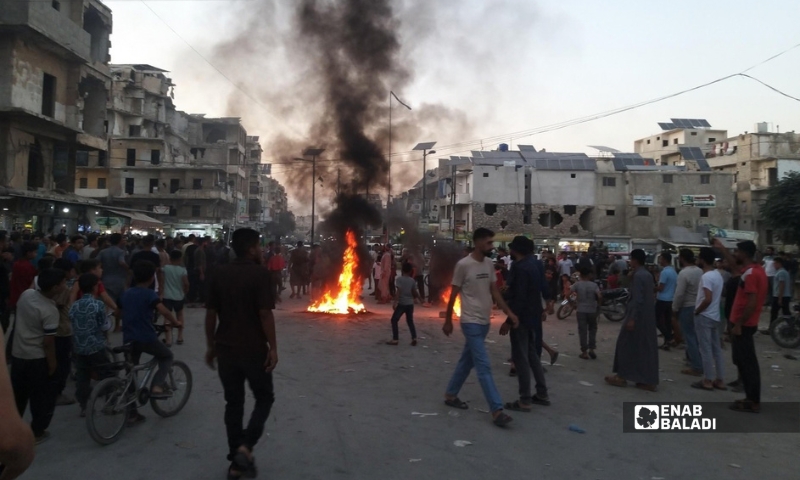
Protests in the Tariq al-Bab neighborhood of Aleppo over rising fuel prices in Syria, September 13, 2026 (Enab Baladi/Mowaffaq al-Khouja).
Syrians Confront Rising Costs
Shock and Fears for the Future
The impact of the fuel price increase in Syria cannot be understood separately from the voices of the public documented by field reporters and consumer protection associations. These accounts revealed a widening gap between official estimates and citizens’ daily experiences, capturing the realities of a public living with the consequences of sudden economic decisions affecting every aspect of daily life.
School students and employees appear to be among the groups most affected, according to Enab Baladi’s monitoring. Minibus fares rose arbitrarily from 30 Syrian pounds (about $0.25) to 50 pounds (about $0.41), bringing the daily transportation cost for a family with two students to between 200 and 250 pounds (about $1.64 to $2.05) for a single minibus route. On a monthly basis, transportation costs reached around 7,500 pounds (about $61.50) per student and 10,000 pounds (about $82) for families with two or three students. Private bus operators contracted to transport students have also raised their fares.
The situation was not much different in other governorates. Abdullah al-Ahmad, a taxi driver, told Enab Baladi’s correspondent in Deir Ezzor that fares within the city’s neighborhoods had risen from 200 Syrian pounds (about $1.64) to 250 pounds (about $2.05), amid a sharp decline in passenger traffic. He called on the government to consider the situation of citizens whose daily income is no longer sufficient to cover their basic needs.
In Suwayda, Enab Baladi’s correspondent observed that bus fares on the Qanawat route had increased from 50 Syrian pounds (about $0.41) to 75 pounds (about $0.61), while taxi fares between Shahba and Suwayda rose from around 200 pounds (about $1.64) to 250 pounds (about $2.05). Fares for public minibuses within the city remained at 50 pounds (about $0.41), with no announced increase as of the time of Enab Baladi’s monitoring.
One taxi driver in the governorate said that on some days he now receives only around two ride requests. He said residents increasingly view taking a taxi as a luxury and prefer walking in order to save money for essential needs.
In Latakia, Enab Baladi’s correspondent found that higher operating costs had led to a sharp increase in transportation fares. The minimum taxi fare for even the shortest trip rose from 250 Syrian pounds (about $2.05) to 400 pounds (about $3.28), prompting many residents to stop using the service..
Price Disparities and Declining Purchasing Power
Enab Baladi correspondents’ field observations across the governorates revealed clear disparities in fuel prices on the open market. In Suwayda, a liter of gasoline was sold for around 340 to 350 Syrian pounds (about $2.79 to $2.87), reaching 400 pounds (about $3.28) in some cases. A liter of diesel ranged between 210 and 220 pounds (about $1.72 to $1.80), with prices reaching as high as 250 pounds (about $2.05). Prices varied among roadside fuel vendors depending on how they obtained their supplies.
A roadside fuel vendor told Enab Baladi’s correspondent in Suwayda that rising prices had “made the situation tighter,” as obtaining gasoline at lower prices had become more difficult. Sales had also declined because of reduced purchasing power. A motorcycle rider who previously bought five liters at a time now purchases only one or two liters, while motorists have reduced their purchases from around 20 liters to seven or ten liters, and sometimes even less.
In Deir Ezzor, Saleh al-Mohammad, who operates a cart selling refined gasoline, said he was shocked when he woke up to news of the fuel price increase, describing it as having come “like a thunderbolt.” He said he sold refined gasoline for 130 Syrian pounds (about $1.07) per liter and noticed strong demand from motorcycle owners. However, he stressed that cars could not use this type of fuel because it had not been processed at an official refinery.
He concluded by saying that the price increase had affected all Syrians and called for prices to be reduced and stabilized.
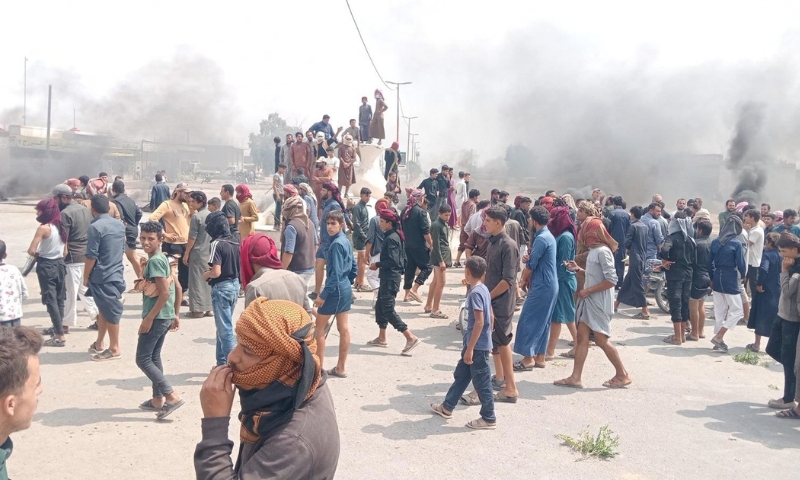
Protests in Raqqa province against higher fuel prices, September 14, 2026 (Enab Baladi/Ahmad al-Hamdi).
Consumer Goods Rise by Between 5% and 10%
In Quneitra (southwestern Syria), farmer Mousa al-Dhiban described the decision as poorly studied, arguing that authorities should have waited and assessed it in light of the circumstances of residents who had already endured difficult conditions after 14 years of war and existing high prices.
Mousa told Enab Baladi that fuel is the lifeblood of daily activity and that higher prices would increase the burden of transportation, agriculture, and the movement of goods and crops. He noted that the price of a bundle of bread had remained unchanged and expressed hope that it would not increase.
He added that people were living in severe poverty and that movement had been paralyzed after the price increase, as most citizens could no longer purchase the quantities of fuel they previously could.
Ahmad al-Ibrahim, a wholesale food trader, said the fuel price increase would affect all goods. He explained that food traders attributed rising prices to several factors, including higher fuel prices, the closure of the Strait of Hormuz, and the rising dollar exchange rate. Together, he said, these factors contributed to higher commodity prices, with some goods increasing by between 5% and 10%.
Prices of red meat and chicken rose significantly because of higher heating and poultry production costs, as well as refrigeration and transportation expenses. The cost of transporting vegetables from wholesale markets to retail stores doubled in some cases, rising from 500 Syrian pounds (about $4.10) to 1,000 pounds (about $8.20).
Extent of Commodity Price Increases
Prices of several basic goods and vegetables varied between provinces, according to price monitoring conducted by Enab Baladi. Immediately after the fuel price increase was announced, prices rose, despite there being no immediate justification for such an increase.
In Damascus, a kilogram of tomatoes was priced at around 40 Syrian pounds (about $0.33), up from between 20 and 30 pounds (about $0.16 to $0.25). Cucumbers reached 60 pounds (about $0.49), up from 40 to 50 pounds (about $0.33 to $0.41), while potatoes rose to 80 pounds (about $0.66), from between 40 and 50 pounds. Meanwhile, the price of a kilogram of pasta remained at around 120 pounds (about $0.98), ghee at 380 pounds (about $3.11), sugar at 90 pounds (about $0.74), vegetable oil at around 240 pounds (about $1.97), and rice at 210 pounds (about $1.72), an increase of around 50 pounds (about $0.41).
In Raqqa, prices of some basic food items showed no significant change, according to traders, although they could rise in the coming period. Vegetable prices, meanwhile, increased by around five Syrian pounds (about $0.04) per kilogram.
In Daraa, a kilogram of long-grain rice cost between 180 and 400 Syrian pounds (about $1.48 to $3.28), an increase of more than 30% compared with previous prices. Short-grain rice was priced at 130 pounds (about $1.07), sugar at 100 pounds (about $0.82), pasta at 150 pounds (about $1.23), flour at 80 pounds (about $0.66), and ghee at 600 pounds (about $4.92). Tomatoes were priced at 30 pounds (about $0.25), cucumbers at 70 pounds (about $0.57), and potatoes at 80 pounds (about $0.66).
In Latakia, as in Damascus, a kilogram of rice cost around 120 Syrian pounds (about $0.98), sugar 90 pounds (about $0.74), pasta 110 pounds (about $0.90), flour 70 pounds (about $0.57), and ghee 325 pounds (about $2.66). Tomatoes were priced at 35 pounds (about $0.29), while cucumbers and potatoes each cost 70 pounds (about $0.57).
In Aleppo, price increases for some goods ranged between 20 and 50 Syrian pounds (about $0.16 to $0.41). In Deir Ezzor, a kilogram of rice used for kabsa cost between 230 and 250 pounds (about $1.89 to $2.05), while regular rice was priced at around 120 pounds (about $0.98) and pasta at around 110 pounds (about $0.90) per kilogram.
Winter Fears and a Looming Heating Crisis
Higher petroleum product prices have intensified public fears over heating costs during the coming winter. Several Suwayda residents told Enab Baladi that securing heating fuel had been difficult even before the latest increase, and they now fear they will be unable to purchase the quantities they need this year.
According to residents’ approximate estimates, a household needs at least five liters of diesel per day for heating, bringing the daily cost to around 1,000 Syrian pounds (about $8.20).
Several people said some families had begun collecting cardboard and cloth to use for heating because they could not afford fuel. Securing heating diesel has become even more difficult for families that lost their sources of income or their homes during the events of July 2025.
Internal Trade Offers a Different Account: No Price Increases
Hassan al-Shawa, director of the Consumer Protection and Food Safety Directorate, told Enab Baladi that no significant increase in the prices of basic goods and commodities had been recorded in markets. He said this was because the fuel price adjustment was still in its early stages and had not yet directly affected local products and markets.
Al-Shawa added that, based on the results of periodic price surveys, indicators showed that prices, particularly those of basic goods, remained within normal ranges and that no citations or violations had been recorded in this regard.
Regarding measures to protect consumers against exploitation and price increases, al-Shawa said the Consumer Protection Directorate uses its Prices Department to conduct price surveys and determine indicative average prices across all provinces. Based on those indicators, inspectors conduct field monitoring and directly issue citations for “selling above the price” against anyone found to be unjustifiably raising prices or exploiting the decision.
Al-Shawa said recent field inspections showed general stability in market activity and prices, with no significant or unjustified increases recorded in basic goods. Consumer protection directorates in all provinces were instructed to intensify inspection campaigns through their field teams to identify violations, regulate markets, and prevent exploitation of the current circumstances.
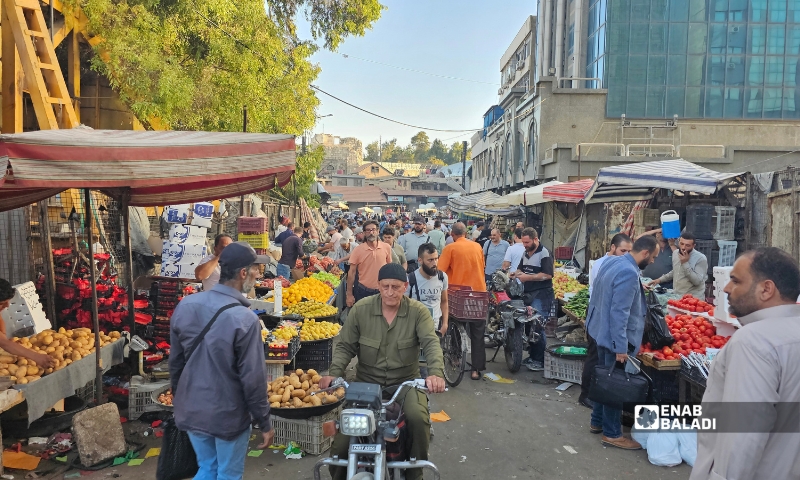
The old wholesale produce market in Damascus, September 17, 2026 (Enab Baladi/Ahmad Maslamani).
Patchwork Decisions Made Behind Desks
Where Does the Problem Begin and Where Does Its Impact End?
Abdul Razzaq Habza, secretary of the Consumer Protection Association, described the situation from the first morning hours after the decision was issued as an immediate shock accompanied by widespread confusion, contrary to government expectations that the negative effects would take longer to emerge.
According to Habza, the decision, which raised diesel prices by between 20% and 40%, gasoline by around 20%, and household gas by 7%, was introduced without a prior assessment of its social, psychological, and financial effects on citizens whose ability to adapt had already reached its limits.
Habza said the immediate repercussions included noticeable paralysis across vital sectors. Public and school transportation vehicles either stopped operating or arbitrarily raised fares, while the association’s field inspections, which covered between 20 and 30 samples, documented widespread frustration and disputes between drivers and passengers as traffic patrols mobilized to issue violations.
Habza linked this confusion to delays in circulating official fares through stickers displayed on vehicle windshields, a measure he said should have preceded the decision to reassure everyone. The delay led most taxis to stop operating and passengers to avoid using them.
The Consumer Protection Association secretary said food supply monitoring authorities were unable to control or reduce prices because laws governing the free economy limit their powers to requiring prices to be displayed and combating fraud and deception. They do not have the authority to issue violations over price increases resulting from market movements, particularly when government decisions are the main cause of those increases.
Habza believes the fundamental problem lies in how the crisis is being managed and in the timing of what he described as desk-based, patchwork decisions that surprised citizens without preparation or giving them time to arrange their household finances.
He said these developments raised serious questions about the absence of proactive measures and planning within the government team. With early awareness of global oil price trends, he argued, authorities should have built strategic reserves during stable periods to absorb the price shock or delay its consequences instead of shifting the entire burden onto consumers.
Developments Threaten Livelihoods Across the Provinces
The impact does not stop with the transportation sector but extends into every aspect of daily life.
Economic researcher Ammar Youssef believes the government made a mistake by using energy sources such as gasoline, diesel, fuel oil, and electricity as a tool to address spending needs.
Youssef told Enab Baladi that the problem is not the higher price of gasoline or diesel itself, but its economic repercussions, from transportation fares to food prices and the costs of living and production. He said the 40% increase in gasoline prices had affected various sectors and estimated that prices of some goods could rise by as much as 60% or 70%.
He added that living standards in Syria were already low amid high poverty rates, making any new increase in transportation and energy costs an additional burden on citizens. He argued that government spending should not come at the expense of the public.
According to the economic researcher, citizens will be forced to give up some goods they can no longer afford, including basic items in the food basket, leading to a further decline in purchasing power.
“Citizens will be forced to give up some goods they can no longer afford, including basic items in the food basket, leading to a further decline in purchasing power.”
Ammar Youssef
Syrian economic researcher
Concern Over Recession in the Syrian Market
Economic researcher Ammar Youssef warned that lower demand for goods could affect market activity, slowing production, trade, and supply chains and potentially leading to recession in the Syrian market, particularly as citizens’ purchasing power declines.
“Lower demand for goods could affect market activity, slowing production, trade, and supply chains and potentially leading to recession in the Syrian market.”
Ammar Youssef
Syrian economic researcher
Youssef expected the impact of higher fuel prices on commodity prices to continue even after fuel prices stabilize. He explained that the effects of the increase could take around a month to spread across different sectors before the full picture of new price levels becomes clear, particularly as previous experiences suggest another wave of price increases could occur.
Youssef also expected prices of basic goods, vegetables, and fruit to rise in the coming period. He called for these indicators to be monitored alongside transportation fares, which, if they rise, could in some cases restrict the movement of people and vehicles. He noted that higher transportation costs could prompt citizens to reduce their use of private transportation because of the increased expense.
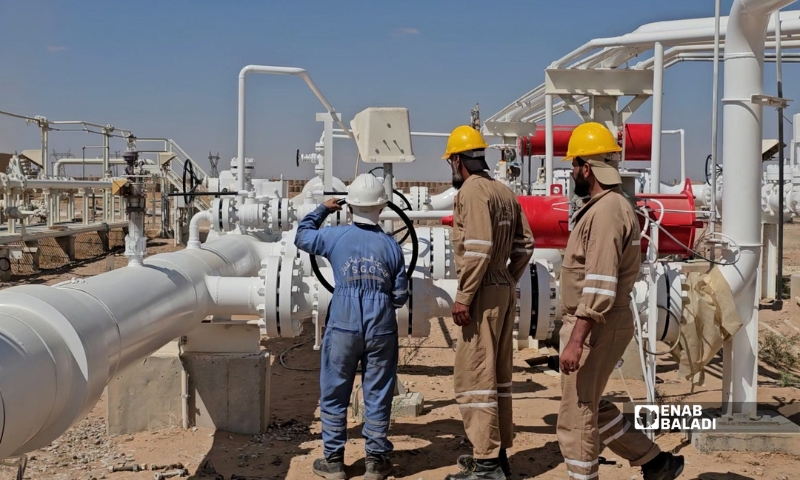
Restarting operations at the Conoco gas field, September 1, 2026 (Enab Baladi/Jassem al-Abdullah).
Lack of Partnership Between the Economy and Civil Society
Habza criticized the lack of participation by civil society and the Consumer Protection Association in highly sensitive economic decisions, noting that the association had presented its official position and called for advance planning and precautionary measures.
Faced with the large number of complaints and appeals received by the association, despite having no executive authority to reduce prices, it proposed urgent measures to ease public frustration, Habza said. These included emergency grants to citizens, such as heating or transportation allowances or any other suitable government support to ease living pressures. The association also stressed that protests should remain rational and peaceful and rejected irrational behavior or rioting.
Habza said government assurances that the price increase was temporary were “open to doubt.” He questioned whether the authorities could guarantee that prices would be reduced again if the refinery resumed operations or global prices fell, particularly given a fragile economy that has been rapidly and severely affected by regional and international developments.
Syrian Energy and Transport Ministries “Absent”
Enab Baladi sent questions to the Ministry of Energy about violations it had recorded following the fuel price increase, their number, the measures taken to control them and prevent price manipulation, and the mechanism for receiving citizens’ complaints. The ministry had not responded by the time this report was prepared.
Regarding freight transportation costs, Enab Baladi sent questions to the Ministry of Transport about the effect of higher fuel prices on transportation fees, the percentage increase in freight costs, how those increases affect final commodity prices, how the increase is calculated, and whether it varies according to transportation distance and vehicle type. The ministry had not responded by the time this report was prepared.
However, the Syrian Arab News Agency, SANA, quoted Khaled Kasaha, director of the Freight Transport Regulation Directorate at the Ministry of Transport, as saying on September 13 that the new adjustment to petroleum product prices, particularly diesel, had significantly affected freight movement.
Kasaha added that transportation activity following the decision had almost completely stopped in several provinces, coinciding with “strikes by a number of truck owners,” negatively affecting freight movement through border crossings and ports.
He said higher diesel prices would lead to:
- A significant increase in the operating costs of freight vehicles.
- Higher prices for various transportation inputs, including drivers’ wages, tires, maintenance, spare parts, and other vehicle operating costs.
- Greater burdens on carriers, affecting freight movement between provinces and through crossings and ports.
Kasaha said the ministry was preparing a comprehensive study examining freight rates, weak transportation activity, and the impact of higher fuel prices on transportation charges. The study aims to present the current situation and the costs borne by carriers before referring the matter to the relevant authorities to reach an appropriate solution.