

Mohammed Jaffal | Ghena Jabr | Nour Kassem
As the 2026-2027 school year begins, education in Syria faces a range of challenges involving schools’ capacity to accommodate students, the stability of teaching staff, the availability of textbooks and supplies, and efforts to unify curricula across different regions after years of multiple educational authorities.
According to the Ministry of Education, the number of students enrolled in schools has risen to about 5.291 million during the current school year, compared with about 4.125 million in 2025, and is expected to reach about six million next year.
The challenges facing education are not limited to the growing number of students. Many schools still require rehabilitation, families face the burden of school uniforms and supplies, and teachers are under pressure over salaries and job stability.
At the same time, the Ministry of Education is working to unify curricula across the country’s governorates, introduce Kurdish into the education system in areas with high concentrations of Kurdish residents, and develop a national curriculum framework.
5.3 Million Students Return
Damaged Buildings Compound Enrollment Challenges
The number of students attending schools this year reached about 5.291 million, compared with around 4.125 million in 2025, while the Ministry of Education expects the figure to reach approximately six million next year.
According to UNICEF data for 2025, about 2.4 million children are out of school, while about 1.6 million are at risk of dropping out, compared with about 4.2 million children enrolled in education.
Difficulties in accessing education are linked to factors including insecurity, poverty, displacement, and disability.
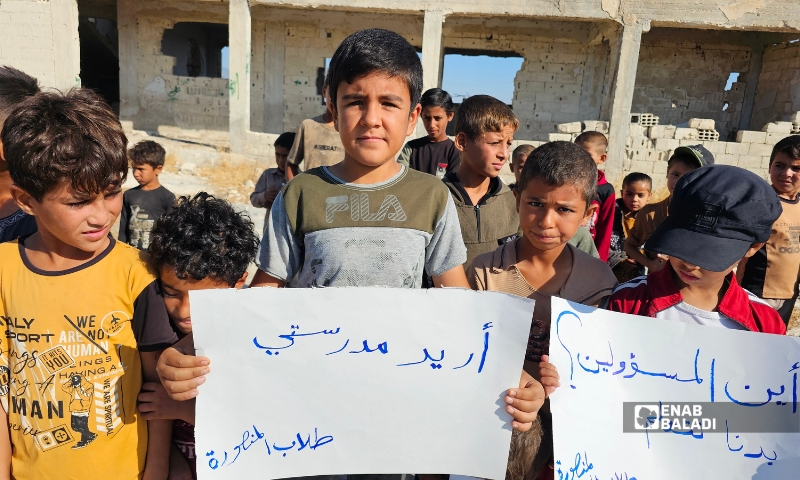
Children hold signs during a demonstration in Mansoura village, rural Hama (central Syria), demanding the rehabilitation of their village school, September 9, 2026. (Enab Baladi)
One-Third of Syria’s Schools Out of Service
UNICEF data for 2026 indicate that about one-third of schools in Syria are out of service, while nearly 8,000 schools remain unfit for use because of partial or total damage, or because they are being used as shelters or collective accommodation centers.
The Ministry of Education acknowledges that some schools do not have enough desks, while others have temporarily adopted double-shift schedules because of increased student numbers.
Gap in Schools That Can Operate Safely
Hatem Stout, secretary of the Damascus branch of the Engineers Syndicate, said the problem with school buildings is not simply the number of schools available, but whether those schools can operate safely and effectively.
According to Stout, the priority is to restore the operational capacity of the existing school network before determining the actual shortfall that requires the construction of new schools.
He said the problem goes beyond structural damage. Some schools are damaged or destroyed, others have been used as shelters, while still others lack electricity, water, sanitation, equipment, furniture, and suitable learning spaces.
Mohammad Hanoun, director of educational buildings at the Ministry of Education, said rehabilitation and maintenance work had been completed on about 1,680 partially or fully damaged school buildings, returning them to service, while 465 buildings are undergoing routine maintenance.
“Engineering assessments of schools showed that the nature of the damage varied according to the circumstances in each area.”
Mohammad Hanoun
Director of Educational Buildings at the Ministry of Education
According to Hanoun, damage is primarily classified into two categories. The first is total structural destruction, which is more common in areas that experienced intensive military operations and requires complete reconstruction. The second is partial damage, such as limited cracks, vandalism, or the theft of windows, equipment, and desks, while the building’s structural frame remains usable after repairs.
Hanoun explained that partially damaged buildings are given priority in rapid rehabilitation plans because they can be prepared and returned to service in a shorter period.
He added that rehabilitation is preceded by engineering assessments and detailed technical studies to ensure structural safety, while restoration work is carried out by the government, local and international organizations, and local communities.
Capacity Rather Than the Number of Schools
Stout said determining educational needs should not depend solely on the number of damaged schools, but on schools’ actual capacity.
He gave the example of a school designed for 600 students that can currently accommodate no more than 300, explaining that the shortfall in this case is 300 student places, not “one school.”
Stout proposed classifying buildings according to the level of damage and risk, restricting the operation of schools with clear structural hazards until those risks are addressed.
Schools that are structurally sound but suffer from significant deficiencies can receive rapid interventions, with conditional and monitored operation allowed after safety has been verified.
For schools that can operate but suffer from weak services or an inadequate learning environment, Stout suggested carrying out rehabilitation in stages. Schools without major safety or operational problems, meanwhile, need regular preventive maintenance.
Stout also pointed to the possibility of temporary safe operation in some schools that do not meet every ideal condition, provided there is no immediate danger to students or teaching staff.
He linked this approach to the need to address electrical and fire hazards, secure water and sanitation, doors and windows, and minimum levels of heating, ventilation, and lighting, while setting a clear timetable for completing rehabilitation and monitoring implementation.
“When a school is not ideal but faces no immediate structural or operational danger, the concept of temporary safe operation can be adopted instead of automatically closing it.”
Hatem Stout
Secretary of the Damascus Branch of the Engineers Syndicate
Schools Turned Into Shelters
According to UNICEF field and humanitarian updates this year, at least 259 schools have been used fully or partially as collective shelters.
In al-Hasakah (northeastern Syria), some schools were taken out of service because they were being used as shelters, in addition to widespread rehabilitation and maintenance needs resulting from years of war and administrative division.
On May 23, al-Hasakah Education Director Adnan Barri said repeated waves of displacement had led to some schools being used as shelters, causing additional damage. He said the directorate had asked international organizations for help preparing schools before the start of the academic year.
On March 31, UNICEF warned about the continued use of schools in Hasakah as shelters, saying this posed a challenge to the normal resumption of education.
The warning followed a visit by UNICEF Deputy Representative Zeinab Adam to camps and shelters. She said the occupation of schools deprives children of formal education, places additional pressure on the education system, and increases the risk of school dropout amid limited alternatives.
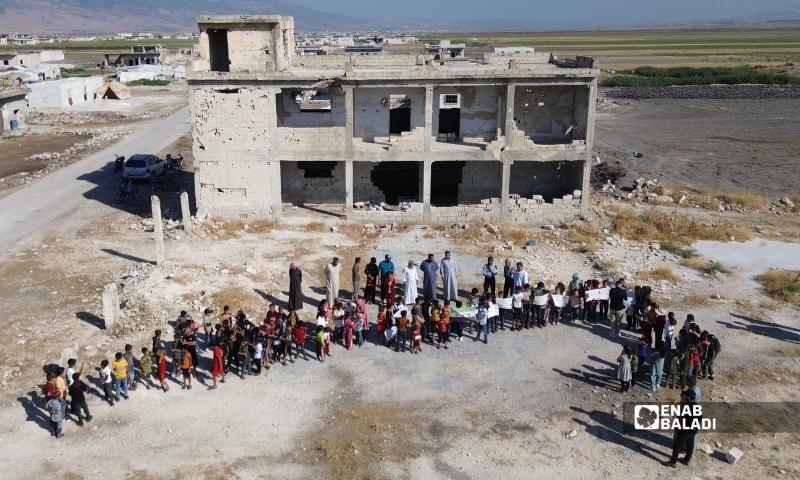
Students and their families hold a protest in Mansoura village, rural Hama, calling for the rehabilitation of the village school, September 9, 2026. (Enab Baladi)
Textbooks, Uniforms, and Living Conditions
Students, Teachers, and Families Under Pressure
Khaled al-Khalaf, director general of the al-Wahda Establishment, said, according to official media, that the establishment had signed a contract with the General Establishment for Printing to print more than one million school textbooks at al-Wahda’s printing presses. He said substantial quantities had been completed without giving a final figure.
The General Establishment for Printing printed and distributed around 24 million copies of school textbooks during the 2025-2026 school year.
According to a Ministry of Education circular obtained by Enab Baladi, new textbooks are distributed to students in grades seven through nine at schools for outstanding students according to student numbers in the various governorates.
Free textbook distribution covers students in basic education from grades one through nine at public schools.
Books provided by UNICEF may also be used, in coordination with the director of the General Establishment for Printing in each governorate, according to a distribution plan prepared in advance.
Books returned from schools for outstanding students during the previous year are also reused after the education directorate determines their condition and the level of need.
The circular stipulates that new books should be distributed starting with older editions and moving to newer ones.
For grades one through three, new books are distributed according to student numbers, except for art and music textbooks. Usable returned books are reused and any shortages are covered with new books.
For grade four, new books are distributed according to student numbers, except for art, music, Islamic education, and social studies textbooks. Usable returned books are reused, with shortages covered by new copies.
For grades five and six, usable returned textbooks are reused and shortages are covered by new books, while each student receives a new English-language activity workbook.
For grades seven through nine, usable returned textbooks are reused and shortages are covered with new books, while new English and French activity workbooks are distributed according to student numbers.
Textbook provision during the current school year therefore relies on a combination of newly printed books and returned books suitable for reuse.
School Uniforms Add to Families’ Burdens
School uniforms present an additional challenge for families at the start of the academic year amid difficult economic conditions and rising living costs.
The Ministry of Education is not currently enforcing a strict school uniform requirement because some families cannot afford new clothing, particularly households with three to five school-age children.
Abdul Razzaq Habza, secretary of the Consumer Protection Association, said adherence to a school uniform is important for ensuring equality among students because families have different financial means.
Habza told Enab Baladi that some better-off families can buy new clothes for their children, while school uniforms are supposed to be standardized among students.
He said the association had contacted the Ministry of Education to request more flexibility over uniform requirements during the first part of the school year, with stricter enforcement to follow later.
Habza said easing the requirement at the beginning of the year could be justified by families’ economic conditions as they also prepare winter supplies and buy heating diesel, before school uniforms become another financial priority.
“Everything has its priority, whether winter provisions, heating, or even securing school uniforms for children.”
Abdul Razzaq Habza
Secretary of the Consumer Protection Association
Education Quality Starts With Teachers and Classrooms
Education quality is not determined solely by the number of schools and students. According to Azzam Khanji, a member of the Higher Education Committee in the People’s Assembly and head of the MIDAD al-Maarifa organization, it is linked to indicators including class size, the stability of teaching staff and vacancy rates, teacher and student absences, teacher qualifications and training, and the availability of textbooks, teaching tools, laboratories, and basic equipment.
Khanji said quality indicators also include the use of teaching methods that involve students in the learning process, as well as students’ test results.
He said four main factors inside the classroom affect education quality: the number of students, the teacher’s command of the subject and teaching methods, differences in students’ levels, and the availability of textbooks, learning tools, and an appropriate classroom environment.
Khanji also pointed to psychological factors, saying economic and social pressures and the effects of war can affect students’ ability to learn.
Regarding differences between public and private education, and between cities and rural areas, Khanji said disparities exist but cannot be generalized across all schools because they depend on resources and the surrounding environment.
He said some private schools have fewer students, better resources, and more stable staff, while differences between rural and urban areas are more evident in access to teachers and educational resources.
Priorities for the School Year
Khanji said the 2026-2027 school year requires practical measures, foremost among them reducing overcrowding in classrooms where teachers cannot adequately follow students’ progress, and increasing the number of teachers.
He also called for practical teacher training in interactive education, modern teaching methods, the use of educational tools, classroom management, assessment, and addressing learning loss.
There are no final estimates for the number of teachers required, but shortages are evident in certain areas and specializations, alongside problems with teacher distribution.
Khanji said a large proportion of teaching staff have academic and educational qualifications, while training opportunities for others were damaged by years of war, creating gaps in professional preparation.
He said the most significant gaps include the need to modernize teacher-training curricula and expand the use of educational technology.
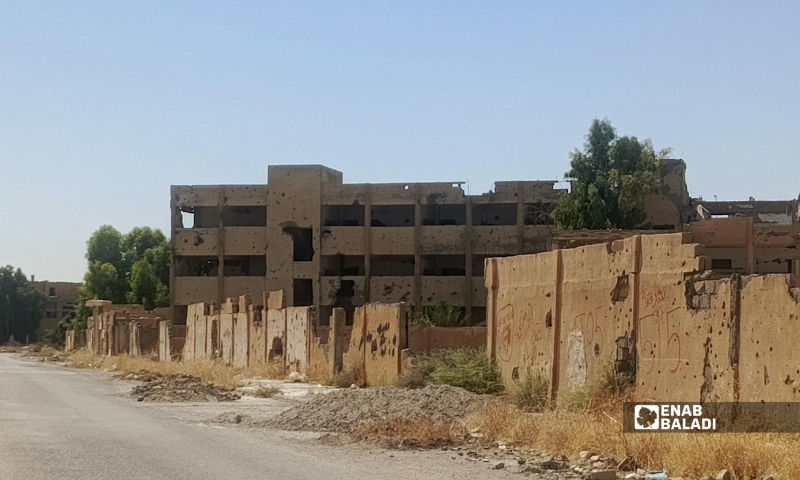
Damage to a school in the Khasarat neighborhood of Deir Ezzor, September 9, 2026. (Enab Baladi)
Interactive Learning in the Classroom
Khanji defined interactive education as moving students from the role of listener to that of participant in the learning process, noting that it can be applied even when resources are limited.
He gave an example from Arabic-language instruction: asking a question, giving students time to think, dividing them into small groups to analyze a short text, presenting, discussing, and correcting the results, and then asking a final question to check understanding.
Khanji said this type of education does not necessarily require laboratories or devices. Instead, it requires a change in classroom management so that the goal is not simply to make students talk more, but to increase thinking and practical application.
“Priority should focus on reducing overcrowding in schools and increasing the number of teachers, alongside teacher training.”
Azzam Khanji
Member of the Higher Education Committee in the People’s Assembly
Teachers Between Stability and Protest
Teacher protests monitored by Enab Baladi come amid a range of demands related to integration procedures, contracts and their renewal, job stability, low incomes compared with living costs, delays in some payments, and disparities or lack of clarity in certain areas.
Khanji proposed several solutions, including establishing a clear and stable system for contracts, renewals, and permanent appointments, adopting a unified salary scale that preserves real income, providing meaningful allowances and incentives for those working in remote areas, and creating an institutional dialogue channel through which teachers’ demands can be discussed before protests occur.
Salary Increases Are Not Enough
The Ministry of Education issued implementation instructions for a substantial increase in wages for education-sector workers, with the amount varying by job title and legal status, along with allowances of 15% and 10% for remote and semi-remote areas, respectively.
The increase comes amid rising living costs and declining purchasing power.
Abdulrahman Mohammad, a professor of finance and banking at Hama University, said teacher salaries vary according to years of service, category, and grade, while periodic increases are granted every two years. Their actual impact remains limited, however, because of the decline in the value of the Syrian pound and the outdated wage structure.
Mohammad estimated that the salary of a newly appointed teacher, after the cost-of-living allowance, may in some cases reach around $200 a month, while pay for additional teaching hours does not, in his assessment, provide a sufficient incentive because of its low value.
He also said allowances for the nature of the work, transportation, and health are limited and in some cases do not cover daily commuting costs.
Mohammad defined purchasing power as a salary’s ability to cover a basket of basic goods and services relative to local prices and the exchange rate.
He estimated that a teacher’s salary covers only a small share of the basic needs of a small family, and said an appropriate minimum salary should range from $300 to $400 a month, linked to the cost-of-living index and exchange rate rather than fixed at a set amount.
Mohammad said salaries should enable teachers to do without private tutoring, which has become a primary source of income for many teachers.
He stressed that raising salaries is necessary but insufficient on its own, calling for improvements to the school working environment and non-financial incentives, including permanent employment, effective health insurance, training, and professional development, alongside improving the social standing of the teaching profession.
He also called for addressing the prevalence of private tutoring and investing in curricula and technology to ease the burden on teachers and improve educational outcomes.
Mohammad said serious economic measures should be part of a comprehensive reform of the education sector, rather than simply salary increases that are eroded by inflation.
Education Budget and the Scale of Needs
The Ministry of Education’s budget for the current year stands at about 7.8 trillion Syrian pounds in current and investment appropriations, according to published figures.
Using the parallel-market exchange rate adopted in his estimate, Mohammad put its value at about $500 million to $600 million, describing this amount as modest compared with the scale of needs.
Mohammad estimated that about 75% to 80% of the budget goes to salaries and compensation, while buildings and rehabilitation receive 8% to 10%, textbooks and curricula 3% to 5%, and training less than 2%.
Investment spending remains limited and is concentrated largely on partial maintenance and providing furniture.
Mohammad compared Syria’s needs with the experiences of countries emerging from conflict, including Iraq after 2003 and Bosnia. He noted that Syria had a relatively strong education infrastructure before the war, meaning reconstruction depends on the scale of damage and resources available.
He said current spending does not match the scale of the crisis, given the damage to schools, the departure of hundreds of thousands of teachers from the education system because of migration or wartime conditions, and rising dropout rates.
Mohammad estimated education spending at about 2% to 3% of gross domestic product, compared with what he described as a commonly cited global range of 4% to 6% for education spending.
Among his spending priorities, he listed ensuring an adequate minimum income for teachers and bringing staff back into the system, potentially benefiting from conditional external support, rehabilitating the most damaged schools to increase capacity, prioritizing basic education in the poorest areas and among displaced people, providing textbooks and stationery to reduce dropout rates, and developing vocational and technical education linked to the labor market.
“The teacher crisis in Syria is no longer simply a wage problem, but a structural crisis reflecting the collapse of the social contract between the state and education personnel.”
Abdulrahman Mohammad
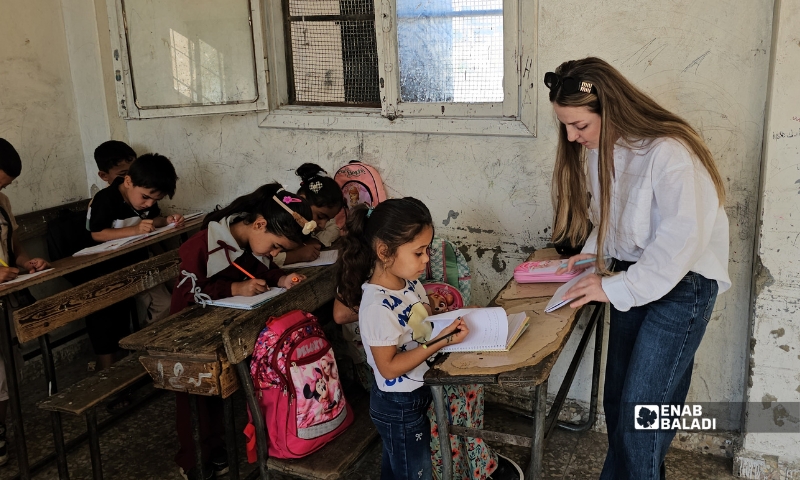
Professor of Finance and Banking at the Faculty of Economics, Hama UniversityA teacher checks new students’ notebooks in a classroom at al-Aziziyah School in Hama as the school year begins, September 6, 2026. (Enab Baladi)
Addressing Educational Division
From Multiple Curricula to a Single Reference
Syrian curricula are entering a new phase in the 2026-2027 school year, with the Ministry of Education announcing the adoption of unified curricula across all governorates.
The ministry decided that the “Damascus curriculum” used during the 2025-2026 school year would continue to be used in 2026-2027, while work proceeds on national curriculum standards before moving to the curriculum-writing stage.
Qassem al-Saleh, an expert in educational sciences, said curriculum unification is a necessary step. He added that a unified curriculum during the transitional period provides a common reference for students, teachers, and examinations, but its real value will emerge when the process moves from standardizing textbooks to building a national curriculum that responds to differences among regions and students and addresses learning loss.
According to the National Center for Curriculum Development, work at the end of 2025 included preparing the general curriculum framework, vocational education, teachers’ guides, adapting curricula to the needs of people with disabilities, and incorporating artificial intelligence into the development process.
Al-Saleh said a curriculum is not limited to textbooks, but also includes objectives, content, teaching methods, assessment, and teacher training.
According to al-Saleh, changing textbooks without training teachers, developing assessment, and addressing learning loss does not necessarily change students’ educational levels.
UNICEF says about 2.45 million children are out of school, while approximately 7.5 million children need humanitarian assistance.
At the end of 2025, an intensive and flexible “Category B” curriculum was launched for students who had dropped out or fallen behind academically. It allows a student to complete two school years in one year with the aim of returning to formal education.
Al-Saleh said this track differs from the traditional curriculum and requires determining a student’s actual level rather than relying only on age or the grade in which the student was previously enrolled.
He stressed that addressing learning loss should not be a temporary measure, but an ongoing policy within the education system.
“Unifying curricula in Syria is a necessary step to address educational division, but it does not mean the curriculum problem has been resolved.”
Qassem al-Saleh
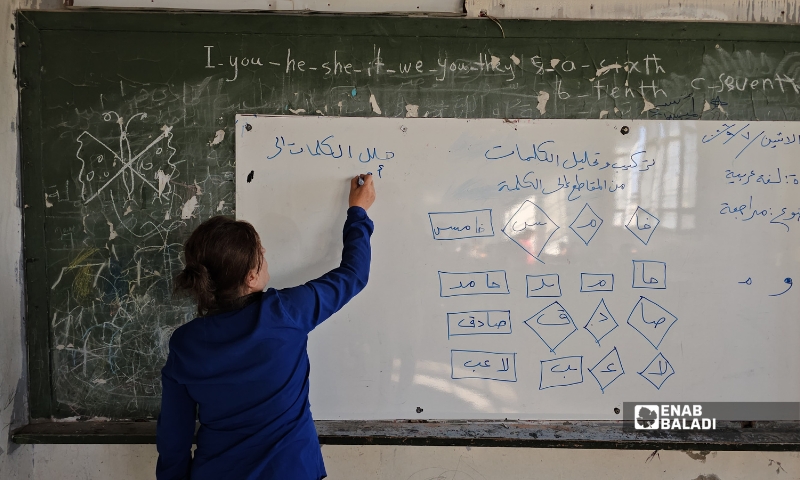
Expert in Educational SciencesA teacher begins reviewing lessons in a classroom at al-Aziziyah School in Hama as the school year begins, September 6, 2026. (Enab Baladi)
Curricula in Northeastern Syria
Areas of northeastern Syria have in recent years used curricula issued by the “Autonomous Administration,” leading to differences in educational content and reference frameworks between regions.
Under Decision 1617, the Ministry of Education allowed students who had previously studied under the Autonomous Administration’s curricula to take lower-secondary and general secondary certificate examinations during the 2025-2026 and 2026-2027 school years.
Education policy researcher Abdul Majid Ali said the measure represents a transitional solution intended to protect students’ right to education rather than hold them responsible for differences between the curricula they studied.
Ali said having a unified educational reference could make it easier for students to move between schools and reduce disparities related to certificates and examinations, although its success depends on how it is implemented.
He added that the real challenge begins inside the classroom because standardizing textbooks does not automatically produce equal educational capacity when schools differ in equipment, teachers, books, and learning tools.
Kurdish Language Tests the Education System
On August 25, the Ministry of Education announced that Kurdish would be adopted as an optional subject for two classes a week. On August 27, it amended the decision to three classes a week in public and private schools in areas with high concentrations of Kurdish residents, alongside Arabic and English.
Kurdish grades are included in students’ final overall scores, while one class per week is allocated to activities.
The ministry tasked the National Center for Curriculum Development with preparing Kurdish-language curricula for all educational stages. During the first school year, students will be able to choose to study social studies, history, geography, and philosophy in either Arabic or Kurdish.
Since January, the center has been preparing the Kurdish curricula through specialists, following stages that include setting standards, writing, review, approval, and printing.
Al-Saleh described the introduction of Kurdish as an “important educational test” that combines a unified educational framework with linguistic distinctiveness.
He said including Kurdish within the national curriculum does not mean creating two education systems as long as there is a single set of national standards and the language is incorporated within them, allowing students to transfer between schools.
Al-Saleh stressed that preparing a Kurdish curriculum cannot simply involve translating Arabic curricula. It requires its own objectives, content, teaching methods, textbooks, and assessment system within the national framework.
Under the ministry’s plan, Kurdish-language curricula are being prepared for all stages, while teaching staff will be recruited through internal and external lists and undergo written and oral examinations, along with training and qualification programs.
Al-Saleh said qualified teachers are the key factor in the success of the initiative. Because the subject contributes to students’ final scores, he said, it must have textbooks, qualified teachers, and a clear assessment system.
Are Unified Curricula Enough?
Ali said curriculum unification addresses only one aspect of the problem and does not eliminate disparities among students.
According to Ali, equality cannot be achieved through a unified textbook alone. It also requires comparable access to schools, qualified teachers, books, educational tools, and support programs.
The Ministry of Education announced that about 24 million textbooks were printed for the 2025-2026 school year, alongside approximately seven million recycled books, while an early plan for 2026-2027 relies on automated distribution and book tracking.
Ali said getting textbooks into students’ hands is part of educational equity, but is not enough if teachers cannot use them effectively, the school environment is unsuitable, or students suffer from learning loss.
“Having a well-equipped school and a textbook does not guarantee the same outcome if the teacher is not specialized, the classroom is overcrowded, or the student has a major learning gap.”
Abdul Majid Ali
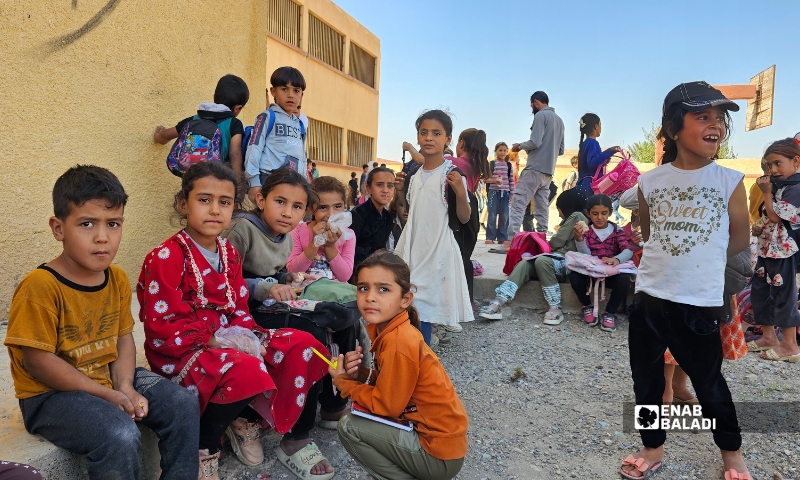
Education Policy ResearcherStudents in the courtyard of al-Salihiya School in Deir Ezzor amid a lack of desks, rehabilitation, and basic services, September 10, 2026. (Enab Baladi)
Toward Education That Goes Beyond Returning Students to School
Alongside curriculum unification, the Ministry of Education faces issues linked to the effects of war, students’ return to school and dropout rates, vocational education, teaching methods, inclusion of people with disabilities, and the use of educational tools and technology.
Al-Saleh said the success of the education system should not be measured only by the number of students attending school, but by their actual educational levels.
He proposed regularly assessing reading, writing, numeracy, and other basic skills and providing targeted support for students who show learning gaps.
Ali said education policy in Syria needs to go beyond curriculum unification because years of educational division require a multiyear policy with measurable goals for curricula, teaching staff, learning-loss recovery, vocational education, and technology.
The Ministry of Education says the National Center for Curriculum Development is also preparing a framework for vocational education, content and textbook standards, authors’ guides, teaching strategies, interactive education, and educational platforms.
Al-Saleh said vocational education can connect schools with students’ needs and the labor market, while Ali said digital tools and modern technology can support education but cannot replace schools or teachers.
The outcome of curriculum unification therefore depends on whether it leads to the rebuilding of a single education system or remains limited to standardizing textbooks and procedures.
Al-Saleh said the initiative’s success should not be measured solely by whether students have the same textbooks, but by whether Syrian students, wherever they are, receive a comparable right to a quality education.
Ali summarized the issue by saying that reopening a school means restoring a place for education, while rebuilding education means restoring the school’s function itself, allowing it to give students knowledge, skills, and a fair opportunity to continue their lives.
From Restoring Schools to Restoring Their Role
The return of students to schools in Syria does not appear to mark the end of the partial disruption education suffered during the years of war. Instead, it is the beginning of a test of the education system’s ability to restore its basic functions, as rising student numbers place pressure on school capacity and rehabilitation.
At the same time, education quality cannot be separated from teachers’ conditions. Staff stability, improved working conditions and wages, and training are directly linked to schools’ ability to handle growing student numbers and address accumulated learning loss.
Curriculum unification, meanwhile, opens an issue broader than simply standardizing textbooks. It involves establishing a unified educational reference while preserving students’ linguistic and cultural particularities.
Between rehabilitating buildings, improving teachers’ conditions, and developing curricula, rebuilding education, according to experts who spoke to Enab Baladi, depends on institutions’ ability to move from addressing urgent needs toward building a long-term education policy that measures success by what students actually learn, not merely by whether they return to their school desks.