


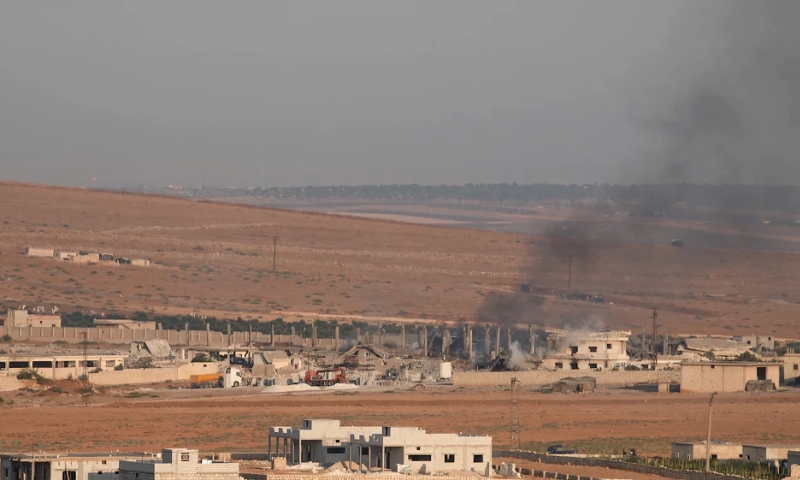
 Smoke rises from a weapons depot after an explosion in al-Eis village, southern Aleppo countryside, September 21, 2026 (Reuters)
Smoke rises from a weapons depot after an explosion in al-Eis village, southern Aleppo countryside, September 21, 2026 (Reuters)
Enab Baladi, Yazan Kur
Weapons and ammunition depots and storage sites have repeatedly exploded across different parts of Syria during September, leaving people dead and injured and raising questions about the causes of the incidents and the handling of large quantities of weapons and ammunition left over from years of war or seized during military operations.
The incidents began on September 1, when a vehicle loaded with ammunition exploded while it was being transported at the western entrance to Binnish (Idlib governorate, northwestern Syria). Another incident was recorded on September 9 inside a temporary weapons and ammunition depot near Sarmada, in northern Idlib.
On September 12, an explosion occurred inside an ammunition depot in al-Dumayr (Rural Damascus), where authorities said the ammunition was damaged and awaiting dismantlement.
On September 18, a similar incident occurred inside an ammunition depot at a military barracks belonging to the Ministry of Defense’s Armament Directorate near Ayyash (western Deir Ezzor, eastern Syria), followed by successive explosions. On September 21, the area around al-Eis (southern Aleppo countryside) also witnessed a series of explosions inside an ammunition depot.
The incidents occurred across Idlib, Rural Damascus, Deir Ezzor and Aleppo under different circumstances. Some involved damaged ammunition or temporary depots used to collect weapons and remnants of war, while the causes of others remained under investigation.
Their close timing has brought renewed attention to questions surrounding the management of weapons and ammunition, the assessment of their technical condition, and the procedures for transporting, storing and disposing of damaged materiel.
Security and military affairs researcher Nawar Shaban Qabaqibo linked the repeated incidents to technical and logistical problems involving large quantities of ammunition seized during military takeover and territorial control operations.
Qabaqibo told Enab Baladi that the close timing of the weapons depot explosions could indicate possible acts of sabotage, but said timing alone was not sufficient to prove that hypothesis.
He added that sabotage remained a possibility, but that there were also factors related to the technical condition of large quantities of ammunition previously stored under technical and logistical conditions unknown to the parties that later took possession of it.
According to Qabaqibo, ammunition is subject to technical classification that determines its condition, while improper storage or transportation can cause its condition to deteriorate through exposure to dust, moisture and high temperatures.
He said some ammunition may deteriorate to the point that it must be destroyed rather than stored again, adding that transporting damaged ammunition or storing it alongside serviceable ammunition without assessment, classification and sorting increases the risks.
Handling and disposing of remnants of war requires specialized expertise, according to the researcher, particularly when the quantities are large and diverse and include weapons and ammunition in different technical conditions.
Qabaqibo does not believe the problem is limited to the quantity of ammunition, but also includes how it is handled after being seized.
He said some armies or armed factions may mine depots or shell them while withdrawing to prevent an adversary from benefiting from their contents. In Syria, however, the danger is also linked to the collection of weapons, military equipment and captured materiel and their random, unregulated accumulation.
He stressed that acquiring weapons and ammunition does not mean they should be stockpiled without controls, pointing to the need to classify them and handle them according to their technical condition.
Citing standards for storing mines, he said their detonators should be removed and stored separately, mines should be classified by type, fuzes should not be kept in the same location as the mines, and the mines should be transferred to remote, dedicated storage facilities.
The security affairs researcher said handling such quantities requires training personnel responsible for weapons and ammunition, beginning with how to handle and classify them and extending to sorting them and determining the appropriate methods for storage or disposal.
He noted that a large proportion of Ministry of Defense personnel came from combat backgrounds and had not previously dealt with the storage of large quantities of weapons and ammunition, making human resources training an essential part of addressing the problem.
For Maen Tallaa, Research Director at the Omran Center for Strategic Studies, the discussion is not limited to technical factors. He told Enab Baladi that the repeated explosions at Syrian army weapons depots raise questions about who may be behind them and the possible objectives involved.
Tallaa outlined several possible explanations for the incidents, ranging from technical failures caused by inadequate preparation or unsuitable conditions for storing weapons and ammunition, to sabotage or intelligence operations carried out from within Syria, and the possibility that some incidents are connected to calculations surrounding the Turkish-Israeli rivalry in Syria.
According to Tallaa, the technical failure hypothesis appears less likely because repeated incidents would ordinarily be expected to lead to the discovery of their causes and the adoption of measures to prevent their recurrence. He said their continuation could indicate that the issue extends beyond isolated technical failures.
However, Tallaa said this assessment does not mean a single cause can be applied to every incident. The types of weapons stored in each depot, the party that had used them and the conditions in which they were stored could all help explain individual incidents.
Tallaa said the presence of weapons linked to Turkish activities or facilities could raise the possibility that the incidents are part of efforts to undermine Turkish influence in Syria, while the explanation could be different if the weapons are old and affected by storage-related problems.
He also said the presence of locally manufactured weapons could raise another possibility, involving their indirect targeting through internal intelligence networks or sources.
These possibilities remain assessments and analysis, according to Tallaa, and do not constitute evidence that sabotage occurred or identify who was responsible for any of the incidents.
Tallaa linked the depot problem to the broader issue of the Syrian army’s defense structure, arguing that addressing the incidents cannot be separated from the deployment of forces and military facilities or from the structure inherited by the current military institutions.
According to the research director, Syria needs to redesign its defense structure because part of the previous infrastructure was based on placing military facilities inside cities and villages for purposes related to maintaining security and enabling direct intervention during unrest. This posed risks to communities, particularly because weapons depots and military facilities were located within residential areas.
Rebuilding this structure from scratch, however, is not a rapid process, Tallaa said. Syria is going through a transitional period that requires making use of parts of the existing infrastructure while simultaneously developing a new one.
He said restructuring the army requires a new deployment plan because the previous distribution of forces does not necessarily correspond to Syria’s current geography, while part of the former military structure was designed to meet different needs.
The selection of sites for storing weapons and ammunition should be based on military criteria as well as considerations related to the environment and surrounding communities, according to Tallaa.
He said the first military criterion is secrecy. Storage facilities should be located in places that can only be accessed through an information system and specific authorization procedures, and they should be subject to a precise administrative system that includes numbering weapons and ammunition and recording their quantities.
The second criterion concerns rapid access to weapons and proper storage. This requires choosing sites away from bombardment and geographic factors that could affect their safety, while ensuring the locations remain suitable for transportation and use.
At the community level, Tallaa stressed that storage sites should not pose a threat to the surrounding environment and should be located away from cities, villages and populated areas, while taking into account the social impact of military facilities and weapons depots.
The researcher said rebuilding the military structure is not only about locations. It also requires an information system that records the types and quantities of weapons, where they are located and how they are transported, alongside evolving security policies designed to prevent the system from being compromised.
He also stressed the importance of developing specialized personnel trained in depot management and storage requirements, incorporating these issues into military education and training, and training personnel assigned to guard storage facilities.
The issue does not end with the Ministry of Defense, according to Tallaa. He stressed the importance of coordination between the ministry, the National Security Agency and the Ministry of Interior in dealing with weapons held within military institutions or outside their control, as well as remnants of war and mines.
Tallaa linked the depot issue to war remnants and mines, saying they require a roadmap of priorities alongside restructuring, integration, absorption, weapons control and demobilization.
He said these issues require substantial policies and resources at a time when capabilities are limited, making it necessary to address them in stages. He also called for cooperation with international organizations specializing in war remnants and mines to identify their locations and remove them.
if you think the article contain wrong information or you have additional details Send Correction






 A
A
A
A
A
A


 More Politics