


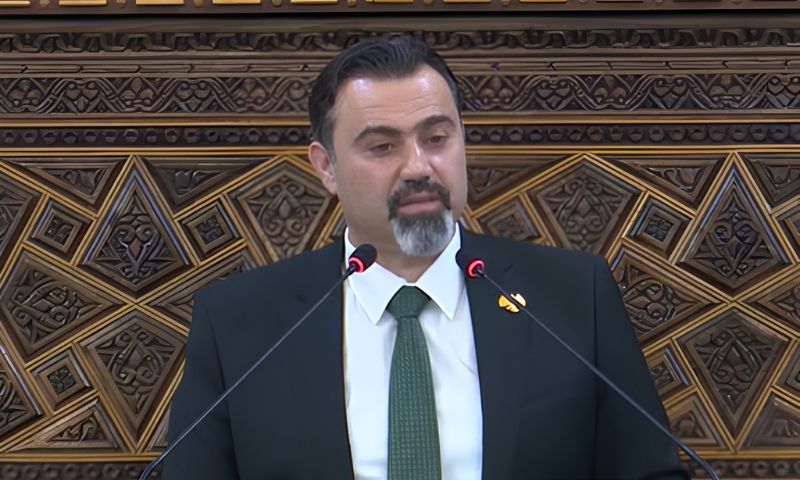
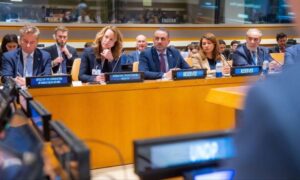
 Education Minister Mohammed Abdul Rahman Turko discusses the ministry's work and its main challenges during a hearing before the People's Assembly, September 14, 2026 (al-Ikhbariya)
Education Minister Mohammed Abdul Rahman Turko discusses the ministry's work and its main challenges during a hearing before the People's Assembly, September 14, 2026 (al-Ikhbariya)
Syrian Education Minister Mohammed Abdul Rahman Turko reviewed the ministry’s work and the challenges it faces during a hearing before the People’s Assembly on Monday, September 14.
Turko said demand for schools currently exceeds the ministry’s capacity, noting that 134 schools have opened in Aleppo and 50 in Idlib, while preparations are underway to open 37 schools in Hama.
He said the ministry is struggling with outdated legislation that no longer meets current needs, in addition to weaknesses in its digital system. Work is currently underway to build an integrated database, he added.
Turko explained that a large portion of the funds earmarked under Decree No. 50 has been allocated to rebuilding schools in areas where residents are returning from camps. He added that the ministry is sharing data on schools and areas targeted for returns with the “Syria Without Camps” committee.
Turko said the ministry will open the first private international school in Syria to offer the International Baccalaureate the following week. He added that the issuance of a decree specifically governing international schools opens the way for private international schools to operate in Syria.
A new visual identity has also been introduced for schools with the aim of making the school environment more appealing to students.
Education Minister Mohammed Abdul Rahman Turko said the ministry has reinstated more than 14,000 teachers who were dismissed because of their participation in the Syrian revolution, giving them the right to choose employment at a location closest to their homes. He said a draft law to regularize the employment status of the dismissed teachers has reached its final stages before being referred to the People’s Assembly. Teachers who reached retirement age before what Turko referred to as “liberation” are also covered by the draft law, including provisions to count their years of service.
Turko also complained about interference by some neighborhood committees in evaluating teaching staff in certain areas. He said the Law on Teachers’ Affairs establishes a legal framework for dealing with teachers and follows a system of progression through professional grades.
He added that the law includes six grades, with teachers advancing from one grade to another according to a specified points system based on training courses and evaluations, with the aim of supporting the education system with competent teachers.
The Ministry of Education has adopted a two-year transitional period for students who studied under previous curricula before moving to the unified curriculum, according to Turko. He said the influx of returning students poses challenges including missing documents, language difficulties and differences between the curricula they previously studied.
Turko added that the ministry completed the national standards for developing new curricula six months ago and referred them to the People’s Assembly. The ministry also printed 41 million textbooks this year, compared with 28 million last year.
The minister said all students from first through fourth grade will receive new textbooks.
He also said the credential equivalency process has become fully electronic, allowing students to register and upload their certificates, identification documents and other information. Work is also underway to enforce compulsory education for the basic education stage in accordance with Law No. 7.
Turko projected that the number of students would reach six million during the current school year. He estimated that two million students have dropped out of education because of economic and social factors, in addition to a lack of access to schools.
He said the ministry is working on two plans, one emergency and one strategic, to secure the right to education and develop the education system, with the aim of moving from addressing existing gaps toward building a stronger and more equitable system.
More than 5.2 million students across Syria’s governorates went to school on September 6 with the start of the 2026-2027 academic year.
Before the school year began, Education Minister Turko discussed final preparations with provincial education directors and instructed them to intensify field visits, follow up on schools’ needs, distribute textbooks, secure basic supplies and complete the implementation of organizational structures in education directorates and educational complexes.
He also instructed the directorates to designate one fixed day each week to receive students, teaching staff and parents and follow up on their needs and problems, while emphasizing flexibility in administrative procedures.
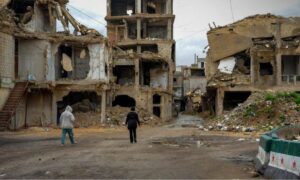
The education process continues to face several problems, as a large number of schools were destroyed during military operations in previous years. Some schools have also faced shortages of teaching staff, forcing them to postpone the start of classes.
if you think the article contain wrong information or you have additional details Send Correction


 A
A
A
A
A
A


 More Politics