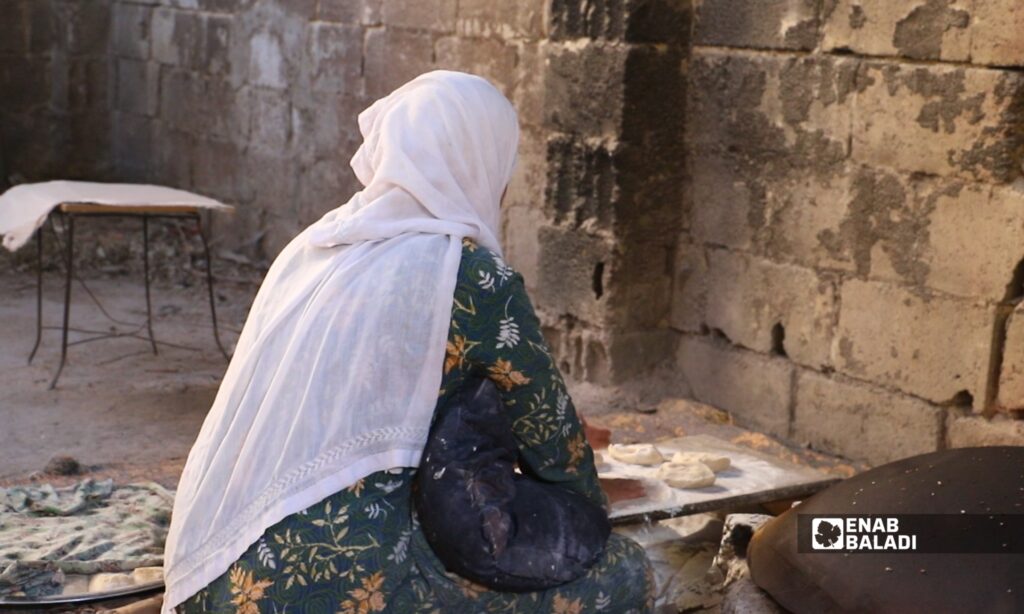
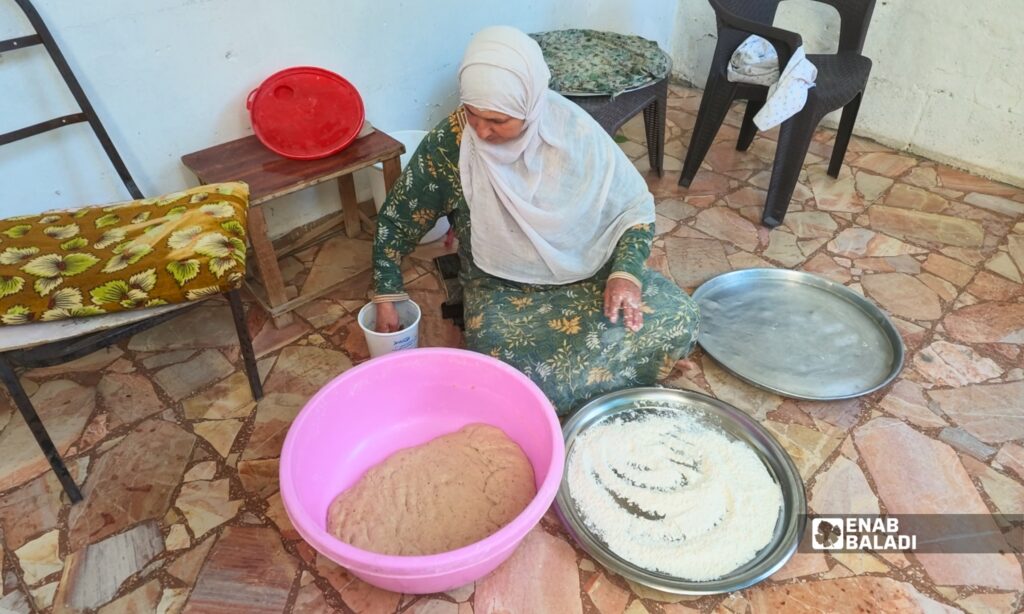
After dawn prayers, Ruwayda Abdul Majid al-Nakash, known in Darayya (Rural Damascus) as Umm Fawaz, begins her day of baking. She divides the dough into portions, rolls each one out by hand, then stretches it in a continuous motion between her palms before placing it on the saj, a domed metal griddle.
Umm Fawaz learned the trade when she was 12 years old, after her family needed a source of income, and she has continued doing it for nearly half a century.
She baked to support her family after getting married, prepared hundreds of loaves a day during the siege of Darayya, and still takes a limited number of orders today from customers accustomed to her bread.
But what has changed over the years is not limited to the amount of bread she makes or the number of customers. The saj was once at the center of work that brought together women from the family and neighborhood. Today, Umm Fawaz sits in front of it alone.
She Started at 12
The death of Umm Fawaz’s brother, along with difficult circumstances her father was going through, pushed the family to look for a source of income. She told Enab Baladi that she was living with five or six sisters, without a breadwinner capable of providing for the household.
The girls suggested to their mother that they make bread at home and that she take it to Damascus to sell.
Ruwayda was 12 when she began watching her older sister bake on the saj every morning. Within about a week, she had learned the steps from her and started baking herself.
She would prepare batches of bread for her mother to take to Damascus, while some customers came to the house to collect their orders. In this way, the skill she learned at an early age became a source of income for the family.
After getting married, she did not stop working. As her husband’s financial means declined, she returned to baking at home and began preparing bread for restaurants, which sent people to collect it from her.
She said the income she earned from baking helped her provide for her family. She continued working even after her children grew up, and her earnings helped cover the expenses of their marriages.
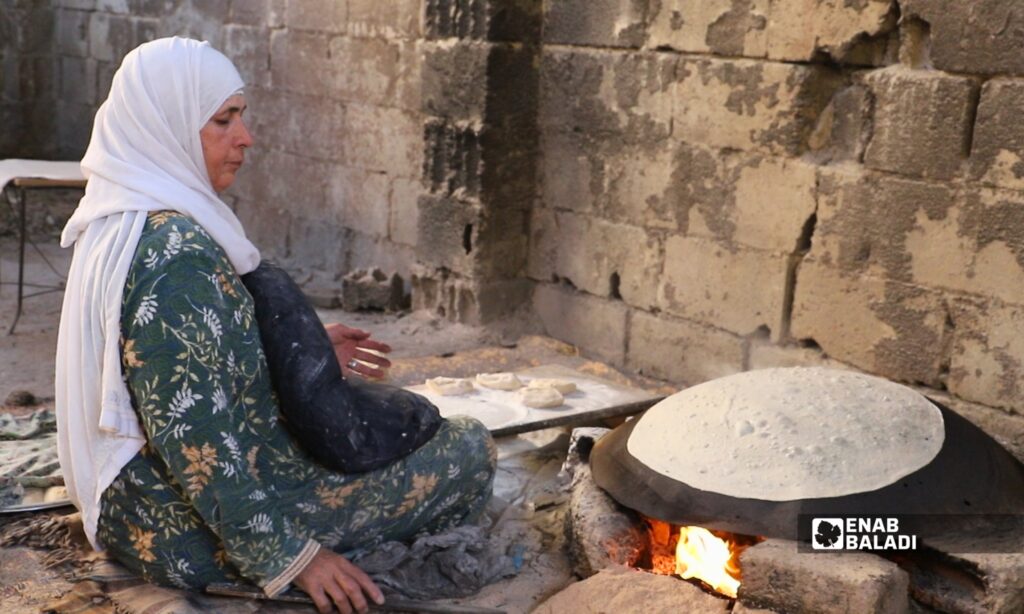
300 to 400 Loaves During the Siege
Umm Fawaz was outside Darayya when the siege began, before her son, who later died during the war, helped her enter the city. She remained there for about two years.
There, the saj went back into use, but under very different circumstances.
She said a young man asked her to prepare bread, so she began baking between 300 and 400 small loaves every day, using the same saj she still works with today.
The flour available at the time was different from the white flour she was accustomed to using. Wheat flour was more difficult to roll out, so she made smaller loaves from it. Someone would then come to collect the bread and distribute it inside the city.
Her work was not limited to baking. She would receive sacks of rice, peas, and fava beans and prepare food in large pots with the help of her daughter-in-law and two sisters.
Umm Fawaz continued doing this until she left Darayya during the forced displacement.
She remembers the fear of airstrikes and taking shelter with her neighbors in a covered pit resembling a trench that they used for protection.
Despite the bombardment, fear, and scarcity of supplies, Umm Fawaz remembers that period through the relationships among those who remained in the city and the way they helped one another. “Even now, I say I miss the days of the siege,” she said, recalling that she left Darayya in tears.
When Baking Meant Coming Together
Before buying bread from bakeries became commonplace, Umm Fawaz remembers families around her kneading dough at home whenever their bread supplies were about to run out.
It was not a one-woman job. Women would place the dough in large containers, divide it into portions, and carry it to a neighbor’s tannour, a traditional clay oven.
There, the tasks were divided among four or five women. One rolled out the dough, another prepared the portions, and a third handled the baking.
Umm Fawaz took part in these gatherings with her mother and her uncles’ wives. After getting married, she had the same experience with her mother-in-law and women from her husband’s family.
The work would take hours, accompanied by conversations and laughter until all the dough had been baked.
Umm Fawaz prefers tannour bread to the saj bread she makes today. Saj bread is thin, while tannour bread is thicker, keeps longer, and has a taste she prefers.
But what she misses most is not the shape or taste of the bread. It is the gathering of women around its preparation. Work that was once shared among several women has now become a task she performs alone.
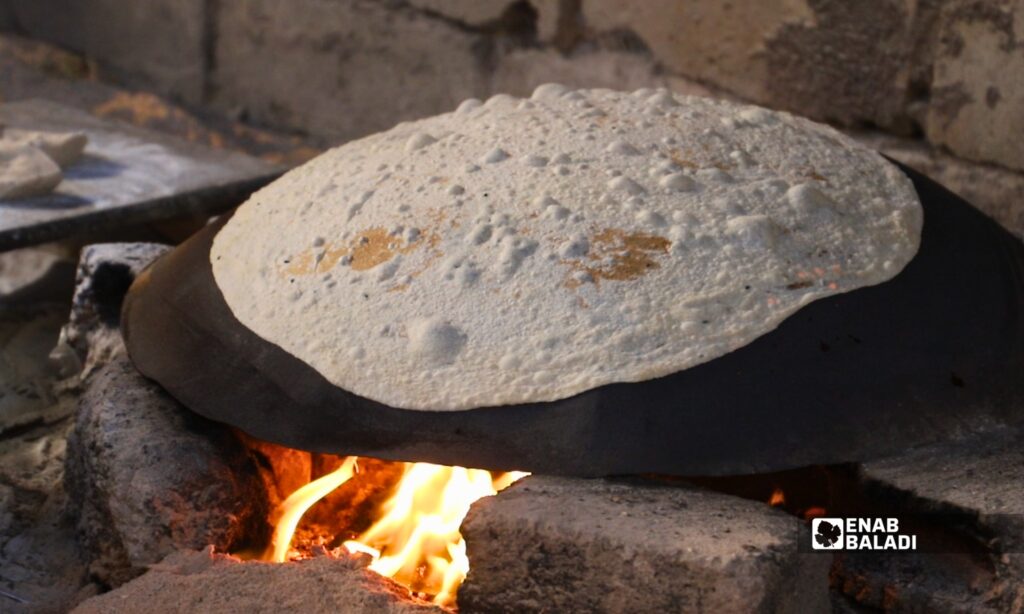
Fewer Customers, but the Saj Remains
Umm Fawaz no longer bakes every day as she did during earlier periods of her life. She currently receives orders once or twice a week from a limited number of customers who have grown accustomed to her bread.
She buys the required flour, then charges customers for its cost in addition to her labor.
She believes buying ready-made bread has become the easier option for many families because of the time and effort required to bake at home. Some customers, however, still prefer handmade bread and continue ordering from her.
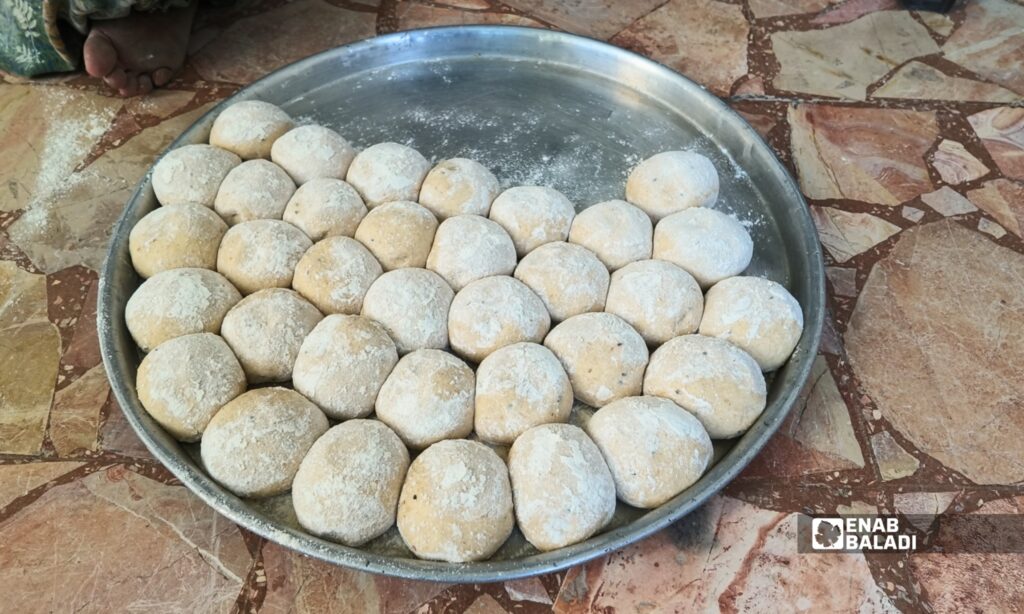
Umm Fawaz does not begin her work by putting dough directly onto the saj. She first checks the flour and sifts it when necessary, then adds salt and a small amount of yeast, saying that too much yeast affects the dough’s smell and taste.
After kneading the dough, she kneads it twice more before leaving it to rest. In the morning, she begins dividing it into portions and rolling them out.
The stage she will not leave to anyone else is rolling out the portions and stretching each loaf. She says uneven dough thickness forces her to redo the work, so she makes sure to handle this part herself.
She moves the loaf between her hands, constantly turning it so its thickness is evenly distributed and one side does not end up thinner than the other.
Women have watched her and tried to learn the movement from her, but mastering it, according to Umm Fawaz, requires practice and the experience she has accumulated since childhood.
Nearly half a century after she first stood beside her sister and watched her at the saj, Umm Fawaz still uses her hands in the same way.
“It is a trade. I learned it from my sister, but I became better at it than she was,” she said.