
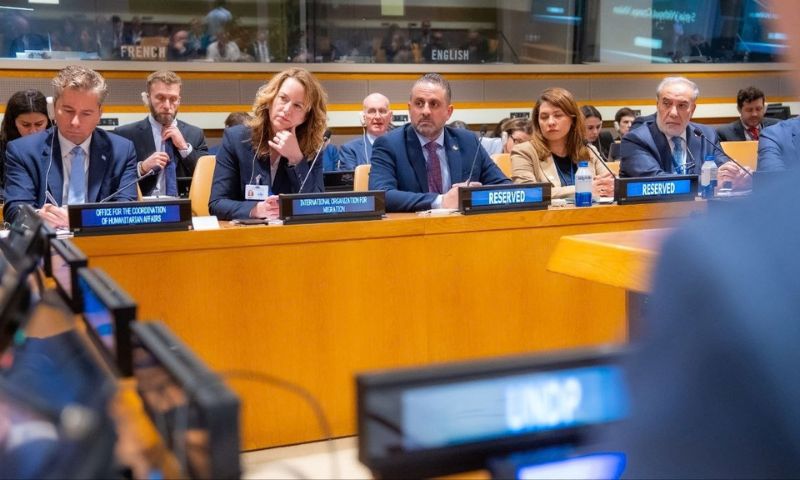

Syria’s Permanent Mission to the United Nations organized a seminar on Wednesday, September 23, titled “Regional Stability, Security and Sustainable Return: The Imperative of a Syria Without Camps.”
The seminar brought together senior UN and international officials, including representatives of the United Nations Development Programme (UNDP), the Office for the Coordination of Humanitarian Affairs (OCHA), the International Organization for Migration (IOM), and the UN Refugee Agency (UNHCR). Syrian Minister of Emergency and Disaster Management Raed al-Saleh, Syria’s Permanent Representative to the United Nations Ibrahim Olabi, and Qutaiba Qadish, director of the International Cooperation Department at the Ministry of Foreign Affairs, also attended.
Deputy Minister of Emergency and Disaster Management Ahmed Ekzayez said the ministry has 1,519 projects aimed at supporting the return of displaced Syrians from camps, targeting areas that have suffered destruction.
He added that identifying obstacles to return, such as the lack of sewage systems, infrastructure, and basic services, makes it easier to design projects based on actual needs. He said an assessment of intentions to return showed that 57% of displaced people living in camps currently want to go back.
Ekzayez said the number of displaced people has declined significantly, but hundreds of thousands are still displaced.
The seminar focused on linking the vision of a “Syria without camps” to national recovery priorities, supporting the sustainable return of displaced people, rebuilding local communities, and strengthening regional stability.
Camps Cannot Disappear Before Stable Lives Are Secured
Minister of Emergency and Disaster Management Raed al-Saleh said return does not simply mean moving people from a tent to a village. Rather, it means ensuring people have a place where they can live stably. He said the ministry does not ask a family to leave its tent and return to a destroyed home or a village without water, a school, or a health center.
In his remarks at the seminar, al-Saleh stressed that tents should not disappear before an alternative is available that guarantees people a dignified, safe, and stable life. Camps, he said, have always been a temporary solution for Syrians and cannot become the future of entire generations.
Qutaiba Qadish, director of the International Cooperation Department at the Ministry of Foreign Affairs and Expatriates, said the Syrian government’s vision supports reconstruction and recovery in Syria and sets out the course of action for the next phase.
He added that Syria has a responsibility to preserve national ownership and lead interventions in line with national priorities, stressing that the country does not only need to build schools and hospitals, but also to ensure that they continue providing services to citizens.
Qadish added that work is underway with friendly countries and others interested in Syrian affairs to support reconstruction, recovery, and sustainable development in Syria.
From Vision to Implementation
UN Under-Secretary-General for Humanitarian Affairs Tom Fletcher said, “We have come a long way in working together to support Syria and strengthen the response to its needs.”
He added that the framework of “no camps, no tents” is encouraging and that they want to move from vision to implementation on the ground. At the conclusion of his remarks, Fletcher said, “The United Nations failed Syrians for a long time, and it must not fail them now during the recovery phase.”
UN Development Programme Administrator Alexander De Croo said there are one million internally displaced people and about two million displaced Syrians returning to the country, adding that no government in the world, regardless of how strong it is, could simply solve such a problem.
International Organization for Migration Director General Amy Pope said 2.9 million displaced people have returned to Syria and that stability must be achieved, as the region needs stability in Syria.
More than 70% of the displaced people the organization has spoken with want to return and are looking for schools and health facilities, Pope said. She added that a plan addressing schools, health facilities, homes, and playgrounds would be essential for the return of Syrians.
More Than 200 Camps Closed
Syrian Minister of Emergency and Disaster Management Raed al-Saleh had previously said that more than 200 camps have been closed so far, while around 141,000 families remain in camps.
Speaking to al-Ikhbariya on September 10, al-Saleh said Idlib governorate (northwestern Syria) has 786 camps housing about 458,000 people, while return areas in Aleppo governorate (northern Syria) contain around 391 camps.
According to the minister, more than 40% of camp residents live in concrete housing that can be administratively organized and converted into residential communities.
The most difficult cases, however, involve around 8% of families who own neither a home nor land. Work is underway to provide solutions for them, including employment opportunities, relocation assistance, and temporary rent support.
Al-Saleh said Decree No. 59, issued by Syrian President Ahmed al-Sharaa, established a committee comprising several ministries and governorates to work on ending the camp issue. He said around 20% of camp residents have returned to their areas since the committee was formed.
He also said preparations are underway for a return convoy involving between 4,000 and 6,000 families, following daily return convoys organized over recent months.