


 Trucks loaded with vegetables that Suwayda 24 said entered Suwayda through the al-Matouna checkpoint, September 6, 2026. (Suwayda 24/Facebook)
Trucks loaded with vegetables that Suwayda 24 said entered Suwayda through the al-Matouna checkpoint, September 6, 2026. (Suwayda 24/Facebook)
Mowafaq Tarif, the spiritual leader of the Druze community in Israel, called for lifting what he described as a siege on Suwayda governorate in southern Syria, saying he had sent messages to UN bodies and embassies of relevant countries. Suwayda Governor Mustafa al-Bakour denied that the governorate was under siege.
Tarif made the demands in a statement published on Monday, September 9, citing reports of “deteriorating public services and humanitarian conditions.”
Tarif said he sent an urgent letter to the United Nations, describing what he called the “renewed siege on Suwayda” as a continuation of the attack the area witnessed in July 2025, aimed at “undermining the residents, their rights, and their standing in Jabal al-Druze and intimidating them,” as he put it.
He added that the siege had intensified over the past two weeks, with food supplies and fuel almost completely prevented from entering, hospital operations crippled, drinking water in short supply, and electricity and internet services cut off across large areas.
Tarif said this affected all Suwayda residents, particularly patients, older people, women, and children, while “the facts are being distorted through systematic media misinformation aimed at concealing the reality on the ground,” according to his statement.
Tarif called for lifting the siege on the city and providing civilian and humanitarian support to “Jabal al-Druze” and Suwayda, as is provided in conflict areas elsewhere in the world. He warned that conditions could deteriorate “with dire consequences.”
The statement said Tarif addressed the letter to UN bodies and embassies of relevant countries, attaching information and details about current conditions.
Tarif also contacted the office of the Israeli prime minister and security agencies, calling for action at all levels and through all channels “before it is too late.”
Tarif is considered one of the most prominent Druze figures worldwide and plays a central role in international efforts related to Suwayda governorate.
Tarif has repeatedly called for what he describes as “stopping the genocide” against the Druze community, referring to the attacks that Suwayda city witnessed in July 2025.
He is also known for his activity with embassies and UN bodies and before members of the U.S. Congress in efforts to raise the Suwayda issue internationally in ways that support his perspective.
By comparison, Tarif’s position is more measured than that of Hikmat al-Hijri, the spiritual leader of the Druze community in Suwayda, who is calling for complete separation from Syria.
Tarif, for his part, continues to use the name Suwayda, which al-Hijri no longer uses in his speeches, replacing it with “Mount Bashan,” a term with Jewish religious significance.
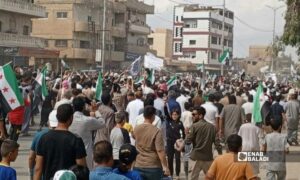
At the same time, Tarif enjoys broad respect among members of the Druze community in Suwayda, reflected in protesters regularly carrying his portraits and displaying messages thanking and praising him.
For his part, Suwayda Governor Mustafa al-Bakour said in a statement on September 5 that the Suwayda-Damascus road was fully open and had not been closed. He said transportation continued, along with the entry of goods, commercial products, food, vegetables, and fuel into the governorate.
In a statement published by the Suwayda Media Directorate on Facebook, al-Bakour stressed that the governorate was committed to presenting citizens with the facts and preventing rumors and inaccurate information that affect markets and people’s lives. He added that government departments and institutions in the governorate continued to operate and provide services to residents.
Al-Bakour asked: If the road is open and food, vegetables, and fuel are entering the governorate, who benefits from promoting claims that the road is blocked and supplies are not arriving? Who monopolizes goods after they enter? Who raises their prices for residents? And who benefits from creating fear in the markets?
Meanwhile, Suwayda governorate is experiencing a sharp rise in fuel and food prices, alongside shortages of some goods and disruptions to essential services, amid conflicting accounts over the causes of the crisis and the movement of supplies through the al-Matouna checkpoint, the main crossing linking the governorate with Damascus.
The effects of the crisis extend beyond the markets. Students have been prevented from reaching their examination centers, electricity and water outages continue, and there are warnings that Shahba Hospital could cease operating because of a diesel shortage.
Suwayda is controlled by local factions operating under the name “National Guard,” with the support of Druze religious leader Hikmat al-Hijri, while government forces have been stationed around the governorate and in its western countryside since the events of July 2025.
The July events began with disputes between Bedouin tribes and local factions, which developed into clashes followed by tribal mobilizations and international interventions.
The events included sectarian violence by both sides, leaving thousands dead, most of them Druze, in addition to the displacement of Bedouin tribes outside the city and the displacement of residents into it.
if you think the article contain wrong information or you have additional details Send Correction


 A
A
A
A
A
A


 More Politics