


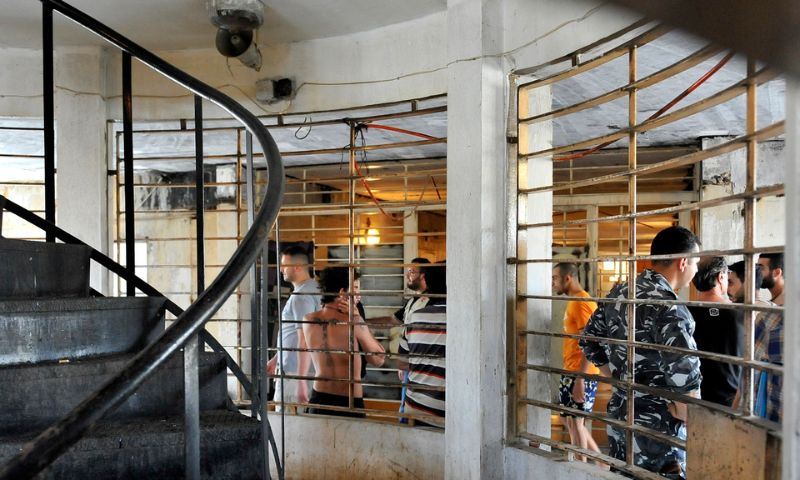
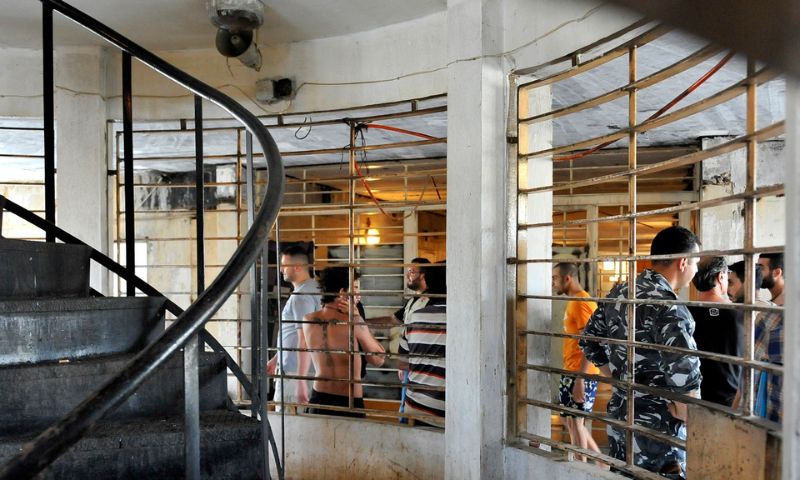
 Roumieh Prison in Lebanon, where many Syrian detainees are held, March 4, 2026. (National Human Rights Commission in Lebanon)
Roumieh Prison in Lebanon, where many Syrian detainees are held, March 4, 2026. (National Human Rights Commission in Lebanon)
Syrian detainee Ahmed Mustafa al-Hamad, 44, died at Hariri Hospital in the Lebanese capital, Beirut, after his health deteriorated during his detention at Roumieh Central Prison, according to the Families of Prisoners in Lebanon group.
The group said in a Facebook statement on Thursday, September 10, that al-Hamad had been detained in Building D at Roumieh Prison for 44 months without trial, noting that his health deteriorated during his time in prison.
According to the group, al-Hamad did not suffer from serious health symptoms before his detention, but symptoms of illness began appearing several months after he entered prison. His condition continued to deteriorate in recent months amid what the group described as overcrowding and inadequate medical care inside the prison.
The group added that the detainee suffered from severe vomiting that prevented him from eating normally for about three months before he was transferred to a hospital in Beirut, where medical examinations showed that he had cancer.
The group said al-Hamad’s family was not informed of his death immediately, adding that his body remained in the morgue for three days.
According to the group, family members learned of his death when they arrived at the hospital to visit him and check on his condition, only to be told that he had died three days earlier.
The group said the handling of the death raised concerns about communication procedures with detainees’ families and called for an investigation into the circumstances of al-Hamad’s death and the medical care he received during his detention.
Al-Hamad’s death comes as attention in Lebanon focuses on the general amnesty law passed by parliament on August 12, according to the Families of Prisoners in Lebanon group.
The group said the law was passed, in significant part, to address humanitarian conditions related to prisons and detainees, but expressed disappointment over what it described as attempts to obstruct its entry into force.
It called on the Constitutional Council to move quickly to bring the law into force, arguing that continued delays are worsening detainees’ conditions amid the circumstances they face inside prisons.
The group said every day of delay in implementing the law could result in the loss of another detainee, warning that conditions continue to deteriorate for prisoners suffering from health problems or harsh detention conditions.
According to the Families of Prisoners in Lebanon group, al-Hamad’s death is the third among detainees in less than a month since the general amnesty law was passed.
Syrian and Lebanese prisoners at Roumieh Prison in Lebanon announced an open-ended strike on January 26 to protest health conditions inside the prison.
A source inside Roumieh Prison, whose name Enab Baladi withheld for security reasons, said the strike was prompted by medical neglect, with medicines, medical care, and treatment unavailable inside the prison.
The source told Enab Baladi that dozens of prisoners were in serious condition because of skin diseases and tuberculosis.
The prisoners also demanded what they called “transitional justice, not selective justice,” according to the source.
Roumieh Prison is experiencing a worsening humanitarian crisis amid deteriorating services and warnings of an imminent humanitarian disaster inside the facility following several deaths linked to a widespread tuberculosis outbreak.
Roumieh Prison holds Syrian and Lebanese prisoners, including prisoners of conscience who supported or participated in the Syrian revolution, as well as inmates with political and criminal backgrounds. Prisoners there have previously staged strikes over poor conditions.
The Syrian Network for Human Rights estimated the number of Syrian detainees at Roumieh Prison at about 2,000, including around 190 detained over their participation in the Syrian revolution.
Roumieh Prison is located northeast of Beirut and is Lebanon’s largest prison. It holds more than 4,000 inmates despite having a capacity of no more than 1,200, resulting in overcrowding and poor services.
There are no official estimates of the number of Lebanese people missing in Syria, but the Association of Lebanese Detainees in Syrian Prisons estimates the number at 622.
Human Rights Watch published a report in August 2023 citing complaints from families of Syrian prisoners in Lebanon that food in prisons had become “insufficient and of such poor quality that it was often unfit for consumption.”
Amnesty International warned in a report published in June 2023 that the number of deaths in Lebanese detention centers and prisons in 2022 had doubled compared with 2018, before the start of the economic crisis.
if you think the article contain wrong information or you have additional details Send Correction


 A
A
A
A
A
A





 More Politics