


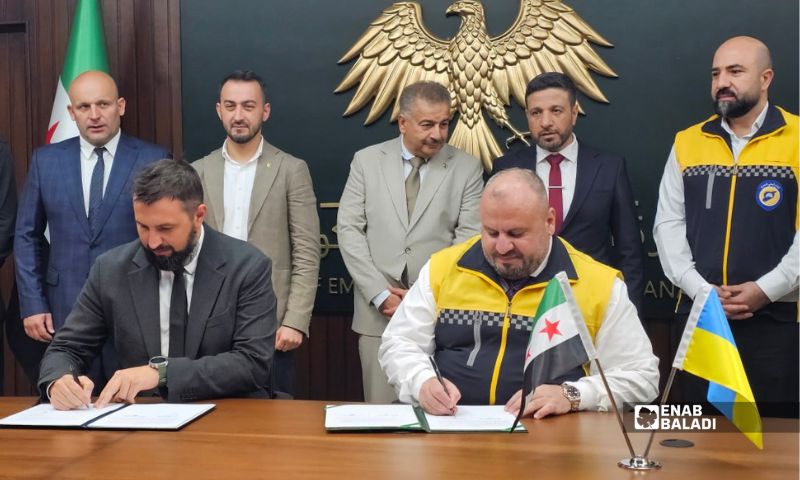
 Signing of a cooperation agreement between Syria and Ukraine on mine clearance, September 20, 2026. (Enab Baladi/Ahmad Maslamani)
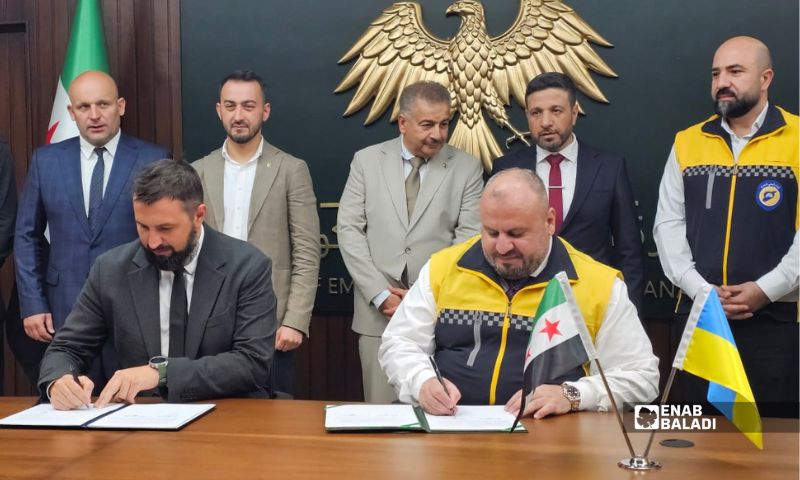
Signing of a cooperation agreement between Syria and Ukraine on mine clearance, September 20, 2026. (Enab Baladi/Ahmad Maslamani)
Syria is seeking to benefit from Ukrainian expertise and technology in dealing with landmines and remnants of war under a cooperation agreement signed with Ukraine on Sunday, September 20, in the field of humanitarian demining. Enab Baladi attended the signing of the agreement.
The Syrian Ministry of Emergency and Disaster Management said the agreement aims to draw on Ukraine’s advanced expertise in mine clearance and the technical and technological surveying of contaminated land, particularly in agricultural areas.
According to the ministry, the agreement covers several areas of cooperation, including field training and capacity-building programs, as well as field visits by Ukrainian teams and experts to Syria to inspect areas with high levels of contamination from mines and remnants of war, particularly in northern Syria.
The ministry added that the agreement also provides for strengthening institutional cooperation between the two sides and developing joint working mechanisms to accelerate mine-related operations. It also seeks to support efforts to rehabilitate agricultural land and return it to production, contributing to the revival of the agricultural economy and improving the livelihoods of affected local communities.
Syrian Civil Defense Director Munir al-Mustafa said the involvement of multiple parties in the war in Syria resulted in the presence of different types of mines and unexploded ordnance, noting similarities between some munitions and mines used in Syria and those used in Ukraine.
He added that some of the munitions Russia used to bombard areas of Syria, as well as certain types of mines, are similar to those found in Ukraine, while some types used by other parties inside Syria differ.
Mines and unexploded ordnance are a complex issue that will take time to address, in addition to their impact on civilians, agricultural land, facilities, and industrial areas across Syria, al-Mustafa said.
He said the Ukrainian side will provide Syria with technologies it has developed and used to detect mines and unexploded ordnance, adding that Ukrainian teams will conduct field visits over three days to several governorates, including Aleppo, Idlib, and Rural Damascus.
Al-Mustafa said the visits will include field trials of technology used in Ukraine to assess whether it can be applied in Syria.
Theoretical assessments indicate that the technology could be used in Syria, according to al-Mustafa, but field testing will determine its effectiveness and whether it can be used in detection and clearance operations.
Al-Mustafa said Syria is in contact with several countries seeking to support it in addressing mines and unexploded ordnance. He noted that the agreement currently signed is with Ukraine, while negotiations and communication remain ongoing with other countries, including Germany, to benefit from technologies used there.
According to the Civil Defense director, introducing these technologies into field operations could accelerate the detection and removal of mines and unexploded ordnance and strengthen the field response of teams from the Ministry of Emergency and Disaster Management.
Al-Mustafa stressed that, as of now, no area of Syrian territory can be described as completely free of mines and unexploded ordnance, despite the removal of thousands of mines and munitions since December 8, 2024.
He explained that declaring any area completely free of mines and unexploded ordnance requires additional surveys and precise clearance operations. Determining how long mine clearance across Syria will take depends on establishing the number and distribution of mines and munitions, figures that have not yet been fully compiled.
Ukraine views dealing with mines and remnants of war as a process that does not end with removing hazardous objects, but as a fundamental step toward enabling residents to return and creating the conditions for reconstruction.
In this context, Ukrainian Deputy Minister of Economy and Environment Ihor Bezkaravainyi said the agreement centers on cooperation in humanitarian demining but goes beyond that field by opening new prospects for cooperation between the two countries after a long period in which relations were interrupted.
The Ukrainian deputy minister said the agreement’s primary goal is to exchange expertise and knowledge in humanitarian demining and transfer Ukraine’s experience to the Syrian government and Syrian people, helping make Syrian land safer.
He noted that demining is not limited to removing hazardous objects from beneath the ground, but is also connected to preparing agricultural land for use, rebuilding infrastructure, attracting investment, and restoring normal life and security in the country.
Bezkaravainyi described mine clearance as the first stage in the process of recovery and restoring normal life.
Teams from the Ministry of Emergency and Disaster Management responsible for removing remnants of war and combating mines carried out 981 operations to remove unexploded ordnance left by the war and conducted 369 non-technical survey operations during the first half of 2026.
The teams also organized 631 awareness sessions focused on increasing public understanding of the risks posed by remnants of war and ways to prevent harm, according to the Ministry of Emergency and Disaster Management.
Ahmed Yazji, director of the ministry’s Department for the Removal of War Remnants and Mine Action, previously told Enab Baladi that clearance teams receive direct reports every day from residents returning to their homes, adding that survey and response operations begin as soon as those reports are received.
Yazji said casualties continue to occur almost daily as residents return to their areas while many remain unaware of the dangers posed by mines and remnants of war.
The ministry recorded about 70 deaths and injuries caused by mines and unexploded ordnance from the beginning of 2026 through July, according to Yazji, who said around 80% of Syrian territory remains contaminated by remnants of war.
if you think the article contain wrong information or you have additional details Send Correction


 A
A
A
A
A
A





 More Politics