


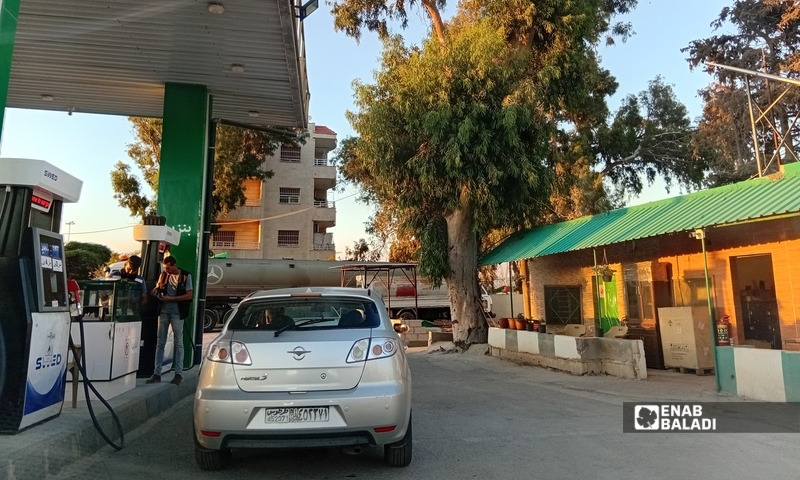
 Residents fill their vehicles at a fuel station in Baniyas, Tartous governorate, western Syria, Sept. 9, 2026. (Enab Baladi)
Residents fill their vehicles at a fuel station in Baniyas, Tartous governorate, western Syria, Sept. 9, 2026. (Enab Baladi)
The Energy Services Directorate under Syria’s Ministry of Energy approved a sharp increase in the prices of petroleum products and household and industrial gas.
The new prices took effect on Sunday, Sept. 13. The price of a liter of 95 octane gasoline rose to 195 Syrian pounds (about $1.48) from 152 pounds (about $1.15), while 90 octane gasoline increased to 185 Syrian pounds (about $1.40) per liter from 147 pounds (about $1.11).
Diesel recorded the largest relative increase, rising to 175 Syrian pounds (about $1.32) per liter from 125 pounds (about $0.95).
The increase was not limited to vehicle and heating fuel, but also directly affected the gas sector. The price of a household gas cylinder rose to 1,600 Syrian pounds (about $12.10) from 1,470 pounds (about $11.12), while an industrial gas cylinder increased to 2,560 Syrian pounds (about $19.36) from 2,350 pounds (about $17.78).
The changes in petroleum product prices come amid continuing fluctuations in global oil markets and a review of local factors affecting costs.
The pricing mechanism is based on periodic assessments that can raise or lower prices, “to ensure that price bulletins accurately reflect the actual economic situation at the time,” according to the Petroleum Products Pricing Committee.
Although the prices are temporary and may rise or fall depending on global prices, the latest increase comes as winter approaches, meaning higher heating costs.
The committee previously said that global oil prices are one of the main factors affecting the local pricing formula.
It also said the pricing assessment monitors changes in the domestic economy to produce precise recommendations based on a comprehensive analysis of the various factors affecting the energy sector.
The committee also pointed to several direct factors used in determining prices, most notably exchange rate fluctuations, import or production costs, transportation and shipping expenses, operating and maintenance costs, as well as the level of technical readiness.
if you think the article contain wrong information or you have additional details Send Correction


 A
A
A
A
A
A







 More Economic Reports