


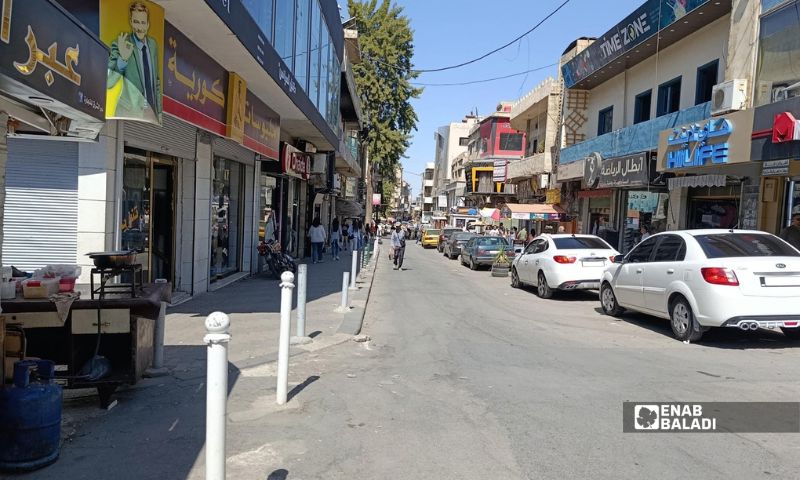
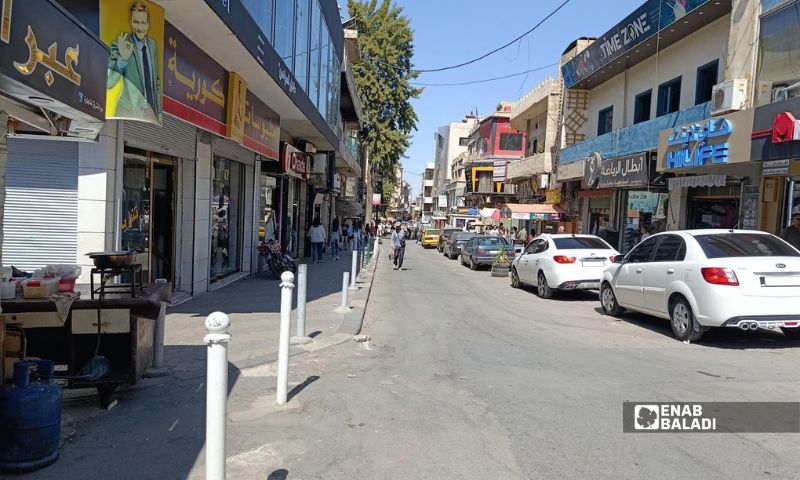
 Shops along Umayya Street in Suwayda city, August 11, 2026. (Enab Baladi)
Shops along Umayya Street in Suwayda city, August 11, 2026. (Enab Baladi)
Shop owners in Suwayda are facing mounting pressure from high rents and operating costs, alongside declining purchasing power and weak sales, prompting some to scale back their businesses or close, while others continue despite accumulating losses.
Monthly shop rents range from about $100 to more than $600, depending on location and size. Shop owners also have to cover electricity bills, taxes, workers’ wages, and the cost of goods.
The exchange rate for one US dollar stands at 138 liras for buying and 138.75 liras for selling.
“Samer al-Halabi,” a pseudonym used for personal reasons, owns two clothing shops, one for children and another for young people. He told Enab Baladi that the economic situation in the governorate is “very bad.”
Following the events of July 2025, al-Halabi closed one of his shops because of declining purchasing activity, operating costs, and rent.
The rent for his remaining shop is $300 a month, and he said he has been unable to pay it for three months despite continuing to operate.
His expenses also include an electricity bill of about 8,000 liras per billing cycle, which comes every two months, in addition to municipal tax and other costs.
Al-Halabi said he is caught between two costly options. He fears closing the shop and losing the business he has built, but at the same time, he cannot continue paying expenses that exceed his sales.
He said the main problem is weak commercial activity. Sales used to be reasonably good, but now, he said, people often come in only to ask about prices without buying.
During a visit to the market, Enab Baladi observed limited purchasing activity, while shop owners continue to bear rent and other expenses regardless of sales.
A female shop owner told Enab Baladi that business at present amounts to “one loss after another,” saying sales barely cover operating expenses and are not enough to pay the rent.
The woman, who is in her 30s and asked not to be named, said she previously needed a female employee to help at the shop, but she can no longer afford the wage and now works alone.
Rising operating costs are also reducing shop owners’ ability to employ workers when sales are insufficient to cover wages, rent, and other expenses.
Weak purchasing power also limits merchants’ ability to raise the prices of their goods in line with increasing costs, as they fear that higher prices would further reduce sales.
Business activity varies from one shop to another. The owner of an accessories and makeup shop in al-Seir Square in central Suwayda said activity at his shop is “good,” although he described market activity in general as weak.
He added that narrow profit margins sometimes force merchants to raise the prices of some goods to secure a profit and remain in business.
Rent is not the only challenge. Shop owners interviewed by Enab Baladi said the disruption of the Damascus-Suwayda road in early September affected commercial activity, particularly clothing stores whose business depends on seasonal sales.
Many merchants had ordered school clothing, but delays in the arrival of their goods caused them to lose part of the season.
One shop owner said, “Our business depends on seasons.” Merchants whose goods arrived before the road disruption, or who had old stock, were able to sell, while those whose shipments were delayed lost the period of high demand.
This leaves shop owners facing fixed rent and operating costs while their sales remain tied to the season, market activity, and prevailing conditions.
Rental costs are not limited to conventional shops. They also affect kiosks and street stalls used by some small businesses.
Kiosk rents start at about 5,000 liras, while in some locations they exceed $100, bringing their rents close to those of some shops despite their smaller size.
This means that even entrepreneurs who choose a small space to reduce costs still face a significant rent burden.
Enab Baladi previously observed that some small businesses had turned to street stalls amid high shop rents and the fixed costs associated with running a business.
Restaurants are also affected, with rent forming part of growing operating costs while sales remain closely tied to customers’ ability to spend.
At the end of each month, rent remains a fixed obligation, while sales fluctuate according to market activity and purchasing power.
Between shop owners trying to cover rent and others considering closure before their losses accumulate further, business owners continue to test their ability to survive in a market where business does not move at the same pace every day.
if you think the article contain wrong information or you have additional details Send Correction


 A
A
A
A
A
A







 More Society