


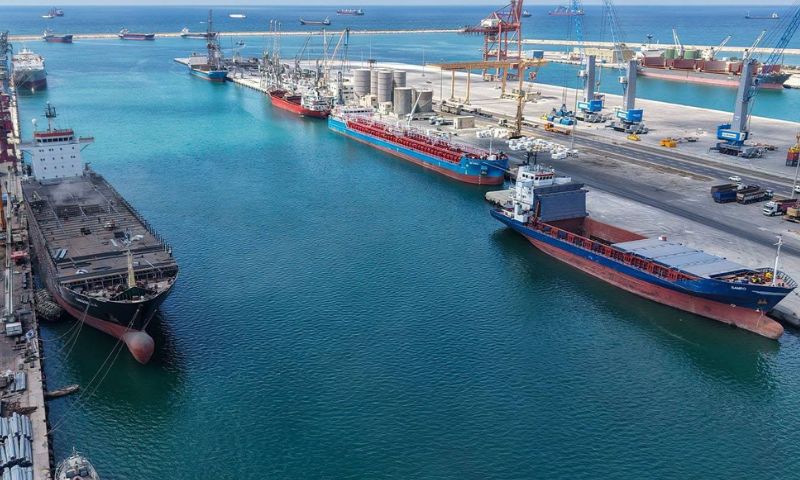
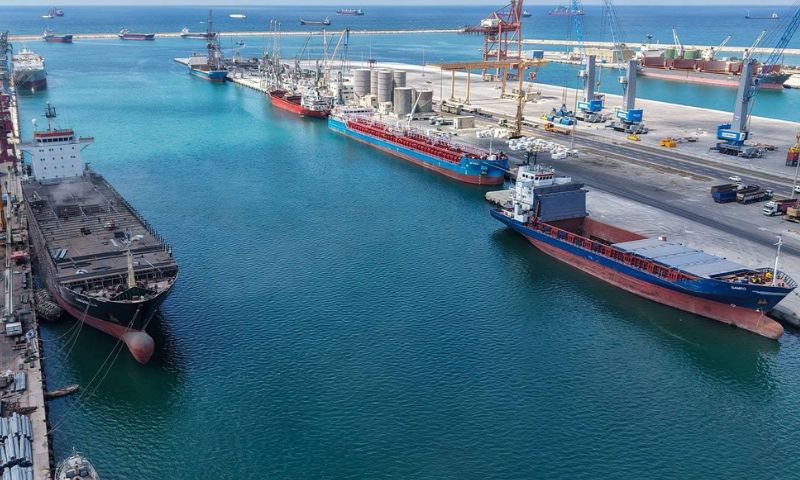
 Commercial vessels received at Tartus Port, August 25, 2026. (General Authority for Land and Sea Ports and Customs)
Commercial vessels received at Tartus Port, August 25, 2026. (General Authority for Land and Sea Ports and Customs)
Russian Navy vessels have returned to Tartus Port on Syria’s Mediterranean coast, in a move that contrasts with an earlier announcement that the section of the port used by Moscow would be handed over to the Syrian side, according to Radio Free Europe/Radio Liberty (RFE/RL) on Friday, September 11.
Images obtained by the broadcaster and taken in early September showed a group of Russian vessels at Tartus Port, including the destroyer Admiral Levchenko and the support vessels Sparta and Akademik Pashin.
The vessels had traveled through the Mediterranean toward the eastern Mediterranean in late August. Maritime tracking data showed that Admiral Levchenko accompanied Sparta and Akademik Pashin, along with the oil products tanker General Skobelev, after they passed through the Strait of Gibraltar on August 27.
According to RFE/RL, the Russian group switched off its tracking devices during the voyage before later appearing in Tartus, where images showed the vessels arriving at the port and unloading cargo whose nature was not identified.

Russian vessels at Tartus Port, September 11, 2026. (RFE/RL)

The Russian fleet sailing south along the Spanish coast en route to Syria in late August, September 11, 2026. (RFE/RL)
The Syrian Foreign Ministry announced that it had reached an understanding with the Russian government under which the Syrian government would administer civilian facilities that had been controlled by Russia along the Syrian coast.
Syria’s official news agency, SANA, cited the Foreign Ministry’s Communications and Media Department on August 9 as saying that the civilian facilities to be administered by Syria included Hmeimim Airport (Latakia, western Syria) and the fourth commercial berth at Tartus Port.
The department said the two sides had agreed to transform Russian military bases into joint training and qualification centers in a manner that preserves mutual interests.
The memorandum of understanding also established a three-month deadline for completing the transfer process, after which the new arrangements would take effect.
The Foreign Ministry’s Communications and Media Department said the understanding followed a year and a half of talks led by the ministry.
It said the move was the most significant since negotiations began and would contribute to building a different phase in Syrian-Russian relations.
The General Authority for Land and Sea Ports and Customs said the Syrian side had taken control of the commercial sites previously operated by Russia within Tartus Port, including Berth No. 4 and its associated warehouses and facilities.
The General Authority of Civil Aviation and Air Transport said Syrian Foreign Minister Asaad al-Shaibani visited Latakia International Airport accompanied by the head of the aviation authority, Omar Hosari.
The authority said the visit followed the signing of what it described as the historic Syrian-Russian memorandum of understanding, which paved the way for the airport’s administration to return to the Syrian side.
According to the aviation authority, the tour included inspecting the condition of the airport and its facilities and reviewing its operational readiness.
Amid the major transformations Syria has undergone since the end of 2024, Russia’s presence entered a period of significant repositioning after years of extensive deployment that established Moscow as one of the most prominent actors in Syria, particularly since its direct military intervention alongside the former regime in September 2015.
By mid-2024, Russia had about 114 military bases and positions distributed across Syria’s governorates, with a notable concentration in Hama, Latakia, Tartus, al-Hasakah, Quneitra, and Aleppo, as well as deployments in Raqqa, Deir Ezzor, Damascus, and the Damascus countryside.
The deployment included major bases as well as military, security, and logistical positions. Among the most prominent were the Tartus naval base and Hmeimim Air Base, in addition to bases at Hama Airport, al-Shayrat Airport in Homs, Kuweires Airport in Aleppo, and Qamishli International Airport in northeastern Syria, reflecting the extent of Moscow’s broad presence on the ground during that period.
This map, however, began changing rapidly with the “Deterrence of Aggression” offensive, which began in late November 2024 and ended with the fall of the regime on December 8 of the same year, ushering Syria into a new phase that reshaped the balance of power.
During 2025, the number of Russian bases fell to just three before declining further following developments at the beginning of 2026. Russian forces withdrew in January from Qamishli International Airport in al-Hasakah governorate, as the map of territorial control in northeastern Syria changed.
By February, Russia’s military presence had become limited to only two locations on the Syrian coast, Hmeimim Air Base and the Tartus naval base.
Syria’s new government has maintained good relations with Russia despite Moscow’s long-standing support for the Assad regime during the Syrian war. President Ahmed al-Sharaa has made two visits to Moscow in recent months, in addition to other visits by Syrian political and military officials.
if you think the article contain wrong information or you have additional details Send Correction


 A
A
A
A
A
A



 More Politics