
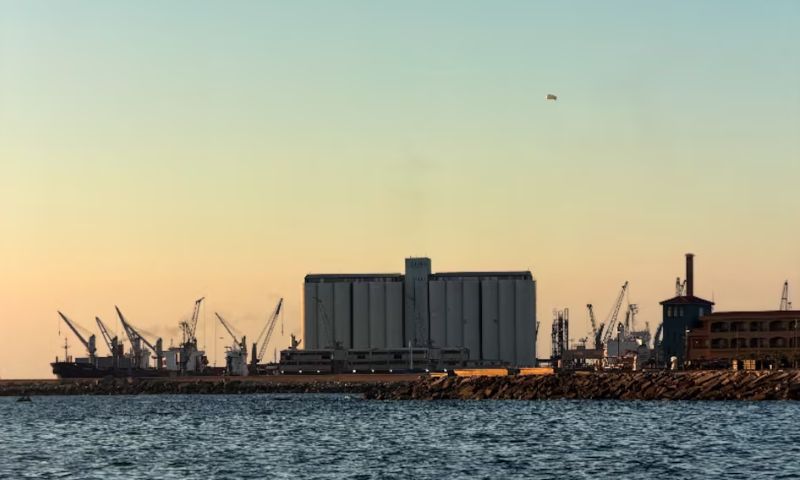

A group of Russian military and commercial vessels arrived at the port of Tartus (Syrian coast), marking the first Russian resupply operation for the Tartus and Hmeimim facilities since Moscow and Damascus reached an understanding on the future of Russia’s military presence in Syria, according to Reuters.
Reuters said a Russian convoy of four vessels arrived at Tartus port on September 7 after crossing the Mediterranean, delivering supplies to facilities used by Russia on the Syrian coast.
The convoy included the destroyer Admiral Levchenko, the cargo ship Sparta, the navy replenishment oiler Akademik Pashin, and the oil products tanker General Skobelev.
Satellite images verified by Reuters showed Sparta and Akademik Pashin docked at Tartus port on September 8, while General Skobelev remained offshore.
Enab Baladi published images on September 11 obtained by Radio Free Europe/Radio Liberty (RFE/RL), showing the same Russian vessels at Tartus port after they had moved through the Mediterranean toward the eastern Mediterranean in late August.
According to RFE/RL, the Russian group switched off its tracking systems during the voyage before later appearing at Tartus port, where images showed the vessels arriving and unloading cargo whose nature was not known.
Maritime tracking data, according to the same source, showed that the destroyer Admiral Levchenko escorted Sparta and Akademik Pashin, as well as General Skobelev, after they crossed the Strait of Gibraltar on August 27.
Supplies Included Ammunition
The information reported by Reuters adds new details to what was previously known about the return of Russian ships to Tartus.
The agency quoted a Syrian military source and a Russian-Syrian businessman familiar with the operation as saying that Sparta unloaded supplies, including ammunition, intended for Hmeimim Air Base (Latakia governorate) and Tartus.
However, Reuters said it could not independently verify the contents of the shipment or its destination.
The agency also confirmed that the Russian vessels stopped broadcasting tracking signals after crossing the Strait of Gibraltar toward the Mediterranean, before Reuters was able to follow their movements through satellite imagery until they reached the Syrian coast.
Syrian authorities and the Russian Embassy in Damascus did not comment on the operation, according to Reuters.
Understanding Reshapes Russian Presence
On August 9, the Syrian Foreign Ministry announced that it had reached an understanding with the Russian government under which the Syrian side would manage civilian facilities previously used by Russia on the Syrian coast.
According to the Syrian Foreign Ministry’s Communications and Media Department at the time, the civilian facilities to be managed by Syria included Hmeimim Airport and commercial berth No. 4 at Tartus port.
The understanding also stipulated that Russian military bases would be converted into joint training and qualification centers in a way that preserves the mutual interests of both sides. It set a three-month period for completing the transition and bringing the new arrangements into effect.
According to the Syrian Foreign Ministry, the understanding followed about a year and a half of talks between the two sides. Damascus described it as a step toward a different phase in Syrian-Russian relations.
At the same time, the General Authority for Land and Sea Ports and Customs announced that the Syrian side had taken control of commercial sites previously occupied by Russia within Tartus port, including berth No. 4 and its associated warehouses and facilities.
The General Authority of Civil Aviation and Air Transport also announced that Latakia International Airport had returned to Syrian administration after Syrian Foreign Minister Asaad al-Shaibani visited the airport with Omar Hosari, head of the General Authority of Civil Aviation and Air Transport.
Ships Return Amid Reduced Russian Deployment
The return of Russian ships to Tartus comes as Russia’s military deployment in Syria has been significantly reduced compared with previous years.
Russia established its military presence in Syria after intervening directly alongside the former regime in September 2015, relying on Hmeimim Air Base and Tartus port as two principal hubs for air and naval operations and logistical supplies.
The number of Russian military bases and positions in Syria had reached about 114 by mid-2024, before the deployment map began changing rapidly following the fall of the former regime on December 8, 2024.
The number of Russian positions declined over the following year, and Russian forces withdrew from a number of sites across several Syrian governorates.
In January, Russian forces withdrew from Qamishli International Airport in al-Hasakah governorate (northeastern Syria), amid changes to the territorial control map in northeastern Syria.
By February, Russia’s military presence in Syria had been confined to two main locations on the coast, Hmeimim Air Base and the naval site in Tartus.
Both bases are strategically important to Moscow. Hmeimim serves as the center of Russia’s air presence in Syria, while Tartus provides maritime access to the Mediterranean and has been used by Russia for supply and logistical support operations in recent years.
The nature of the cargo unloaded by the Russian vessels in Tartus remains independently unconfirmed, despite Reuters sources saying it included ammunition intended for Hmeimim and Tartus.
The available information indicates that the return of Russian ships to Tartus effectively began before the latest understanding was fully implemented, as Moscow and Damascus move toward redefining the form of Russia’s presence in Syria rather than ending it entirely.