


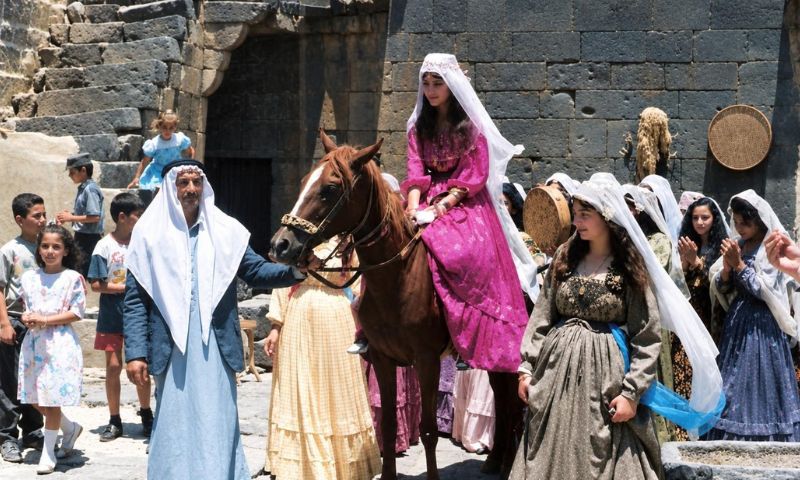
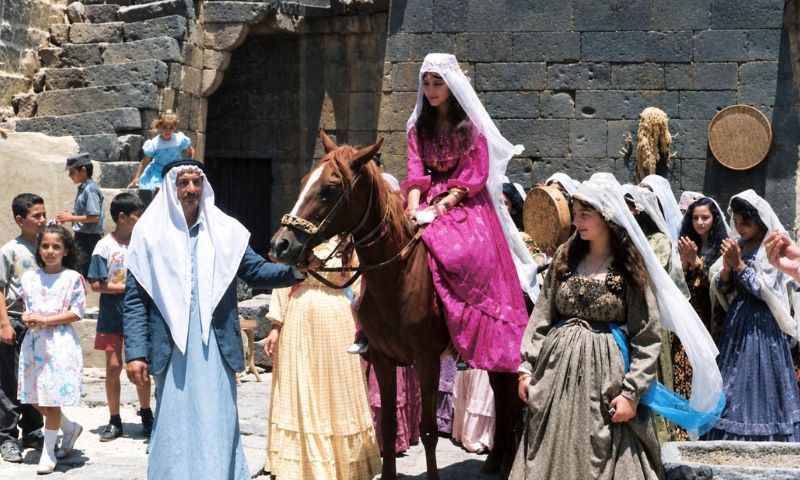
 Wedding traditions in Suwayda city, January 25, 2023. (Salman al-Badaish)
Wedding traditions in Suwayda city, January 25, 2023. (Salman al-Badaish)
Izzat al-Shoufi, who married in 1978, remembers his wedding and those held in his village, which lasted for seven nights and included feasts and the slaughtering of livestock in a tradition known as “al-qira.”
But weddings in Suwayda (southern Syria) no longer resemble those held decades ago. Marriage ceremonies that once lasted for days have been reduced to fewer and shorter rituals. In some cases, the marriage contract and wedding now take place on the same day, while some couples forgo a wedding celebration altogether.
This change in customs is linked to rising marriage costs. Couples now face expenses including wedding hall rentals, hospitality, transportation, furnishing a home, and the bride’s trousseau. The events of July 2025 and their aftermath in the governorate have also pushed some couples to scale back or cancel their celebrations.
Izzat al-Shoufi, 68, said the first night included a celebration for the groom that resembled today’s bachelor parties in some respects. The second night was reserved for what was known as the “bride’s dinner,” a gathering of women and girls from the families of the bride and groom, during which “mansaf al-malhiya” was served.
On the third day, the bride would be taken to what was known as the “guest house,” the home of a family who were friends of the groom’s family. The tradition was intended to show appreciation for the groom and express affection. A henna ceremony would be held for the bride at the guest house before she was escorted on horseback to her husband’s home.
Celebrations continued throughout the seven days. Large numbers of guests attended, including family acquaintances from different villages, along with musical groups and singers.
Weddings did not remain this elaborate, as the length of the celebrations gradually began to shrink.
According to Izzat, by roughly the 1990s weddings had been shortened from seven nights to three. These included the bride’s dinner, a celebration attended by relatives of the bride and groom without the bride, and then the wedding day.
Over time, the ceremonies were shortened further. In many cases, they became limited to a single day combining the marriage contract, known locally as “aqd al-mashayekh,” with the wedding, known as “al-radda,” after the contract had previously been held one or two days before the wedding.
During these ceremonies, the bride and her female relatives wore Suwayda’s traditional attire, known as “al-Arabi.” The following day, the bride would be escorted to her husband’s home in a large wedding procession, known as an “arsiya,” while the wedding would be held either in a square in the groom’s village or at a wedding hall in the city.
Today, however, some couples prefer not to hold a wedding celebration at all.
The “tatmima” ceremony, which precedes the marriage contract, has also declined. During the ceremony, families would carry out what is known as “hadd al-fayd,” meaning setting the dowry and the wedding date. A large group of the groom’s relatives, known as the “kadda,” would participate, sometimes requiring buses to transport them. Today, participation is limited to fewer family members.
The “bride’s dinner” has also changed. Once attended by large numbers of women and girls, today it more closely resembles a bachelorette party for the bride, with fewer relatives and close friends and lower costs.
Samar, who preferred not to give her full name, believes older weddings were simpler than they may appear today, despite lasting longer, drawing more guests, and involving the slaughter of more livestock.
The woman, in her 50s, explained that most of the animals slaughtered for wedding feasts came from livestock raised by the families themselves, while some guests also gave livestock as wedding gifts.
Samar described those weddings as simple and full of affection, far removed from the outward displays associated with weddings today.
Today, marriage expenses extend beyond the wedding ceremony itself. Costs begin with preparing and renting a home and extend to the bride’s trousseau, hospitality, transportation, and renting a venue for the celebration.
According to prices monitored by Enab Baladi, booking some wedding halls or cafes costs an average of about $350. The price rises depending on the services included, such as a DJ or hospitality.
Transportation costs for buses carrying guests add further expenses, along with hospitality costs for the marriage contract ceremony, even when no wedding celebration is held.
Furnishing the home represents another expense, along with buying household items and furniture, while the bride’s trousseau, including clothing and other necessities, adds further costs.
Shahd al-Qassem, 24, a newlywed, told Enab Baladi that she had spent nearly $300 but had not yet finished buying what she needed, as she was still focusing on essential items.
For some couples, rising costs have not been the only factor changing the form of their weddings. The events of July 2025 brought losses and new circumstances for families and young people who had already begun preparing for married life.
Odai Azzam, a young man from western rural Suwayda who is preparing to marry next month, had planned to marry last year. He said he had his home and work arrangements in place and saved the money needed for the marriage.
But the July events forced him to flee his home, and he lost everything he owned, including the money he had saved for his wedding.
He told Enab Baladi that he has since rebuilt his life with limited means. He will live with his family in the same rented home in Suwayda city, although he had planned to live in an independent home in his village.
Odai will not be able to hold a wedding celebration because he considers its cost too high compared with what he can currently afford. He will instead complete the marriage ceremonies without the celebration he had planned.
While weddings in Suwayda once lasted for days and involved entire families and villages, today they are shorter and include fewer rituals.
As the cost of establishing married life itself rises, a wedding celebration is no longer a priority for some couples, but rather an expense that can be reduced or eliminated altogether.
if you think the article contain wrong information or you have additional details Send Correction


 A
A
A
A
A
A





 More Society