


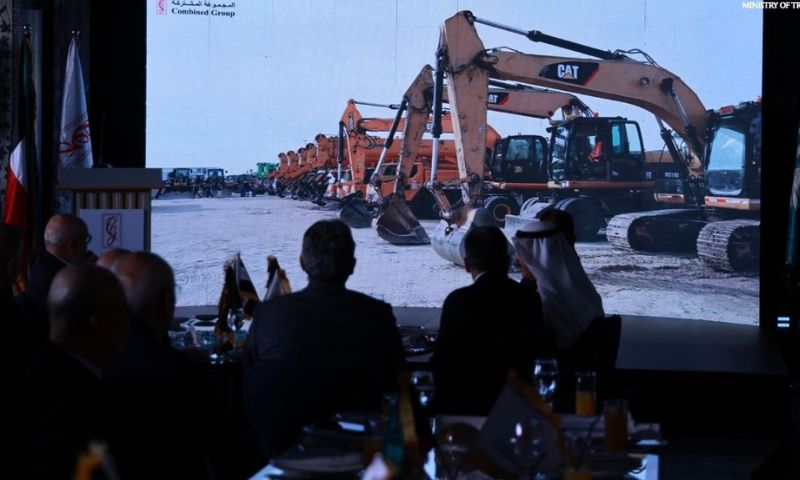
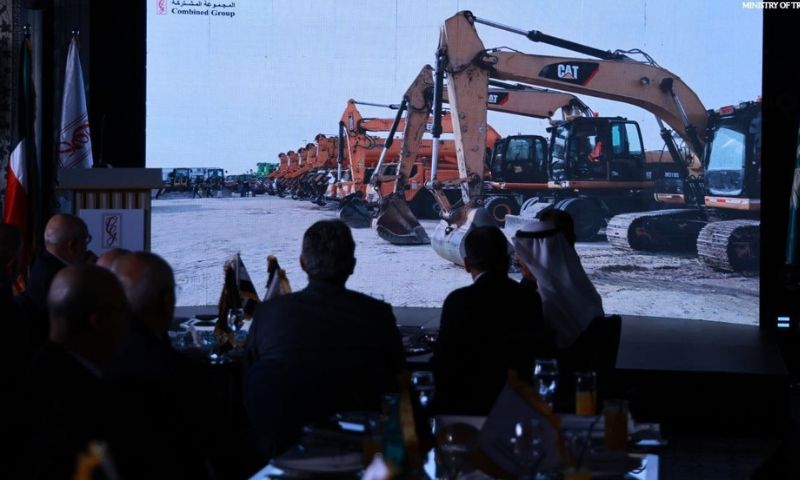
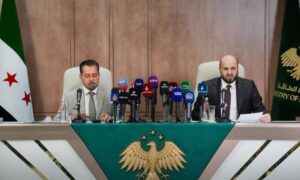
 A view of the signing ceremony for the contract to rehabilitate the international Nasib-Damascus highway, September 22, 2026. (Ministry of Transport)
A view of the signing ceremony for the contract to rehabilitate the international Nasib-Damascus highway, September 22, 2026. (Ministry of Transport)


 A
A
A
A
A
A
About three weeks after machinery entered the site to begin work, Syria’s General Establishment for Road Transportation signed a contract with Kuwait’s Combined Group Contracting Company (CGC) to maintain and rehabilitate the international Nasib-Damascus highway.
Transport Minister Yarub Badr said in a statement published by the Ministry of Transport on Tuesday, September 22, that the General Establishment for Road Transportation had solicited international bids to rehabilitate key sections of Syria’s central road network. The aim, he said, was to draw on the expertise of specialized contracting companies and upgrade roads in line with international specifications and standards.
Moaz Najjar, director of the General Establishment for Road Transportation, said the project represents an important step toward developing the road network and improving infrastructure efficiency, given the strategic importance of the Nasib-Damascus highway for transport, freight movement, and links between Syria and neighboring countries.
He said work would begin within 15 days of the contract’s signing and would include relaying asphalt layers, repairing barriers and road structures, and maintaining several bridges and areas requiring rehabilitation in accordance with the project’s conditions and specifications. He added that the establishment hopes to implement similar projects in the coming period.
Jibril Jaber, director general of CGC’s Syria branch, said, according to the statement, that the rehabilitation work aims to improve transportation and raise safety standards for road users.
Ahmad Abdulrahman al-Marouf, the company’s deputy CEO for service centers, said the group has the expertise, technical capabilities, and specialized machinery needed to carry out major road and infrastructure projects.
Daraa Governor Anwar al-Zoubi said rehabilitating the road represents an important step for residents of Daraa governorate (southern Syria) because of its economic and commercial role. He said improving the highway would support transportation and economic and commercial development in the region.
The signing comes weeks after implementation procedures for the project began. Heavy machinery and equipment belonging to CGC crossed into Daraa on September 4, marking the start of rehabilitation and maintenance work on 100 kilometers of the highway, as Enab Baladi documented in a previous report.
The General Establishment for Road Transportation, under Syria’s Ministry of Transport, announced the start of implementation procedures on August 27.
The contractor disclosed an unexpected $2 million reduction in the awarded contract, bringing its value to more than $46 million, without affecting the project timeline of 400 days.
According to data from the Kuwait Industries Union and specialized economic platforms, CGC has declared and fully paid capital of about 17.15 million Kuwaiti dinars, approximately $56 million, divided among roughly 171.5 million shares.
CGC is classified as a family-owned company, with stakes held by the al-Marouf family, which is of Syrian origin, alongside investments by Kuwaiti investors, companies, and individuals through publicly traded shares.
The company’s founder and chairman is Abdulrahman Mousa al-Marouf, who holds Kuwaiti citizenship after working in Kuwait for decades.
The company’s market value, financial flows, and operating revenues have exceeded $800 million to $900 million, while its project portfolio has at times surpassed $1 billion to $1.5 billion through its branches in Kuwait and the Gulf region.
Regarding controversy over the project’s funding source, Abdul Hadi Shehadeh, director of the media department at Syria’s Ministry of Transport, previously told Enab Baladi that there was no World Bank funding provided as a grant, contrary to claims circulated in September 2025.
Shehadeh said rehabilitation and maintenance work is being financed entirely by the Syrian state treasury through the general budget. He added that the contractor was selected through an international request for bids, followed by an assessment of the submitted offers and selection of the most suitable bid among the competing companies, with governance, integrity, and equal opportunity standards applied.
According to the director general of the General Establishment for Road Transportation, the work includes removing sections of damaged asphalt and laying new layers, treating areas requiring structural intervention, cleaning the central median, and carrying out traffic safety measures such as road markings, signs, and roadside delineators, in addition to laying the groundwork for lighting systems.
Shehadeh said there would be no expansion at the expense of the median or adjacent agricultural land. Improvements will instead focus on enhancing visual safety through advanced traffic signs and lighting networks at intersections and major junctions, under the direct supervision of the Ministry of Transport and with daily monitoring by assigned engineers.
The highway is particularly important because it forms part of a major land corridor beginning at the Jordanian border and passing through Damascus, Homs, and Aleppo before reaching the Saraqib link, a distance of more than 400 kilometers. This makes it one of Syria’s main routes for passengers, goods, and transit traffic, as well as a key economic artery for overland exports and imports between Syria and Jordan and onward to Gulf countries.
CGC conducted a comprehensive survey of the M5 highway in both directions in April, using laser technology and high-resolution cameras to identify damage and produce accurate models of the road surface.
if you think the article contain wrong information or you have additional details Send Correction





 More Economic Reports