


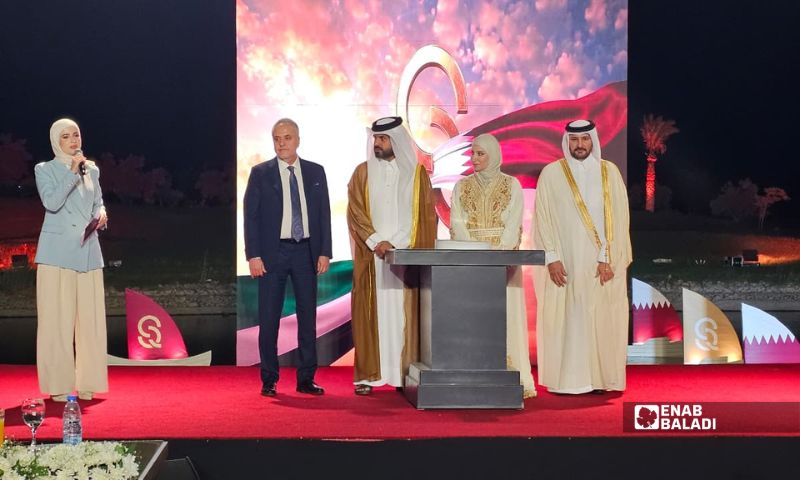
 The launch announcement of the Qatari-Syrian Holding Company, September 6, 2026. (Enab Baladi)
The launch announcement of the Qatari-Syrian Holding Company, September 6, 2026. (Enab Baladi)


 A
A
A
A
A
A
A Syrian-Qatari forum in Rural Damascus brought together Syrian officials, heads of Syrian institutions, Qatari businesspeople, and investors to discuss opportunities for cooperation and investment. The event featured proposals for joint projects across several sectors and the launch of the Qatari-Syrian Holding Company, with the aim of expanding economic partnerships and supporting investment in Syria.
The forum, held on the evening of Sunday, September 6, at the Ebla al-Sham Hotel in Rural Damascus and attended by Enab Baladi, saw the launch of the Qatari-Syrian Holding Company, which unveiled joint investment projects in tourism, real estate, energy, health, agriculture, and transportation.
Attendees included the media adviser to Syrian President Ahmed al-Sharaa, Tourism Minister Mazen al-Salhani, Syrian Petroleum Company CEO Youssef Qablawi, and Syrian Investment Authority Director General Ahmad Rawad Ramadan.
The projects unveiled by the company in a video presentation shown during the event include:
According to announcements made during the forum, the company’s activities also extend to transportation, financial and banking services, insurance, and investment, in an effort to cover sectors linked to its core projects and provide the services they require.
Nayef bin Eid Al Thani, chairman of Tamim Holdings and a founding partner in the Qatari-Syrian Holding Company, told Enab Baladi that the group had begun working on several projects in Syria before the company’s launch was announced, noting that contracts had been signed to operate hotels, alongside preparations to renovate old buildings and put them out to tender.
Al Thani placed tourism projects at the top of the company’s priorities, followed by real estate projects, explaining that this reflects the activities of his companies in hotel management, hospitality, and real estate development.
He said that, in his view, the projects are not limited to investment but also aim to create jobs and stimulate economic activity, noting that tourism projects could help attract tourists.
Regarding progress, Al Thani said he had not encountered major difficulties so far, explaining that contracts had been concluded for some projects and that the next stage would involve issuing tenders for contractors before operations begin.
In his words, the partnership’s objectives go beyond implementing commercially successful investment projects to include supporting the Syrian economy, creating direct and indirect jobs, allowing local companies and suppliers to participate in the projects, and benefiting from Syrian expertise and skills throughout the various stages of implementation.
Wassim al-Muwahhid, CEO of the Qatari-Syrian Holding Company, said tourism represents a major part of the company’s activities because of the experience participating companies have in the hotel and hospitality sectors.
Speaking to Enab Baladi, al-Muwahhid pointed to work on the Shahba Aleppo Hotel in partnership with Bendas, as well as other hotel projects in Damascus and Tartous, in addition to a health project, a project on Aleppo’s Corniche, and tourism transportation projects.
He also discussed a housing project targeting low-income people under the name Bayt al-Watan, stressing that final prices have not yet been determined because of high land prices and construction costs. The company, he said, is working to reach prices affordable to a broader segment of Syrians.
The list of projects presented by al-Muwahhid shows that the company’s activities are divided between projects that could begin work or operations within a shorter period, such as hotels and tourism services, and others that require longer stages of development and financing, including housing, energy, and health projects.
Qatari businessman Mubarak al-Hajri discussed investment in Syria from the perspective of reconstruction, telling Enab Baladi that the objective is to contribute to rebuilding the country and investing in its people, land, and facilities.
Al-Hajri focused on the tourism sector, saying that the diversity of Syria’s tourist destinations, from the coast to natural areas, archaeological sites, and cities, provides multiple opportunities for investment.
He also said that developing these sectors could help attract Gulf investors to the Syrian market.

The launch announcement of the Qatari-Syrian Holding Company, September 6, 2026. (Enab Baladi)
Majd Chourbaji, chair of Glory Holding Group and general manager of the Qatari-Syrian Holding Company, said the company was established as the group’s activities in Qatar converged with a desire to invest in Syria, adding that its objectives include implementing projects that can help create jobs and achieve sustainable development.
Chourbaji identified tourism, hospitality, and real estate as among the company’s main areas of interest, alongside energy and other projects.
She linked the operation of the projects to job creation and improved incomes for workers, saying that the resulting spending could have an impact on other economic sectors and projects.
She also presented the company as a potential gateway for other investors to enter the Syrian market if the current projects are able to move into the implementation and operational stages.
At the same time, participants’ statements also pointed to obstacles facing investment in Syria, particularly those related to procedures, laws, bureaucracy, and sanctions.
Chourbaji said investors continue to face challenges related to regulations and laws inherited from the previous period, in addition to bureaucratic procedures, adding that addressing these issues will take time.
She said sanctions had been among the most significant obstacles to investment and expressed her belief that lifting them would reduce the challenges facing companies.
Chourbaji also spoke of government responsiveness in accelerating some procedures, but said Syria’s investment environment has not yet reached an ideal level.

The launch announcement of the Qatari-Syrian Holding Company, September 6, 2026. (Enab Baladi)
For his part, Syrian Investment Authority Director General Ahmad Rawad Ramadan said the launch of the company represents an addition to economic relations between Syria and Qatar at a time when the country is entering a broad phase of construction and work.
Ramadan stressed the importance of moving investment opportunities from the presentation stage to implementation, noting that the success of the coming phase will be measured by the number of projects that actually begin on the ground.
He said the authority is working to provide a clear and efficient investment environment and an integrated path for investors that begins with an idea and leads to implementation, calling on Qatari investors to study available opportunities and build long-term partnerships.
With sectors proposed at the forum ranging from tourism and real estate to energy, health, agriculture, and transportation, the transition of these projects from plans and contracts to actual implementation remains the most important factor in determining the economic impact of the Syrian-Qatari partnership in the coming period.
if you think the article contain wrong information or you have additional details Send Correction






 More Economic Reports