


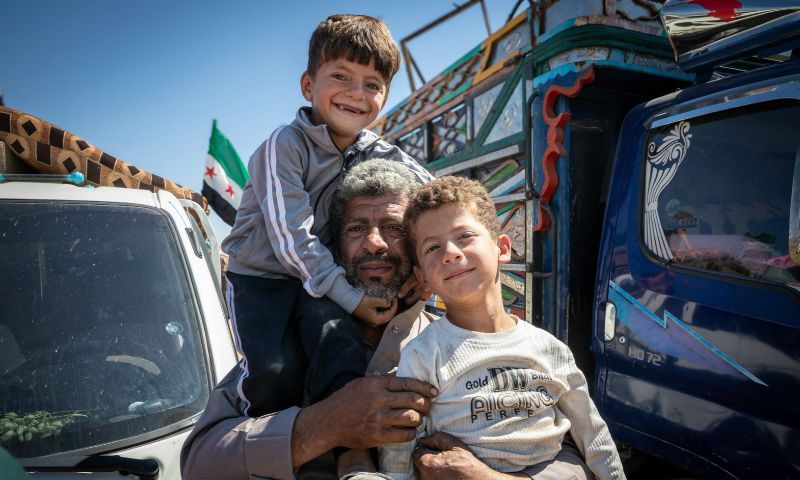
 A man carries two children before leaving a displacement camp in northern Syria, September 27. (OCHA)
A man carries two children before leaving a displacement camp in northern Syria, September 27. (OCHA)
The United Nations Office for the Coordination of Humanitarian Affairs (OCHA) said 38,836 internally displaced Syrians left displacement camps after departures accelerated during July and August.
The UN office said on Sunday, September 27, that 19,600 of those who left received support through return mechanisms during the past two months, noting that 130 internally displaced persons sites had closed.
According to OCHA, the number of internally displaced people who have received return assistance has exceeded 60,000 since January 2026. The office described the development as reflecting continued progress toward the vision of a Syria “without camps.”
OCHA noted that the growing number of returnees is increasing pressure on services and infrastructure in communities of return, as humanitarian needs shift from camps to those communities.
It said inadequate housing, damaged infrastructure, limited services, and restricted livelihood opportunities are undermining sustainable reintegration and increasing the risk of secondary displacement.
By contrast, rehabilitating infrastructure and services helps create conditions for return and recovery across Syria, according to OCHA. This includes rehabilitating bakeries, water and electricity networks, hospitals, schools, roads, bridges, and housing in communities affected by returns.
The UN office said humanitarian partners succeeded in reaching an average of 2.53 million people per month between January and July 2026, adding that 314 organizations assisted in 4,765 communities.
More than $123 million was also provided in cash assistance and vouchers, while Raqqa governorate (northeastern Syria) recorded some of the strongest signs of recovery in northeastern Syria, with improvements in water, electricity, and protection conditions.
Despite this assistance, the UN office warned that economic vulnerability remains a major obstacle to sustainable recovery and durable solutions.
Deputy Minister of Emergency and Disaster Management Ahmed Ekzayez said the ministry has 1,519 projects aimed at facilitating the return of displaced Syrians from camps, targeting areas that have suffered destruction.
He added that identifying barriers to return, such as the lack of sewage systems, infrastructure, and basic services, makes it easier to design projects based on needs. He said an assessment of intentions to return showed that 57% of displaced people living in camps currently want to return.
Ekzayez said the number of displaced people has declined significantly, but the main problem is that hundreds of thousands remain displaced.
His remarks came during a seminar titled “Regional Stability, Security and Sustainable Return: The Imperative of a Syria Without Camps,” organized by Syria’s Permanent Mission to the United Nations on September 23.
UN and international officials participated in the seminar, including representatives of the United Nations Development Programme (UNDP), the Office for the Coordination of Humanitarian Affairs (OCHA), the International Organization for Migration (IOM), and the UN Refugee Agency (UNHCR). Minister of Emergency and Disaster Management Raed al-Saleh, Syria’s Permanent Representative to the United Nations Ibrahim Olabi, and Qutaiba Qadish, director of the International Cooperation Department at the Ministry of Foreign Affairs, also attended.
Several displaced people in Syrian camps have complained about returning to areas that lack infrastructure and basic services, amid government pledges to complete the “Syria Without Camps” program by September 2027.
Syrian President Ahmed al-Sharaa issued Decree No. 59 last March, providing for the establishment of a government committee to rehabilitate infrastructure in areas of displacement in preparation for the return of displaced people to their homes.
The decree stipulated that the committee would be chaired by the Minister of Emergency and Disaster Management, Raed al-Saleh, with the participation of several ministries and governorates, to work on creating suitable conditions for the return of displaced people.
if you think the article contain wrong information or you have additional details Send Correction


 A
A
A
A
A
A



 More Politics