


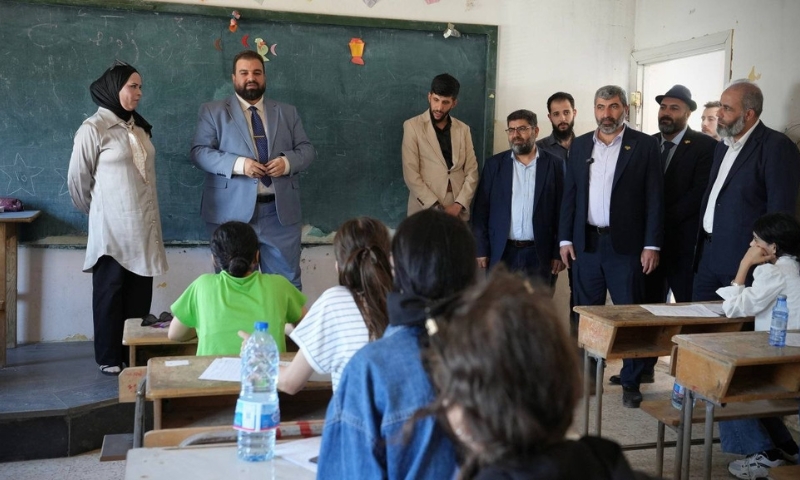
 Suwayda Governor Mustafa al-Bakour inspects the special examination session in the governorate’s northern countryside, August 29, 2026 (Suwayda Governorate)
Suwayda Governor Mustafa al-Bakour inspects the special examination session in the governorate’s northern countryside, August 29, 2026 (Suwayda Governorate)
Enab Baladi, Rkkan al-Khder
Students and parents heading to the northern countryside, where the examination centers were located, were subjected to verbal insults, while local armed groups fired shots into the air at al-Anqud roundabout in central Suwayda city in an attempt to force the buses to turn back.
After the buses returned from al-Anqud roundabout, a number of students and their parents gathered at Municipal Stadium roundabout in the city and staged a sit-in to protest being prevented from reaching the examination centers. The protesters partially blocked the road before the gathering dispersed.
According to Enab Baladi’s correspondent in Suwayda, groups opposing the exams, along with members of the Shahba Operations Room, which is affiliated with the National Guard, blocked buses carrying students and examination supervisors at several points along the Damascus-Suwayda road as they headed to centers in villages in the governorate’s northern countryside.
The correspondent said the groups prevented the buses from continuing toward the northern villages, where Syrian government forces are stationed, at several locations, including the Shahba checkpoint and al-Anqud roundabout.
According to the correspondent, the armed groups that stopped the buses said they intended to continue blocking the road throughout the examination period.
Mutual accusations between the Syrian government and the National Guard, an armed group affiliated with Hikmat al-Hijri, the spiritual leader of the Druze community in Suwayda, have also surrounded the dispute over the students’ exams.
Suwayda Governor Mustafa al-Bakour said that “outlaw groups” had prevented students from leaving the city for their examination centers, according to the official Syrian al-Ikhbariya channel.
In the same context, al-Thawra newspaper quoted Qutaiba Azzam, director of media relations at the Suwayda Media Directorate, as saying that a delegation from the Education Directorate was attacked while traveling to supervise the examination centers and was forced to return after the bus carrying it was targeted.
For its part, the National Guard denied responsibility for preventing students from traveling to take their exams, saying it is “a military institution that follows the will of its people and their civil administration.”
It added that what happened “was a free popular movement rejecting those humiliating and exhausting exams for students and their families.” It said that “those who claim concern for the students’ safety should not have made their future a means of subjugating their families through exams that violate ethical values before educational and pedagogical standards.”
Enab Baladi discussed with a legal expert how Syrian law addresses the rights to freedom of movement and education, as well as the responsibility of the various parties involved in the issue.
According to legal scholar and director of the Syrian Dialogue Center, Dr. Ahmed al-Qurbi, the Constitutional Declaration issued in March 2025 stipulates that Syrian citizens have freedom of movement and that their private lives must be protected. Any infringement on those rights constitutes a criminal offense punishable by law.
Al-Qurbi told Enab Baladi that preventing Suwayda students from traveling to the governorate’s countryside to take their exams could involve more than one crime under Syrian law. He said the least serious of these is the unlawful restriction of liberty through blocking a road by force.
He explained that the alleged violations were not limited to restricting freedom of movement. Blocking roads with weapons, he said, is considered a criminal act under Syrian law and can be punishable by fixed-term or life hard labor, depending on aggravating circumstances.
Regarding preventing a person from continuing their education, al-Qurbi said the law does not contain specific provisions addressing the denial of movement for the purpose of pursuing education. Instead, he said, the matter falls entirely under restrictions on personal liberty, which encompass a person’s movements for work, study, or any other purpose.
He explained that the basic principle under the law is that every person has full freedom to travel wherever they choose, except under certain compelling or temporary circumstances. These could include the spread of an epidemic, as occurred during the COVID-19 pandemic when governments imposed restrictions on citizens’ movements, or armed clashes or war that create exceptional security conditions and may prompt the state to impose a curfew or movement restrictions.
Al-Qurbi said such circumstances cannot be invoked without legal justification to restrict a person’s freedom to travel to any place they choose.
The National Guard, which is affiliated with Hikmat al-Hijri, the spiritual leader of the Druze community in Suwayda, accused the Syrian government of continuing to exert pressure on “the people of the mountain through various methods.” It said one of the most prominent was an attempt to force the exams to be held in “occupied villages,” despite what it described as “broad popular rejection of this step.”
The group described accusations that it was responsible for preventing students from reaching their exams as “false allegations intended to deceive public opinion.”
Legal scholar and Syrian Dialogue Center director Dr. Ahmed al-Qurbi said the Constitutional Declaration stipulates that the state must guarantee its citizens’ right to education. However, he said the circumstances in Suwayda have created realities that cannot be ignored, making it impossible to treat the issue in the same way as in a Syrian area fully controlled by the government.
He added that the control of Suwayda by “armed factions opposed to the government” has made it impossible to hold the exams inside the governorate while providing all the required logistical services, particularly securing the examination centers.
Al-Qurbi explained that conditions in Suwayda left the government with limited options for completing the basic and secondary education certificate exams for the governorate’s students, after obstacles prevented them from taking the regular examination session held earlier.
He said those circumstances had complicated the government’s position. During the first examination session, students were asked to take their exams in Damascus before a decree was issued establishing a special session in the Suwayda countryside. Al-Qurbi said the government had no other option.
if you think the article contain wrong information or you have additional details Send Correction


 A
A
A
A
A
A


 More Politics