


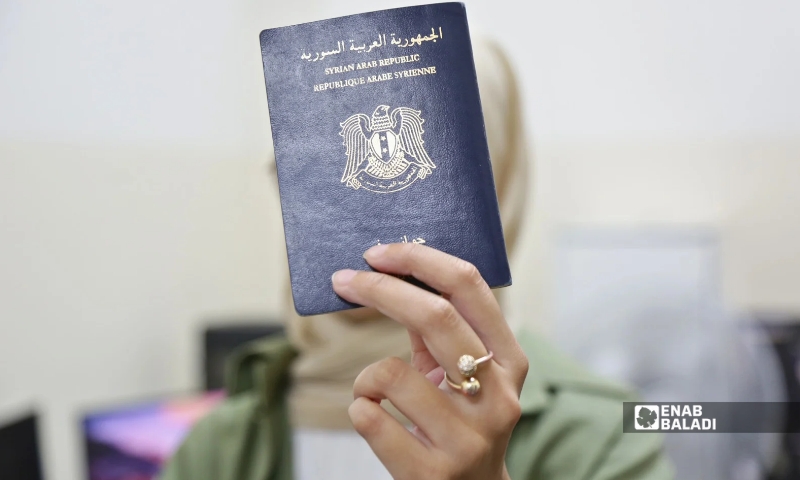
 The International Criminal Police Organization, Interpol, cancels an alert containing lists of more than 24,000 Syrian passports previously reported as stolen, September 5, 2026. (Enab Baladi/Noor Hamza)
The International Criminal Police Organization, Interpol, cancels an alert containing lists of more than 24,000 Syrian passports previously reported as stolen, September 5, 2026. (Enab Baladi/Noor Hamza)
The International Criminal Police Organization, Interpol, canceled an international alert issued in 2024 that contained lists of 24,511 Syrian passports previously reported as stolen.
Abdul Rahim Jabara, director of the International Cooperation Department at the Ministry of Interior, said the alert was canceled following sustained efforts by Interpol’s Damascus branch and the International Cooperation Department, in coordination and continuous communication with Interpol’s General Secretariat. He said the process resulted in “verification that the alert was incorrect and based on inaccurate facts.”
The former regime had requested an international alert on these passports in November 2024, following the capture of Aleppo, claiming they had been stolen from an immigration and passports center in the city. Official documents, however, confirm that the passports had been issued through proper procedures and legally delivered to their holders, according to Jabara.
The canceled alert had caused significant disruption for Syrian citizens and obstructed their travel, leading to the detention of some holders of these passports in several countries and the confiscation of their documents.
On August 12, the Ministry of Justice announced the formation of an “Extradition Committee” to communicate with Interpol regarding individuals wanted by the Syrian authorities. The announcement, made by Deputy Minister of Justice Mustafa al-Qasim, also referred to the establishment of offices to receive transitional justice complaints and to efforts to recover Syrian assets allegedly embezzled and transferred abroad.
This establishes an institutional initiative, but does not in itself create an international mechanism for arrest or extradition. The official announcement also does not identify the committee’s members, its legal mandate, the list of targeted individuals, its procedures, or whether any Red Notice or extradition request is currently under consideration.
According to the Syrian Network for Human Rights, international police cooperation is often portrayed as allowing a state to locate a suspect abroad and simply secure that person’s return. In practice, however, Interpol is an organization for cooperation among national police authorities. It does not issue binding international arrest warrants, administer extradition proceedings, determine criminal responsibility, or compel any member state to surrender an individual.
The Syrian National Central Bureau in Damascus serves as a liaison channel connecting Syrian law enforcement authorities with Interpol’s secure communications network and other member states. It is not an authority with powers outside Syria. Interpol records show that Syria has been a member since June 29, 1953.
The most important practical tool in this context is a Red Notice, which is a request to law enforcement authorities around the world to locate a person and provisionally arrest them pending extradition, surrender, or another legal measure.
A Red Notice remains a request, not an arrest warrant. The individual is wanted by the requesting country or court, not by Interpol. Each country applies its own laws when deciding whether to take action against the person, a point clearly emphasized in Interpol’s own guidance.
The legal process is therefore more complicated than it may appear. A competent Syrian judicial authority must first issue a valid arrest warrant or judicial decision. The relevant Syrian authorities must then prepare a detailed request containing identifying information, a clear description of the alleged conduct, the applicable criminal provisions, and the judicial basis for seeking the individual.
When a Red Notice is requested, Interpol assesses whether its publication complies with the organization’s Constitution and its rules on the processing of data. If the person is located, the country concerned decides whether its domestic law permits provisional arrest. Syria must then pursue extradition proceedings in accordance with that country’s applicable legal system.
The committee could assist during this preparatory stage. Its likely value lies in coordinating judicial, police, prosecutorial, and diplomatic work, as well as matters related to evidence. Such coordination could improve the quality and consistency of requests, including translation and communication with foreign authorities. It cannot, however, compensate for insufficient evidence, an invalid judicial decision, or weaknesses in an individual case.
From a sound legal standpoint, a request also cannot be based on political affiliation, official status, or membership in the structure of a former government. It must instead establish individual criminal responsibility through an allegation that is sufficiently clear and grounded in a legal basis.
Interpol’s own rules impose additional restrictions. Red Notices generally require the case to concern a serious ordinary-law crime, meet minimum thresholds related to penalties, and include sufficient judicial and identifying information. Interpol’s Constitution also requires cooperation to take place within the limits of domestic laws and in the spirit of the Universal Declaration of Human Rights, while prohibiting the organization from intervening in matters of a political, military, religious, or racial character. Its rules on the processing of data further define these requirements.
This does not mean that allegations against former officials are automatically excluded simply because they arise in the context of a political transition or armed conflict. Serious crimes may still fall within Interpol’s scope.
The question is whether the ordinary criminal nature of the alleged conduct outweighs the political or conflict-related elements in which Interpol is prohibited from intervening. This assessment is not automatic. It depends on the nature of the charges, the facts supporting them, the status of the wanted individual, the broader context, the quality of the information submitted, and the requirements of Interpol’s neutrality.
if you think the article contain wrong information or you have additional details Send Correction


 A
A
A
A
A
A







 More Politics