
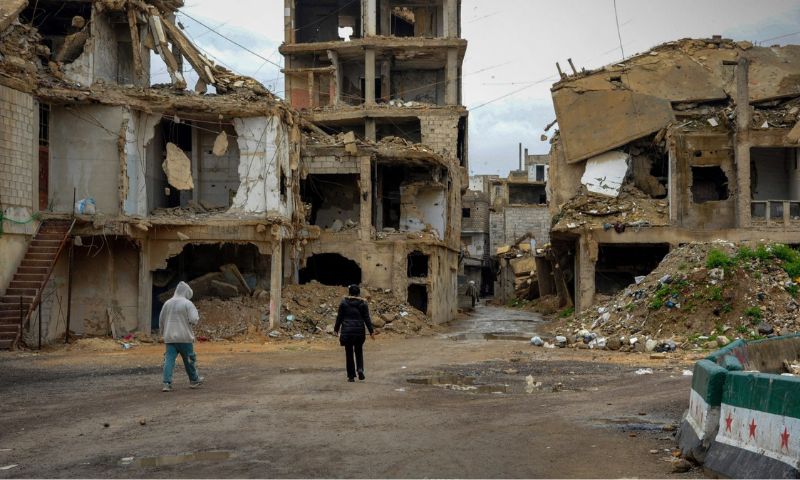

Deputy Minister of Public Works and Housing for Planning and Studies Imad al-Masri said baseline estimates indicate that Syria has about 4.25 million housing units, including around 1.32 million units damaged to varying degrees.
The housing gap reached about 1.9 million units in 2025 and could rise to 2.5 million units by 2030 if the pace of housing supply growth does not accelerate, according to al-Masri.
Al-Masri told the Syrian Arab News Agency (SANA) on Wednesday, September 23, that the ministry aims to produce and address around two million housing units by 2035, which would help reduce the deficit by more than 70%.
To achieve this, the ministry is pursuing four parallel tracks: completing existing and stalled housing projects, rehabilitating homes that can be repaired, rebuilding damaged housing, and increasing new supply in line with actual demand across the governorates.
Priorities Differ by Governorate
Al-Masri said intervention priorities differ from one governorate to another based on the scale of demand and the housing deficit, the condition of the existing housing stock, population growth and return needs, as well as the availability of land and employment opportunities and the capacity of infrastructure and services to accommodate future expansion.
In this context, the ministry uses spatial data and geographic information systems to compare locations and prioritize projects, al-Masri said. The process takes into account efficient land use, development costs, the cost of providing services, and the extent to which projects align with long-term regulatory and regional plans.
The Regional Planning Commission has completed the “National Framework for Regional Planning 2035,” which seeks balanced spatial development and uses spatial databases to define urban and industrial zones, make use of local resources and create jobs while taking natural hazards into account, according to SANA.
On financing, al-Masri said the Ministry of Public Works and Housing is moving toward a mix of government investment, private sector participation, investment partnerships, and foreign investment. One proposed model involves developing land owned by the General Housing Establishment through investors, as in the Abyat Hills project, with the state providing the land and the investor developing the project and its infrastructure.
He added that investment in the housing sector does more than increase the number of residential units. It also stimulates construction, supply chains and service sectors while generating jobs and local economic activity.
Al-Masri said the ministry’s goal is to achieve a balance in urban development among the governorates by directing housing and investment projects toward areas capable of growth and absorption, while rehabilitating existing cities to achieve a more efficient distribution of population, economic activity and services.
Reconstruction Estimates Vary
The World Bank estimated the cost of Syria’s reconstruction at around $216 billion under its midpoint scenario, according to a report issued on October 21, 2025.
The nationwide physical damage and reconstruction assessment covers infrastructure and buildings from 2011 through 2024. The war damaged nearly one-third of Syria’s total prewar fixed capital, including buildings, factories, machinery, equipment, transportation assets such as trucks, and devices and technologies used in production.
The World Bank estimated direct physical damage to infrastructure and residential and non-residential buildings at around $108 billion. Infrastructure accounted for 48% of total damage, or $52 billion, followed by residential buildings at $33 billion and non-residential buildings at $23 billion.
United Nations estimates put Syria’s reconstruction costs at between $250 billion and $400 billion.
Syrian Economy Minister Mohammad al-Shaar told Reuters in October 2025 that reconstruction costs in Syria could exceed $1 trillion if infrastructure is rebuilt using modern methods. He said the process would take a long time, while rebuilding homes alone could take between six and seven years.