
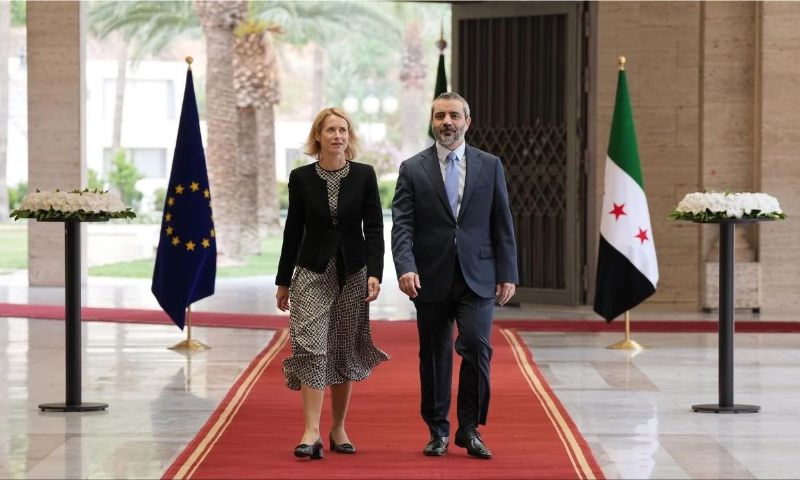

Syrian Foreign Minister Asaad al-Shaibani discussed several issues with EU High Representative for Foreign Affairs and Security Policy Kaja Kallas during her visit to Damascus, including new agreements, support for the Syrian government during the transitional process, and developments in southern Syria.
At a press conference held today, Tuesday, September 29, following Kallas’s visit, al-Shaibani announced that Damascus intends to raise the level of its diplomatic representation to the European Union in Brussels to ambassadorial level.
According to al-Shaibani, Damascus also intends to conclude a new partnership agreement to replace the 1977 international cooperation agreement between Syria and the European Union, with the two sides preparing a joint scoping paper before the end of the first quarter of next year.
The Syrian government is seeking a “strategic” commitment by including Syria in the EU’s Multiannual Financial Framework from 2028 through 2034, ultimately aiming to build a “solid” partnership implemented through state institutions.
Syria is drawing on the experience of Estonia, Kallas’s home country, which al-Shaibani described as a leader among digital states, with the aim of making it a partner in Damascus’s governance programs and in the SIGMA roadmap for governance development, ultimately improving the delivery of government services to citizens.
Regarding southern Syria, al-Shaibani called on the European Union to take a “decisive position” by having the Foreign Affairs Council describe the attacks by “their real names,” as he put it, and demand the withdrawal of Israeli forces from territories they entered following December 8, 2024.
Al-Shaibani also called for the remaining sanctions on Syrian government institutions to be lifted while retaining sanctions on figures associated with the former Syrian regime.
He also said the partnership between Syria and Europe is rooted in their shared geography, adding that “Syria’s stability is an integral part of Europe’s own security.”
During the press conference, al-Shaibani also discussed Syrian efforts on internal security, combating narcotics and human trafficking, as well as issues with international dimensions, including closing the file on weapons of mass destruction.
The foreign minister also referred to steps related to the government’s political process, including convening the People’s Assembly and integrating the Syrian Democratic Forces (SDF).
Kallas Awaits Effective Syrian Role
For her part, Kallas said the success of Syria’s transition matters to Europe and, first and foremost, to Syrians, who she said had “waited a long time for peace, freedom, and a future.”
She added that Europeans are using political and economic tools to help Syria pursue an inclusive transition, noting that the European Union moved after the fall of the former regime to lift economic sanctions on Syria and support recovery and reconstruction.
Europe now aims to mobilize more investment and improve its partnership with Syria, Kallas said, adding that progress also depends on the Syrian side.
Kallas also pointed to an upcoming high-level dialogue concerning political and security technical committees before next summer.
She said investment requires security, safety, and the rule of law, as well as equal participation by women and men.
Kallas added that a successful transition depends on national reconciliation and accountability, noting that the European Union supports transitional justice bodies and the Missing Persons Commission in these areas.
Regarding southern Syria, Kallas briefly referred to negotiations between Syria and Israel and called for respect for the 1974 ceasefire agreement.
Kallas also addressed Russia’s presence in Syria, saying, “We believe the Syrian government has managed to reduce the Russian presence here, and there are alternatives to Russia that can be trusted and relied upon instead.”
During the press conference, Kallas also addressed international issues related to Syria’s position on the ongoing conflict between the United States and Iran, saying Damascus’s decision to distance itself from the conflict had helped prevent it from spreading.
European Position on Syria
Enab Baladi described the European position toward Syria’s new government as broadly paralleling the US approach of conditional support.
Europe has lifted most sanctions imposed on Syria, particularly those affecting early recovery, reconstruction, and the entry of European investment companies.