


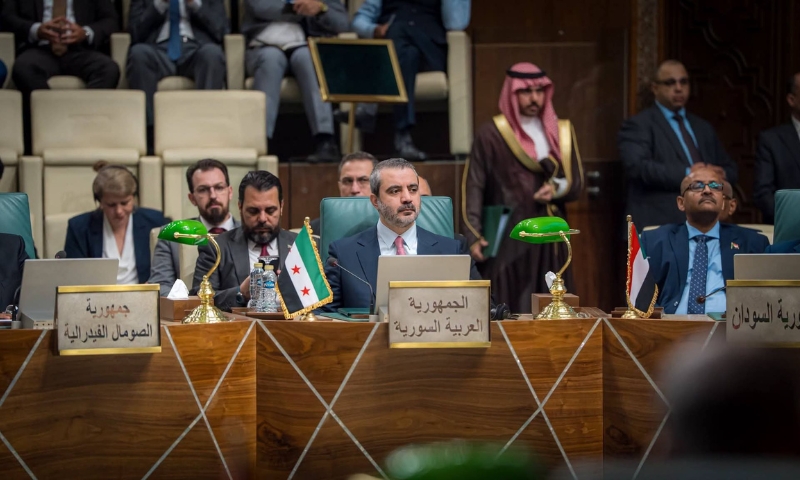
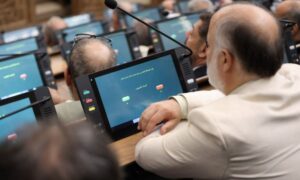
 Syrian Foreign Minister Asaad al-Shaibani takes part in a meeting of Arab foreign ministers at the Arab League Council in Cairo, September 7, 2026. (Syrian Ministry of Foreign Affairs)
Syrian Foreign Minister Asaad al-Shaibani takes part in a meeting of Arab foreign ministers at the Arab League Council in Cairo, September 7, 2026. (Syrian Ministry of Foreign Affairs)
Enab Baladi, Yazan Kur
After nearly 15 years, the Arab League has ended the political, economic, and social sanctions imposed on Syria, under a decision adopted by the League Council at the ministerial level during its 166th regular session in Cairo on September 7. The move reflects a shift in the Arab approach toward Syria, from isolation and sanctions to supporting recovery and reconstruction.
The decision stipulated lifting sanctions imposed on the Syrian state by Arab League institutions and bodies, as well as joint Arab action organizations, including measures adopted since November 2011. Individual measures against several former regime officials, including travel bans and asset freezes, will remain in place.
The decision also tasked the Economic and Social Council with following up on the implementation of the sanctions removal and eliminating measures imposed on Syria by Arab League institutions and bodies.
The move follows a series of international and Arab steps that have ended a significant part of Syria’s economic isolation, including the lifting of U.S. and European sanctions and Syria’s removal from the U.S. list of state sponsors of terrorism, as Foreign Minister Asaad al-Shaibani noted during the meeting of Arab foreign ministers.
Damascus welcomed the decision, describing it as a step toward strengthening joint Arab action and supporting economic recovery, reconstruction, and stability. The Central Bank of Syria said lifting Arab sanctions opens broader prospects for economic and banking cooperation with Arab countries and institutions, particularly in trade, investment, and capital flows.
The lifting of sanctions could allow Arab companies and institutions to expand their activities in Syria and resume or implement previously signed projects and agreements, particularly in the energy, electricity, transport, ports, infrastructure, agriculture, and industrial sectors, after financial and legal restrictions linked to sanctions had hindered a number of these investments.
However, lifting Arab sanctions does not automatically mean an influx of investment or an immediate improvement in the Syrian economy. Damascus’ ability to attract capital remains tied to other factors, including the legal, banking, and administrative environment, security and political stability, and the ability of Syrian institutions to turn agreements and memoranda of understanding into actual projects.
Amer Fakhoury, a professor of public international law and an expert on international relations, told Enab Baladi that the importance of the Arab League’s decision to lift sanctions on Syria is “primarily political,” describing it as a gradual closing of a period that began in 2011, when Syria’s membership in the Arab League was suspended and political and economic measures were imposed on it.
Fakhoury said Syria’s return to the Arab League in 2023 was a first step, but restoring its seat did not necessarily remove the legacy of isolation. He said the decision to lift sanctions, issued on September 9, represents an additional step along this path.
According to the international law professor, the decision lifts political, economic, and social sanctions on the Syrian state and its institutions while maintaining sanctions imposed on former regime officials. He said this sends a clear message distinguishing the current Syrian state from officials associated with the previous period.
He added that the decision effectively means the end of the Arab isolation of the Syrian state, but said he would not describe the current phase as “full engagement.” In his view, full engagement cannot be measured by a single decision, but rather by the scale of diplomatic relations, trade, investment, banking activity, aviation, joint projects, and political and security coordination.
Fakhoury distinguished between the political decision and its economic consequences, explaining that lifting sanctions does not mean billions of dollars will immediately enter Syria. It does, however, remove an important layer of political, legal, and psychological restrictions that had made dealing with Syrian institutions more difficult.
He said the decision could further open the way for bilateral trade, financial transfers and banking transactions, trade financing, the movement of companies and capital, land and air transport, and the establishment of joint Arab projects.
Fakhoury placed particular emphasis on the banking sector, saying reconstruction “does not begin with cement alone, but with the financial system.” An investor may decide to invest, he said, but an inability to transfer funds, open letters of credit, finance trade, or repatriate profits makes implementing investments more complicated.
Regarding reconstruction, Fakhoury said the decision could help advance the process, but warned against exaggerating its immediate impact given the scale of Syria’s needs.
He pointed to World Bank estimates putting the cost of rebuilding Syria’s damaged physical assets at about $216 billion, within a range of $140 billion to $345 billion, while direct physical damage was estimated at about $108 billion.
He said these figures illustrate the scale of the gap between lifting sanctions and actual reconstruction, describing the decision as a facilitating factor that is not sufficient on its own to cover rebuilding needs.
The public international law professor believes lifting sanctions could encourage Arab investment, noting that some investments had already begun before the decision was issued.
He cited Saudi Arabia as an example, saying an investment package in Syria was announced in February 2026 covering airports, aviation, telecommunications, water, real estate, and infrastructure.
Among the projects Fakhoury cited is “Silklink,” implemented by Saudi Telecom Company (stc), at a value of 3 billion Saudi riyals. The project aims to establish a fiber optic network spanning more than 4,500 kilometers, along with data centers and international connectivity infrastructure. He also pointed to other aviation projects, including the development of airports in Aleppo and the establishment of “flynas Syria.”
On the extent of Syria’s return to the Arab system, Fakhoury said he prefers to describe the current stage as a transition from “political return” to “practical integration,” while stressing that Damascus has not yet reached the end of this process.
He explained that Syria’s return to the Arab League in 2023 represented the first step, while the lifting of sanctions in 2026 marks a second, more advanced stage. The next stage, he said, would involve turning political rapprochement into a network of Arab-Syrian interests encompassing trade, investment, banking, transport, energy, security, borders, and joint projects.
Fakhoury said expanding Syria’s economic relations with Saudi Arabia, Gulf countries, Jordan, Egypt, and other Arab states could connect Damascus more closely to a network of Arab interests, with relations extending beyond diplomacy to investment, infrastructure, and trade.
He said this could give Arab countries greater capacity to positively influence Syria’s future, arguing that influence in international relations does not always come through pressure and sanctions, and that investment, trade, and economic integration can be more influential than isolation.
if you think the article contain wrong information or you have additional details Send Correction


 A
A
A
A
A
A


 More Politics