
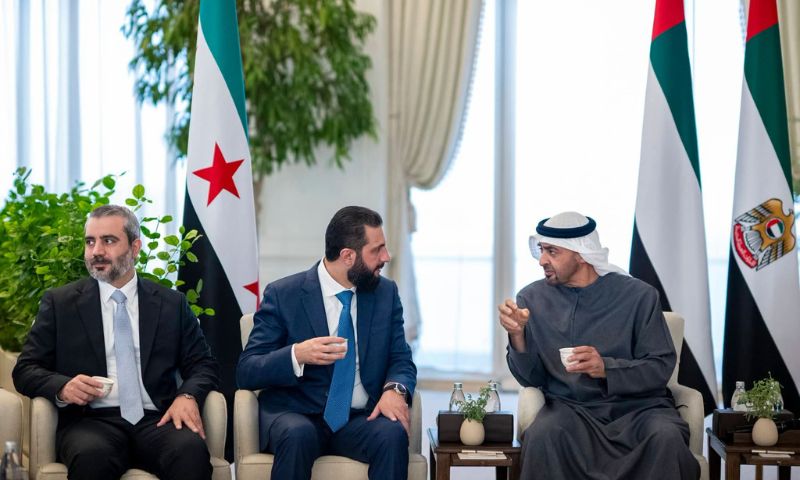

Syrian President Ahmed al-Sharaa and his UAE counterpart, Sheikh Mohammed bin Zayed Al Nahyan, affirmed their commitment to continue advancing Syria-UAE relations in a way that helps fulfill both countries’ aspirations for development and for building a more “advanced and prosperous” future.
During their meeting on Tuesday, September 15, the two presidents discussed bilateral relations, various aspects of cooperation between the two countries, and ways to strengthen them, particularly in the economic and development fields. They also discussed expanding cooperation and partnerships to support development efforts and serve mutual interests, according to the Syrian Presidency.
The two sides praised the visit of a UAE economic delegation to Syria last May, saying it was aimed at “strengthening cooperation and establishing frameworks that support economic recovery and contribute to developing strategic projects through sustainable development partnerships that serve the development priorities of both countries,” according to the Emirates News Agency, WAM.
The two sides also discussed a number of regional and international issues and developments, particularly those affecting the Middle East and their implications for the region’s future, security, and stability. They stressed the importance of working to establish the foundations of regional and international security and stability in a way that serves the interests and development of peoples worldwide.
Al-Sharaa met the UAE president in the capital, Abu Dhabi, in the presence of Syrian Foreign Minister Asaad al-Shaibani and UAE Deputy Prime Minister and Foreign Minister Sheikh Abdullah bin Zayed Al Nahyan, on the sidelines of the Arab Media Summit 2026 in Dubai.
The two presidents also discussed the Arab Media Summit and the importance of the issues on its agenda.
Bin Zayed thanked al-Sharaa for accepting the invitation to participate in the summit, which represents the largest media gathering in the Middle East and is organized by the Dubai Press Club under the patronage of UAE Vice President Sheikh Mohammed bin Rashid Al Maktoum.
UAE Vice President, Prime Minister and Ruler of Dubai Sheikh Mohammed bin Rashid Al Maktoum also said UAE-Syrian relations are based on “affection, friendship, brotherhood, and appreciation,” expressing optimism that Syria would return to the global standing it “deserves.”
Syria Has Become a “Great Opportunity”
Al-Sharaa said during his address at the Arab Media Summit in Dubai on Tuesday that “Syria, which the world and the media once viewed as a major problem, has become a great opportunity from which everyone can benefit,” adding that the country had returned to its regional and international role.
Syria is undergoing “a transition from a quasi-socialist system dominated by corruption and bureaucracy to a liberalized system based on a free-market economy,” according to al-Sharaa.
He added that Syria had transformed from an exporter of Captagon and a conflict zone into an area of stability, and that it was now being discussed as a secure commercial corridor for supply chains between East and West.
The Syrian president said the country’s location serves the entire region, making its stability a shared interest for all. He praised the UAE as one of the first countries to “seize opportunities in Syria,” citing DP World’s investment in the Port of Tartous.
According to al-Sharaa, the phase Syria is going through has its own special circumstances, during which the country is trying to benefit from all available experiences despite the challenges. He noted that Syria had endured 60 years of administrative corruption and poor planning and is now rebuilding itself and its institutions.
The “liberation of Damascus” restored Syrians’ confidence in the state and brought hope not only to Syrians but to the entire region, according to al-Sharaa. He said Syria had succeeded in quickly overcoming threats of internal division and sectarian wars, as well as challenges related to infrastructure, energy, and sanctions.
He said the sanctions imposed on Syria had been extensive, with some dating back to 1979, noting that entire generations had never been exposed to financial trading mechanisms or bank guarantees. He described the lifting of sanctions as a “new birth for Syria.”
Syria’s Economic Advantages
Syrian President Ahmed al-Sharaa said the size of the Syrian economy stood at about $20 billion at the time of the “liberation” in late 2024, before rising to $32 billion in 2025, with expectations that it would reach $50 billion this year.
He added that Syria “offers tremendous opportunities for Gulf states, neighboring countries, and Europe,” noting that the government is working on major investment projects while focusing on clear principles, foremost among them credibility, to attract countries interested in building relations with Syria.
Al-Sharaa also highlighted the importance of the agricultural sector, saying Syria has production capacity sufficient to feed 70 million people, which could rise to meet the needs of 100 million people if modern technologies become available. He said this could contribute to food security across a large part of the region.
Al-Sharaa also addressed Syria’s transitional phase and the shocks beyond its control that have accompanied it, saying the period requires important decisions whose positive effects will become apparent over time.
Focus on Openness and Stability
Syria is open to everyone and relies heavily on support from its Arab “brothers,” according to al-Sharaa, who said Damascus has managed to build relations with multiple parties. He added that Syria is working to achieve stability in the region amid concerns that wars could expand further.
He said Syria is working with other Arab countries to find ways to reduce the effects of war and avoid potential future risks. Amid numerous challenges, he said, Damascus has focused on “continuous and serious work to serve the Syrian people.”