


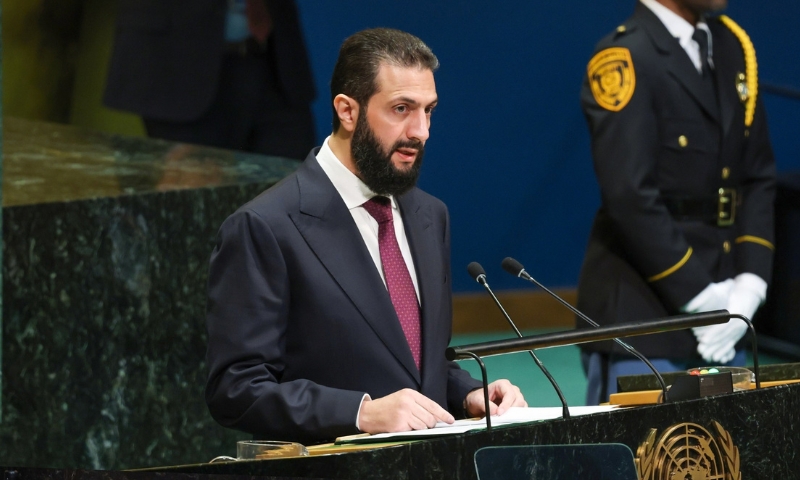
 Syrian President Ahmed al-Sharaa delivers Syria’s address at the 81st session of the United Nations General Assembly, September 23, 2026. (Presidency of the Syrian Arab Republic)
Syrian President Ahmed al-Sharaa delivers Syria’s address at the 81st session of the United Nations General Assembly, September 23, 2026. (Presidency of the Syrian Arab Republic)
Enab Baladi, Rkkan al-Khder
One year after his first participation, Syrian President Ahmed al-Sharaa returned on September 23 to deliver his second address at the annual meeting of the United Nations General Assembly, focusing on Syria’s recovery over the past year and growing international engagement with Damascus.
Al-Sharaa said that around 100 countries had opened channels of communication with Syria through nearly 4,000 engagements, meetings, and calls, while Damascus had become home to around 60 diplomatic missions and delegations had begun arriving in Syria as the country sought to restore its place among nations.
Al-Sharaa added that Syria had begun its recovery, highlighting progress made on the chemical weapons file and nuclear program and praising cooperation with the Organisation for the Prohibition of Chemical Weapons and the International Atomic Energy Agency.
Regarding the fight against drug networks, the Syrian president said authorities had seized around 700 million Captagon pills, dismantled 90 international networks, and worked to combat human trafficking and crime.
He also addressed the lifting of European and US sanctions, noting that all the previous steps had contributed to Syria’s recovery and helped enable the return of 3.5 million displaced people and refugees.
Wael Alwan, a researcher at the Jusoor Center for Studies, said Syria’s participation in this year’s UN General Assembly meeting was no less important than its participation last year. He said the previous participation focused on the beginning of the political transition and Syria’s complete repositioning into a regional and international standing entirely different from that of previous decades, generating considerable welcome and engagement with Syria’s return to an open, cooperative, and flexible role within its regional and international environment.
Alwan added that this year’s participation sought to reaffirm that new positioning amid the highly sensitive circumstances facing the Middle East, including the US-Israeli war on Iran, which coincides with a global energy crisis caused by the continued closure of the Strait of Hormuz, as well as other conflicts threatening security and stability in Lebanon and Yemen.
Ammar Jallo, a researcher at the Dialogue Center for Research and Studies in Washington, said the Syrian president’s speech brought together the main concerns of countries regarding Syria by addressing chemical weapons, the nuclear program, and drugs, as well as Syria’s recovery and its contribution to the return of refugees.
Jallo said al-Sharaa sought to reassure countries about the new Syria, adding that the speech’s importance lay in its grounding in practical steps, including the International Atomic Energy Agency’s praise for Syria’s cooperation and its access to nuclear facilities that existed under the Assad regime, as well as the departure of Iran and its militias from Syria and efforts to put an end to non-state activities by some Palestinian factions and other groups operating in the country.
Syrian President Ahmed al-Sharaa did not limit his speech to recovery and growing international engagement. He also addressed continuing Israeli violations in southern Syria and reaffirmed Damascus’ claim to the Golan Heights.
He warned that Israeli actions threaten Syria’s stability and run counter to the direction of the international community, while reiterating the Syrian government’s commitment to the 1974 Disengagement Agreement.
Jallo said al-Sharaa’s renewed emphasis on Syria’s commitment to diplomatic solutions clearly suggested that the country’s new approach represented a strategic course rather than passing statements or tactical steps, while maintaining Syria’s rights and continuing to document Israeli violations.
Jallo said he did not expect such speeches to translate into practical measures on the ground capable of stopping Israeli violations in southern Syria, given what he described as an Israeli government representing a hardline current. He attributed this to ambitions for regional dominance, including taking territory or extending influence in southern Syria, Lebanon, the West Bank, or Gaza.
Jallo said any future Israeli government could be more receptive to developing relations with Damascus because Syria’s stability represents an Israeli security interest, something he said many Israeli politicians and intellectuals recognize, on the grounds that a strong and stable Syria would prevent entities operating outside state authority from establishing a presence along the border between Syria and the occupied Golan Heights.
Alwan, for his part, said al-Sharaa’s messages were closely linked to the sensitive timing of the meetings. He said the Syrian president therefore focused on what Israel causes through what he described as its arrogance, excessive use of force across the region, and obstruction of initiatives aimed at achieving stability, while emphasizing Syria’s consistent commitment to openness toward security and peace without relinquishing national principles or yielding to pressure from others.
According to Alwan, al-Sharaa based his remarks on Israeli violations on the international legitimacy Syria enjoys. He said this legitimacy enabled the Syrian president to state these internationally supported principles explicitly, clearly, and forcefully, while Damascus had succeeded in building considerable diplomatic flexibility globally and was increasingly adopting a strategic approach by drawing national red lines that could not be crossed.
Alwan added that Israel’s overwhelming military power gives it an advantage, whether at the negotiating table or on the ground, but at the same time generates considerable regional and international opposition. He said this was reflected in the positive response to Syria’s positions, in contrast with the departure of many leaders and officials when Israeli Prime Minister Benjamin Netanyahu delivered his UN address.
Alwan said the significance of Syria’s position on Israeli violations also stems from the fact that Damascus is not alone in accusing Israel of obstructing regional and international efforts toward security and stability. In his assessment, curbing what he described as “Israeli interference” ranks among Syria’s top priorities.
if you think the article contain wrong information or you have additional details Send Correction





 A
A
A
A
A
A


 More Politics