


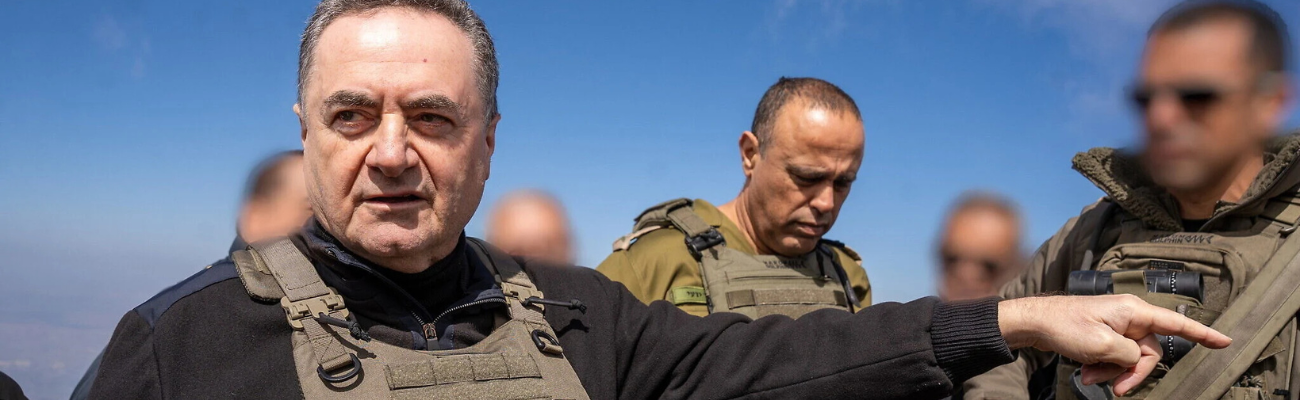
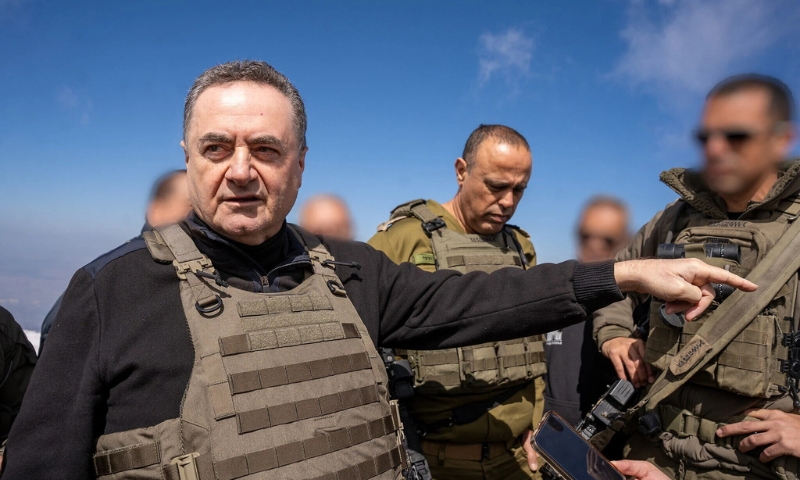
 Israeli Defense Minister Israel Katz stands on Mount Hermon, which Israel occupies in southern Syria, March 11, 2025. (Times of Israel/Emanuel Fabian)


 A
A
A
A
A
A
Mowaffak al-Khouja | Mohammad Deeb Bazzet | Odai al-Haj Hussin
While the Israeli government speaks of a security agreement with Syria, its army continues to carry out incursions and establish checkpoints in southern Syria, while also launching strikes deep inside the country.
Israeli threats and escalation, alongside simultaneous talk of negotiations, point either to the absence of a clear strategy or to concealed intentions amid pressure from the United States aimed at preventing the region from sliding into a confrontation whose consequences are unknown.
This dual approach raises questions about the future relationship between two neighboring countries, one of which has traditionally regarded the other as an enemy despite changes in political leaders and governments.
After Israel targeted Abu al-Duhur airport (Idlib, northern Syria), amid reports that Tel Aviv intended the strike as a message to Turkey, whose forces had reportedly been present at the airport shortly before the attack, a claim Ankara denied, the Syrian and Israeli governments sat at the same table under US sponsorship in the Jordanian capital, Amman.
In this report, Enab Baladi examines scenarios for the future relationship between Syria and Israel, the prospects of signing a joint security agreement or moving toward an open regional war, and the roles of regional states with direct interests, Turkey and Jordan, alongside the United States as mediator.
Conflict Scenarios: Peace or War?
Several scenarios have emerged for the future relationship between Syria and Israel, ranging from a form of peace whose outlines remain undefined to the less likely possibility of a Syrian-Israeli war that could expand to involve regional states, amid signs that Israel intends to keep military tension and escalation embedded in the geopolitical landscape.
Israel carried out strikes on the Abu al-Duhur military airport in Idlib governorate in northern Syria at dawn on August 18. Israel did not directly claim responsibility, but hinted at the attack and its intended messages indirectly. The strikes were among the few Israeli attacks to extend beyond southern Syria and reach the country’s northern interior since the fall of the former Syrian government.
Repeated statements by Israeli politicians also indicate that Tel Aviv remains wary of Syria’s current leadership and fears attacks launched from Syrian territory toward Israel, particularly after Israeli Prime Minister Benjamin Netanyahu spoke of a security belt established by Israel to counter the possibility of a “jihadist invasion” from Syrian territory.
In addition to the Abu al-Duhur strike, Israeli incursions have not stopped since they began in the first hours after the former government fell on December 8, 2024. Israeli shelling has also targeted areas around villages and populated communities in the southern Syrian governorates of Quneitra and Daraa.
At the same time, diplomatic efforts to broker a Syrian-Israeli security agreement have continued. The strikes on Abu al-Duhur were followed by a high-level meeting between the Syrian government, whose delegation was headed by Syrian Foreign Minister Asaad al-Shaibani, and an Israeli delegation headed by Mossad chief Roman Gofman.
The meeting, sponsored by the United States and hosted by Jordan, took place as part of efforts to de-escalate tensions and support stability in Syria and the region.
According to information that emerged from the talks, discussions focused on practical mechanisms to halt Israeli attacks, arrests, and targeting operations, as well as reviving negotiations to reach a security agreement that could form the basis for a broader future accord.
The discussions also addressed the importance of supporting Syria’s stability and preserving regional security, including efforts to narrow differences between Turkey and Israel and prevent existing tensions between the two countries from spilling onto Syrian territory.
According to a report by Al-Monitor, Israel has begun “recalibrating” its Syria policy and is exploring a path that could lead to a security agreement, while also seeking to ease tensions with Turkey and repair its relationship with US Special Envoy for Syria Thomas Barrack.

An Israeli soldier stands on a tank near Majdal Shams in the occupied Syrian Golan, December 11, 2024. (Reuters)
Managing the Conflict
Dr. Samir al-Abdullah, a senior researcher at the Arab Center for Contemporary Syrian Studies, does not expect Syria and Israel to achieve comprehensive peace or slide into a full-scale war in the near future. Instead, he expects the conflict to continue being managed through limited security understandings.
These understandings would be accompanied by intermittent negotiations and Israeli military pressure.
Al-Abdullah believes Israel is interested in an agreement that guarantees border security, prevents threats from emerging in the south, and establishes mechanisms for early warning, coordination, and regulation of foreign military presence.
At the same time, Israel has not yet shown a clear willingness to accept a balanced agreement requiring a full withdrawal from the areas it occupied following the collapse of the Assad government, or one restricting its freedom of military action inside Syrian territory.
According to al-Abdullah, the strike on Abu al-Duhur airport and the continuing incursions reflect this contradiction, as Israel uses force to impose its “red lines” and strengthen its negotiating position, particularly regarding Syrian-Turkish military relations and efforts to rebuild Syria’s military capabilities.
Al-Abdullah said Israel’s actions do not necessarily indicate rejection of an agreement in principle. Instead, they suggest a preference for security arrangements that entrench its superiority and provide broad guarantees rather than pursuing a fair political settlement. Any resulting security agreement, therefore, would not amount to a peace treaty or a final settlement of the Golan issue, but would instead be a temporary arrangement designed to reduce tensions and prevent friction.
Israel’s actions do not necessarily indicate rejection of an agreement in principle, but rather a preference for security arrangements that entrench its superiority and provide broad guarantees, rather than pursuing a fair political settlement. Any resulting security agreement would therefore not be a peace treaty or a final settlement of the Golan issue, but a temporary arrangement aimed at reducing tensions and preventing friction.
Dr. Samir al-Abdullah
Senior researcher at the Arab Center for Contemporary Syrian Studies
For his part, Dr. Zaki Lababidi, a board member of the Syrian American Council, ruled out the possibility that current tensions would develop into a broad military confrontation. He believes any Israeli escalation in the coming period would be driven by domestic political considerations rather than conditions on the ground in Syria, particularly with Israeli elections approaching.
Lababidi told Enab Baladi that Israeli Prime Minister Benjamin Netanyahu has repeatedly used military escalation in recent years to strengthen his political position, but said current circumstances are different because Israel’s international image has deteriorated following the war in Gaza and because clear US and European pressure exists to prevent the conflict from expanding.
Obstacles to Security Understandings
The main obstacles to security understandings between Syria and Israel remain a lack of trust, disagreements over withdrawal and sovereignty, Turkish-Israeli competition, and weak international guarantees and enforcement mechanisms.
Al-Abdullah therefore believes any agreement would require an end to Israeli strikes and incursions, a clearly defined phased withdrawal, and reciprocal security arrangements under United Nations supervision, paving the way for a later and broader discussion of peace and the Golan issue.
What About Damascus?
Damascus is theoretically capable of committing to prevent its territory from being used to threaten Israel, regulating military deployments in southern Syria, and activating communication channels and international verification mechanisms, according to al-Abdullah.
However, from a political and national perspective, the Syrian government cannot accept an agreement that permanently restricts its army and alliances, entrenches the reality of “occupation,” or turns southern Syria into an Israeli security sphere of influence, al-Abdullah said.
Israeli Violations in 2026
Sijil Center, which specializes in documenting Israeli violations in Syria, recorded 267 violations committed by Israeli occupation forces inside Syrian territory during August.
The center’s statistics showed that Israeli violations in August rose 43% from July, when 187 violations were recorded, and increased about 12% from June, when 239 violations were documented.
According to Sijil Center, August recorded the second-highest monthly number of Israeli violations since the beginning of 2026, after March, when 321 violations were documented. The August figure also exceeded the 254 violations recorded in April.
The center’s data showed that Israeli forces committed 1,752 violations inside Syria from the beginning of 2026 through the end of August.
Prospects for Escalation and Damascus’ Preparations
The regional system is in a state of disorder and war remains ongoing, with Syria serving as an arena for aspects of the conflict between Israel and Iran, according to Lawrence al-Shamali, a researcher at the Syrian Center for Security and Defense Studies, known as MISDAD.
Al-Shamali told Enab Baladi that Syria is exercising restraint in the face of repeated Israeli attacks and that Damascus possesses several tools and points of leverage that could be used to exert security and military pressure on Israel.
He added that Israel is fully aware of the threat Syria’s geography could pose if Damascus were to choose military escalation against Israel.
He explained that Syria can build new alliances with actors capable of posing threats to Israel, and also has human resources with practical military experience.
Israel is also seeking to maintain security along its border with Syria because of the threat that the border could pose to it.

Syrian President Ahmed al-Sharaa meets a US congressional delegation and US Special Envoy for Syria Thomas Barrack in Turkey, July 8, 2026. (Syrian Presidency)
Regional Positions: Turkey and Jordan Between Influence and Mediation
Israeli escalation deep inside Syria is raising growing questions about the role of regional powers in the Syrian file, particularly Turkey, which seeks to consolidate its influence in Syria, and Jordan, which is moving cautiously between its immediate security interests and its relationships with Washington and Tel Aviv.
The strike on Abu al-Duhur airport, in which Israel went beyond the geographic limits of its more customary operations in Syrian airspace, reshuffled calculations involving Ankara and Amman and made the question of the limits of Turkish and Jordanian roles central to any assessment of the future of the Syrian Israeli conflict.
Calculations of Influence and Stability
Political analyst Darwish Khalifa believes the Israeli air force’s ability to reach Abu al-Duhur airport in northern Syria, beyond the area in which Israel usually operates in Syrian airspace, is an important indication that Tel Aviv does not want a Syrian military establishment capable of rebuilding itself and again becoming a regional actor or influential power.
Khalifa told Enab Baladi that Israel has a problem with the Turkish presence in Syria, as it believes Ankara’s support for political Islamist movements could affect its security, particularly after Israel lost part of its image as the region’s dominant security power following the October 7 operation, known as Al-Aqsa Flood.
He added that Israeli government leaders had long portrayed Israel as the region’s dominant security power, but that image suffered a major setback after October 7. Israel, and particularly the governing Likud party, therefore does not want to lose further security or political standing, especially with elections less than two months away.
We are entering a new phase that will take shape after the region stabilizes, after the war with Iran, and amid a larger question over who will have the upper hand and the greatest influence in the region.
Darwish Khalifa
Political analyst
Khalifa said Turkey has a clear interest in seeing a stable Syria because stability would benefit Turkish trade and exports. He explained that some Turkish exports previously traveled through the port of Haifa and then overland to Jordan and Gulf states.
Today, Turkish trucks can travel from Gaziantep in Turkey’s far south through Syrian territory to the Syrian-Jordanian border in about four to five hours, Khalifa said, reducing transport costs and opening Syrian border crossings and roads to transit traffic and Turkish exports.
He noted that Turkey has a strategic interest in a stable Syria, in ending the current factional and militia environment, and in restoring the effective functioning of state institutions. He said there is a clear divergence in how Syria, Turkey, and Israel view these issues, but that the matter extends beyond simple competition for control and influence.
Khalifa believes Turkey enjoys greater popular standing in the region because it has not entered into direct hostility with most regional states, while Israel occupies territory in Lebanon, Syria, and Palestine. As a result, he said, it is difficult for Israel to gain the same level of popular and societal acceptance as Turkey.
Hosting With Security and Geopolitical Weight
Regarding Jordan’s hosting of the meeting that brought together the Syrian foreign minister and intelligence chief on one side and the head of Israel’s Mossad on the other, Khalifa believes the meeting marked the beginning of a track promoted by US envoy Thomas Barrack.
Khalifa told Enab Baladi that Jordan has a direct security interest in stability in southern Syria. Continued instability there and the persistence of a situation in which Suwayda (southern Syria) remains outside Syrian state authority could create opportunities for drug and Captagon smuggling into Jordanian territory, even if such activity occurs intermittently, directly affecting Jordan’s security and stability.
He added that Israeli expansion in southern Syria and its presence in areas near the Yarmouk Basin and al-Wehda Dam add another dimension. The area is connected to the water security of both Syria and Jordan, meaning both countries are affected in one way or another by developments in southern Syria, both in security and water terms.
According to Khalifa, Jordan’s selection as host for the meeting was highly significant. It allows Amman, on the one hand, to follow the course of negotiations and any understandings reached and, on the other, to offer support and advice to the Syrian side while strengthening relations with the United States as a regional actor capable of contributing to restoring stability in Syria.
Jordan’s selection as host for the meeting was highly significant. On the one hand, it allows Amman to follow the negotiations and any understandings reached, while on the other it can provide support and advice to the Syrian side and strengthen its relationship with the United States as a regional actor capable of contributing to restoring stability in Syria.
Darwish Khalifa
Political analyst
Khalifa said the United States wants to calm the competition between Israel and Turkey and focus, together with its regional allies, on Iran, whether by containing what Washington considers destabilizing Iranian behavior or later returning Iran to the position of a conventional state within the regional system.
He continued that if the United States succeeds in steering the region, particularly Syria and its south, toward stability, this would positively affect the region’s populations and US interests, while potentially limiting opportunities for China to expand strongly into the area and take advantage of its geopolitical location and economic potential.
He concluded that Jordan’s hosting of the meeting should not be viewed merely as the selection of a venue, but as part of wider regional arrangements in which Syrian, Jordanian, Israeli, and Turkish security interests intersect with US calculations concerning the region’s future.

Damage to the General Staff building in the Syrian capital, Damascus, following Israeli strikes, July 16, 2025. (AFP)
Jordan’s Consistent Position and Continued Neutrality
Jordanian political and security expert Dr. Amer Al Sabaileh said Jordan’s position has not specifically addressed Turkey, but has consistently emphasized preserving Syria’s geography as it is, which would also apply to Turkey even if indirectly. He said the absence of a direct statement on the matter was surprising.
Al Sabaileh told Enab Baladi that Jordan always speaks about the unity of Syrian territory and opposes actions that destabilize Syria.
He added that Jordan’s position would not change even in the event of escalation, because Jordan has no interest in conflicts or becoming involved in them.
Developments inside Syrian territory do directly affect Jordan, but Amman has managed this issue throughout the 15 years of the Syrian crisis, al Sabaileh said.
He noted that, from the US perspective, Jordan is geographically closest when it comes to Syria, and Washington treats it as a monitoring point for developments. Throughout the Syrian crisis, Jordan has consistently served as a reconnaissance and coordination hub for files related to Syria.
For the United States, Jordan is geographically the closest point when it comes to Syria, and Washington treats it as a monitoring point for developments. Throughout the Syrian crisis, reconnaissance and coordination centers for Syria-related files have consistently been based in Jordan.
Dr. Amer al Sabaileh
Jordanian political and security expert
Al Sabaileh said Jordan represents an important point for monitoring developments in Syria, particularly southern Syria, because it is a US ally with an American presence and geographic proximity. Amman therefore logically serves as a central hub for Washington in managing the Syrian file.
The US Position: Between Mediation and Commitment to Israel
The US role in Syria has become increasingly visible in efforts to contain tensions between Syria and Israel and promote security understandings intended to prevent the region from sliding into a broader confrontation.
At the same time, Washington continues to maintain its strategic commitment to Israel, raising questions about the limits of its ability to combine the role of mediator with its close partnership with Tel Aviv.
This balance became clearer after the Israeli strike on the Abu al-Duhur base. US Special Envoy for Syria Thomas Barrack criticized the operation, saying it did not serve de-escalation efforts. He also revealed that Washington was working on a mechanism to prevent friction among Syria, Israel, and Turkey, while the US administration stressed that its policies on key issues, foremost among them the Golan, had not changed.
As US efforts to revive security understandings continue, questions remain over what role Washington could play if this process falters, and whether it would merely seek to manage escalation or possess effective tools to influence the relationship between Damascus and Tel Aviv.
These developments raise questions about the limits of Washington’s influence in managing the Syrian-Israeli conflict, the relationship between its de-escalation efforts and its traditional commitment to supporting Israel, and the possible scenarios if the security track fails.
An Early Track
Syrian American Council board member Zaki Lababidi believes the United States did not enter the mediation track between Syria and Israel only recently, but began playing that role after the fall of the Assad government, with Ambassador Thomas Barrack appointed to oversee the Syrian file. According to Lababidi, Washington recognized from the start that developments in Syria could lead to regional escalation if they were not contained early.
Lababidi told Enab Baladi that Israeli strikes targeting Syrian military bases and airports after the fall of the government resulted from Israel’s lack of trust in the new authorities and its effort to disable Syria’s military capabilities and prevent them from being rebuilt.
Washington understood that continuation of this trajectory could open the door to a broader confrontation in the Middle East, something that does not align with the policy of US President Donald Trump, who prefers to avoid wars.
He added that the Israeli strike on Abu al-Duhur airport cannot be separated from Israeli concerns over the growing Turkish presence inside Syria. In his assessment, Tel Aviv fears that Turkey could deploy air defense systems that would restrict the freedom of action of the Israeli air force, one of the main pillars of Israel’s military superiority.
According to Lababidi, the United States viewed the Israeli strike as harmful to de-escalation efforts because it came while Washington was working to establish understandings intended to prevent tensions in the region from expanding.
He added that the US administration also recognizes that Benjamin Netanyahu’s government seeks to keep Syria unstable, while US policy proceeds from a different vision centered on Syria’s political and economic stability.
In Lababidi’s view, Washington does not want to open a new front while the region is still dealing with the repercussions of the confrontation with Iran. It also does not want a clash between Israel and Turkey, since Ankara is a major US ally in the North Atlantic Treaty Organization, NATO, maintains direct relations with the Trump administration, and possesses substantial military capabilities that Washington recognizes.
Washington does not want to open a new front while the region is still dealing with the repercussions of the confrontation with Iran. It also does not want a clash between Israel and Turkey, since Ankara is a major US ally in NATO, maintains direct relations with the Trump administration, and possesses substantial military capabilities that Washington recognizes.
Dr. Zaki Lababidi
Board member of the Syrian American Council
He believes the Syrian-Israeli meeting held in Jordan would not have taken place without US pressure. Lababidi said Washington pressured Israel to enter the process to de-escalate tensions and halt airstrikes, adding that the United States places no fixed limit on its role in preventing a confrontation involving Syria, Turkey, and Israel because it views regional stability as part of its direct interests.
Differences With the Netanyahu Government
Lababidi said US envoy Thomas Barrack faces Israeli pressure because of his positions in support of Syrian stability and because his approach is close to the Syrian and Turkish positions. He said Barrack is pushing for the rebuilding of the Syrian state and an improvement in its economic conditions, while this approach, in Lababidi’s view, conflicts with Benjamin Netanyahu’s government, which sees a weak and chaotic Syria as serving Israel’s security interests.
He added that this divergence has also been reflected in steps taken by Washington, including lifting US sanctions and working to remove Syria from the list of state sponsors of terrorism. Lababidi said these measures form part of a broader US vision aimed at supporting Syrian stability and economic reintegration despite pressure from pro-Israel groups inside the United States seeking to obstruct that path.
He said the influence of the Israeli lobby in Washington remains present, but is no longer as strong as it once was, arguing that otherwise US policy would not have shown this level of openness toward Syria. He added that Trump views Syrian stability as an essential component of Middle East stability and of the success of major regional economic projects, such as oil transport lines and railways linking the Gulf to the Mediterranean through Syrian territory.

A trilateral meeting in the Jordanian capital, Amman, bringing together the Jordanian foreign minister, the Syrian foreign minister, and the US special envoy for Syria, August 12, 2025. (Syrian Foreign Ministry)
The Security Agreement and the Golan
According to Lababidi, the security agreement sought by Washington is not linked to its position on the Golan, but is intended to create a stable environment that would allow regional economic projects to move forward, strengthen the US presence in the region, and limit Russian and Chinese influence, particularly after the reduction of Russia’s military role in Syria.
He added that, from Washington’s perspective, any settlement between Syria and Israel is a fundamental condition for the success of these projects. He said US recognition of Israeli sovereignty over the Golan was a decision made by Trump during his first term in fulfillment of an election promise, while some officials in the United States continue to regard the Golan as occupied Syrian territory and believe the decision was ill-advised.
US Special Envoy for Syria Thomas Barrack previously said his statement describing Israel’s occupation of the Syrian Golan was a description of the historical status of the issue.
In comments to the Associated Press published on August 24, Barrack added that US President Donald Trump had established US policy on the Golan in 2019.
Barrack’s comments came in response to an earlier statement in which he referred to Israel’s occupation of the Golan, language that contrasted with Trump’s recognition of Israeli sovereignty over the area.
Lababidi said the United States is exerting significant pressure to prevent any confrontation between Israel and Turkey because such a scenario would not serve the interests of either side. He added that major advances in Turkey’s defense industry and military capabilities would make any confrontation costly, limiting the risk of direct military escalation at this stage.
The United States is exerting significant pressure to prevent any confrontation between Israel and Turkey because such a scenario would not serve the interests of either side. Major advances in Turkey’s defense industry and military capabilities would make any confrontation costly, limiting the risk of direct military escalation at this stage.
Dr. Zaki Lababidi
Board member of the Syrian American Council
if you think the article contain wrong information or you have additional details Send Correction
النسخة العربية من المقال
-
Follow us :





 More In-Depth