


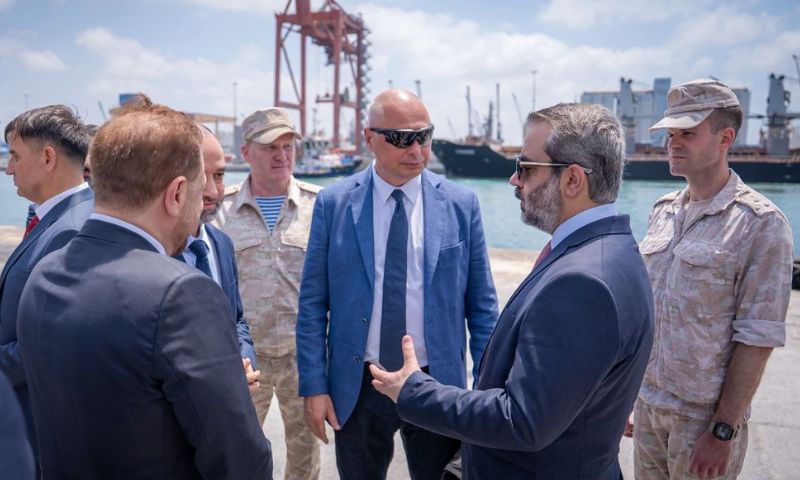
 A field tour of Tartous Port to inspect the facilities and installations covered by the memorandum signed between Syria and Russia, August 9, 2026. (Syrian Ministry of Foreign Affairs and Expatriates)
A field tour of Tartous Port to inspect the facilities and installations covered by the memorandum signed between Syria and Russia, August 9, 2026. (Syrian Ministry of Foreign Affairs and Expatriates)
The Syrian government has agreed with the Russian side to take over Berth 4 at Tartous Port, along with its warehouses and associated facilities, after Russia has operated the berth, paving the way for Syrian authorities to resume management of one of the port’s most important facilities.
The agreement comes amid expectations that operating the berth could increase the port’s capacity and accelerate the movement of ships and cargo. However, the extent to which the move affects import costs and commodity prices will depend on operating efficiency and the berth’s ability to reduce transportation and logistics costs.
At the same time, the move raises questions about whether it can deliver tangible economic gains, from increasing the port’s operating capacity to reducing import costs and ultimately lowering consumer prices, while strengthening Tartous’s position on the regional maritime transport map.
Mazen Alloush, director of the International Relations and Cooperation Department at the General Authority for Ports and Customs, told Enab Baladi that the agreement to take over Berth 4 at Tartous Port represents a significant step that could increase the port’s operating capacity, enhance its ability to receive vessels and handle different types of cargo, improve operational efficiency, and strengthen its role in trade and maritime transport.
According to Alloush, bringing the berth into operation is expected to reduce vessel congestion and pressure on the port’s other berths, accelerate loading and unloading, increase handling rates and productivity, and shorten vessel waiting times, improving logistics and operational efficiency at Tartous Port.
Alloush said the transfer procedures are being completed within the timeframe specified in the memorandum.
Taking over Berth 4 at Tartous Port carries implications beyond technical and administrative considerations, as it comes within the state’s efforts to strengthen its sovereignty over vital facilities and reorganize the management of one of Syria’s most important foreign trade gateways.
Abd al-Rahman Muhammad, a professor of finance and banking at the Faculty of Economics at Hama University, told Enab Baladi that the move is significant on two levels, the first sovereign and strategic, and the second economic and operational.
At the sovereign level, taking over the berth effectively marks the end of the concession agreement previously concluded with the Russian port management and operation company, restoring direct Syrian government control over one of the port’s most important berths.
According to Muhammad, this could strengthen state sovereignty over vital infrastructure and give the government greater latitude to make decisions regarding the port’s management and development.
At the operational level, the economist said that Berth 4, which was designed to receive high-capacity vessels and handle multiple types of cargo, could increase Tartous Port’s capacity and allow it to receive ships that some of the older berths cannot handle as efficiently.
Among the main benefits the berth could provide is an increase in the volume of cargo and containers that can be handled, easing pressure on other berths and accelerating unloading operations. It could also expand the range of services provided and enable the handling of different types of cargo requiring modern equipment and facilities.
According to Muhammad, the berth could also become an additional source of revenue for the state if it is managed efficiently and its operating capacity is used optimally.
Muhammad added that increasing the operating capacity of Tartous Port could have a positive effect on import and transportation costs, and consequently on the prices of some goods in the Syrian market, but this depends on several factors.
Reducing shipping costs is among the most important of these factors, the economist said. Shortening vessel waiting times before unloading could reduce additional fees associated with delays. If Berth 4 accelerates cargo handling and reduces the time vessels spend in port, this could lower the final cost of imports.
Increasing capacity alone, however, is not sufficient, according to Muhammad. He said that if management of the new berth is affected by bureaucracy, a shortage of skilled workers, or outdated cargo handling and customs integration systems, the additional capacity will remain underused and no savings will be achieved.
Competition in the shipping and import sector will also play an important role in determining whether lower costs are passed on to consumers. If the market remains concentrated among a limited number of shipping companies or importers, savings from lower operating costs could instead become additional profit margins rather than translate into lower commodity prices, Muhammad said.
Muhammad also noted that import costs are not determined at the port alone. They are affected by the exchange rate, overland transportation costs, fuel prices, and various fees, all of which could absorb part of the savings generated by more efficient maritime transport.
Therefore, any decline in commodity prices resulting from the takeover of Berth 4 and improved port efficiency will remain dependent on the state’s ability to turn increased operating capacity into an actual reduction in costs across the entire supply chain, rather than only during the cargo handling stage inside the port.
Alloush said Berth 4 is 630 meters long, with a graduated draft starting at 10 meters on its eastern side and reaching 13.20 meters on the western side. It is also adjacent to Berth 5, which is designated for roll-on, roll-off vessels, allowing greater integration in vessel reception and cargo handling operations.
The berth’s technical specifications allow it to receive three large ships simultaneously, each with loads of up to 55,000 tons. Its operations can also be integrated with the reception of roll-on, roll-off vessels, while adjacent warehouses and storage areas can be used to store various types of cargo.
The Syrian Ministry of Foreign Affairs announced that it had reached an understanding with the Russian government under which the Syrian government would manage civilian facilities previously controlled by Russia on the Syrian coast.
The official Syrian Arab News Agency, SANA, cited the Foreign Ministry’s Communications and Media Department on Sunday, August 9, as saying that the civilian facilities to be managed by Syria include Hmeimim Airport and the fourth commercial berth at Tartous Port.
The memorandum of understanding also set a three-month timeframe for completing the transfer process and bringing the new arrangements into effect.
if you think the article contain wrong information or you have additional details Send Correction


 A
A
A
A
A
A





 More Economic Reports