


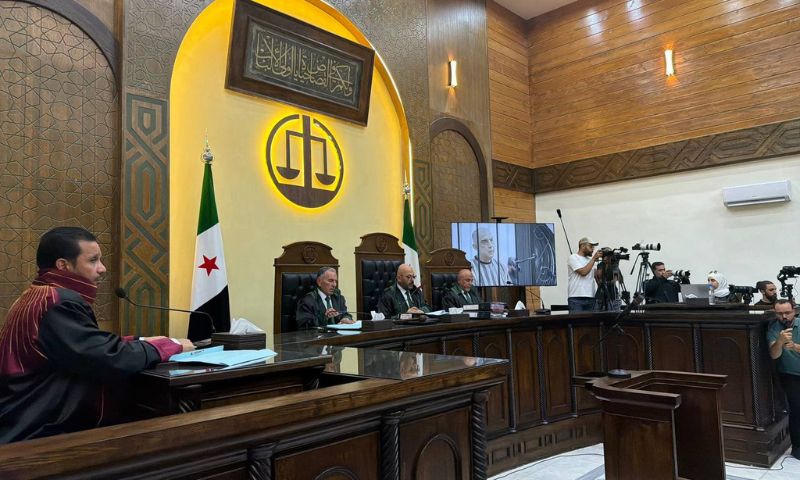
 A court session announcing a death sentence in absentia against Bashar al-Assad in Damascus, August 11, 2026 (Ministry of Justice)
A court session announcing a death sentence in absentia against Bashar al-Assad in Damascus, August 11, 2026 (Ministry of Justice)
Syrian Deputy Justice Minister Mustafa al-Qasim said the ministry has formed a committee to communicate with the International Criminal Police Organization, Interpol, with the aim of extraditing “criminals.”
Al-Qasim told Syria’s al-Ikhbariya channel today, Wednesday, August 12, that international cooperation with Syria would accelerate work on the justice file through countries cooperating to extradite criminals who fled to their territories.
He added that the ministry has established offices to receive complaints concerning crimes related to transitional justice in order to facilitate procedures for citizens, noting that the ministry is seeking to recover Syrians’ looted funds and pursue those investing them abroad.
He said the Justice Ministry is seeking the highest possible degree of alignment between the Syrian judiciary and international trial standards, while stressing the principle of Syrian national sovereignty within the framework of transitional justice.
Al-Qasim’s remarks came one day after the Fourth Criminal Court in Damascus sentenced Atef Najib, the former head of the Political Security Branch in Daraa, to death. The court also issued death sentences in absentia against Bashar al-Assad and his brother, Fahd al-Freij, Louay al-Ali, Qusay al-Mahyoub, Wafiq Nasser, and Talal al-Aismy.
The Syrian Ministry of Justice responded to Amnesty International’s criticism of the Syrian judiciary’s decision to issue death sentences against ousted regime leader Bashar al-Assad and figures linked to the former regime, saying the organization’s statement did not accurately reflect the nature of the judicial procedures followed in these cases or the guarantees provided by Syrian law to litigants.
The ministry said the trials were held before a competent civilian criminal court, conducted by qualified judges and with the participation of victims and their representatives in accordance with legal procedures. It said constitutional and legal guarantees, along with relevant rules and principles of international humanitarian law and international human rights law, were observed, and that the proceedings were based on facts, evidence, and judicial files, while guaranteeing defense rights and avenues for appeal and objection under applicable procedures.
In a statement issued today, Wednesday, the ministry expressed respect for the attention international human rights organizations give to justice and human rights cases. It said justice in these cases is being pursued within state institutions and their jurisdictions, in a manner that preserves victims’ right to redress and defendants’ right to a trial under the law.
Amnesty International said in a post on X on Tuesday, August 11, that for the government to truly turn the page on the horrors of the past, it should abolish trials in absentia, end the use of the death penalty, and criminalize in domestic legislation the core crimes covered by international law.
According to the ministry’s statement, the nature of the period Syria is going through, and the crimes and violations left by many years of conflict, impose a legal and moral responsibility on the state to achieve justice and hold those responsible accountable. It said this does not mean, under any circumstances, bypassing constitutional and legal guarantees or diminishing the rights of any party to a case.
The ministry stressed that the rule of Syrian law and the independence of the judiciary are the basis for administering justice in the new Syria. It said the judicial reform it is pursuing is a comprehensive national reform aimed at strengthening judicial independence, consolidating fair trial guarantees, and developing legislation and judicial institutions in a way that strengthens citizens’ confidence in the judiciary and ensures accountability without revenge or politicization.
Amnesty International called for comprehensive judicial reform in Syria to ensure that all judicial proceedings fully respect fair trial guarantees, international law, and international standards.
According to the organization, prosecuting those responsible for atrocity crimes committed during Assad’s rule should be an important step toward achieving justice, uncovering the truth, and providing reparations to tens of thousands of victims.
Separately, some countries refuse to extradite wanted people to their home countries if they face a death sentence, while others require the penalty to be waived before extradition.
According to an article by transitional justice specialist Mansour al-Omari on the Arab Reform Initiative website, Germany does not extradite wanted people if the offense is punishable by death under the law of the requesting state.
Under German law, extradition is not permitted unless the requesting state provides assurances that the death penalty will not be imposed or carried out.
In Sweden, the Extradition for Criminal Offences Act identifies several circumstances in which extradition is prohibited, including when the person being extradited could be sentenced to death for the offense.
As for Russia, where Assad and his brother live along with a number of senior figures from the former regime, al-Omari does not expect the Kremlin to extradite its former ally to Syria, regardless of whether Moscow granted Assad full refugee status or temporary asylum on humanitarian grounds.
Although any future decision on Assad’s extradition would most likely be political, Russia could invoke several international treaties to which it is a party, particularly the United Nations Convention against Torture, to justify refusing to extradite him.
Nevertheless, Russia remains obligated under international law to investigate the crimes attributed to Assad, according to al-Omari.
if you think the article contain wrong information or you have additional details Send Correction







 A
A
A
A
A
A


 More Politics