
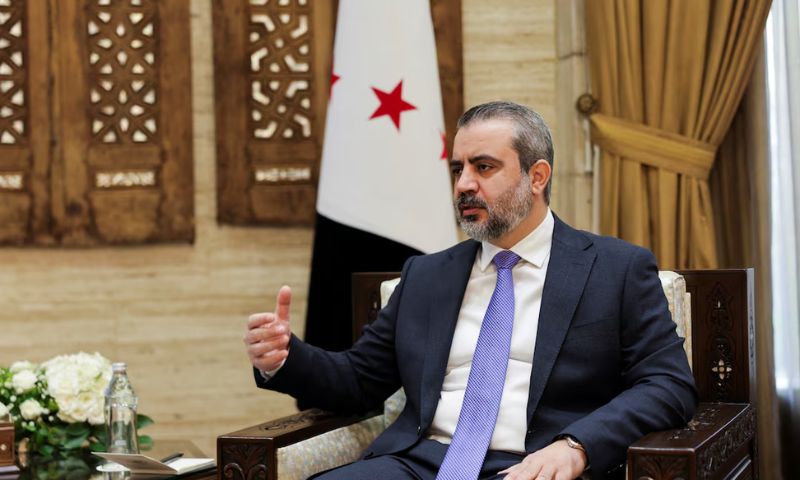

Syrian Foreign Minister Asaad al-Shaibani outlined Damascus’s position on negotiations with Israel amid escalating tensions between Tel Aviv and Ankara that have spilled over onto Syrian territory.
In an interview with Reuters on Sunday, August 23, al-Shaibani said Damascus is seeking de-escalation in the region and the resumption of dialogue with Israel despite a lack of trust.
At the same time, he stressed that Syria would not give up Turkish support, expressing gratitude for Turkey’s assistance in rebuilding the Syrian army.
Damascus Expects Negotiations to Resume
The Syrian foreign minister said Syria expects negotiations with Israel over a security agreement to resume soon, expressing hope that such an agreement would lead to an Israeli withdrawal from Syrian territory.
Al-Shaibani said the Israeli government had tried to maintain its security through brute force but had failed everywhere. He said no date had been set for negotiations to resume, despite continued U.S. efforts to pressure Israel to return to the negotiating table.
He said the Syrian government has high hopes of building stable relations with its neighbors, despite the difficulty of placing trust in Israel, adding that Damascus is extending its hand for understanding, peace, diplomacy, and regional stability.
Al-Shaibani urged Israel to seize a “historic opportunity” while the door to diplomacy remains open, stressing that Damascus’s priority is to stop Israeli attacks and that confidence-building steps are needed in that direction.
He said negotiations over the security agreement had been suspended since the start of the war with Iran but expected them to resume. He added that contacts between Syria and Israel were cut off after the airstrike that targeted the Abu al-Duhur airbase in Idlib (northwestern Syria).
Despite the suspension of contacts, the Syrian foreign minister said he believes communication is necessary, particularly with a party that continually threatens Syria’s security. He added, however, that Damascus would have no need for communication if it produced no results, given its lack of trust in the Israeli government.
Damascus Calls for Mutual Respect
Al-Shaibani said Syria respects Israel’s security concerns and called on the other side to respect Syria’s concerns as well, including Israel’s use of Syrian airspace, Israeli airstrikes, and arrests in the south.
He added that the two sides had agreed on almost everything on paper at the beginning of this year regarding a security agreement that would require Israel to stop attacking Syria and would be linked to its withdrawal from territories seized after the fall of the Assad regime.
He said the agreement included an understanding to establish several security zones on Syrian territory near the Israeli border, including a buffer zone where only the United Nations would be present, as well as other areas where Syrian forces would be deployed at varying levels of strength.
Al-Shaibani said Israel had sought to evade implementation, adding that Damascus had not seen a genuine willingness on the Israeli side to reach an agreement.
Syria Grateful for Turkish Support
The Syrian foreign minister said Israel bombed the Abu al-Duhur airbase even after Syria conveyed a message that it would not become a Turkish base. He said Syria relies on Turkish support for military training and cooperation, as it does on cooperation with other countries, including Jordan and Saudi Arabia.
He reiterated that Damascus would not give up Turkish support and expressed gratitude for Turkey’s assistance in rebuilding the Syrian army.
Regarding the mechanism mentioned by U.S. Special Envoy for Syria Thomas Barrack to prevent conflict among Israel, Turkey, and Syria, al-Shaibani said no agreement had yet been reached on the mechanism. He said it should halt attacks and pave the way for a security agreement rather than entrench the Israeli occupation.
Al-Shaibani noted that Israel seized the Golan Heights in the 1967 war, while Syria and Israel have technically been in a state of war since 1948.
He added that Damascus’s current priority is to stop what he described as Israeli aggression even before a security agreement is reached, which could pave the way for discussions on peace and the Golan Heights.
Five Rounds Without Results
The Syrian and Israeli sides have held five previous rounds of negotiations without reaching the desired results, amid differing positions between Damascus, which demands Israel’s withdrawal from Syrian territory, and Israel, which insists on remaining for security reasons.
The fifth round of negotiations between Syria and Israel ended in Paris on January 7. The two sides agreed to increase the pace of negotiations, hold more frequent meetings, and take confidence-building measures between the two countries.
The negotiations resulted in the establishment of a liaison cell to exchange intelligence between the two countries and an agreement to halt Israeli military activities in southern Syria.
A joint U.S., Israeli, and Syrian statement issued on January 7 said senior officials from Israel and Syria had met in Paris and reaffirmed their commitment to reaching lasting arrangements for the security and stability of both countries.
Despite the agreement to halt Israeli military activities in southern Syria, the Israeli army continues to carry out incursions involving a number of violations on Syrian territory.
The latest of these attacks was an Israeli drone strike on a vehicle on the road between the Beit Jinn farm and the town of Beit Jinn in the Damascus countryside (southwestern Syria) on Saturday, August 22.
It was preceded by an Israeli military strike on the Abu al-Duhur airbase in the Idlib countryside on August 17, which escalated tensions between Turkey and Israel after Israel accused Turkey of seeking to deploy military equipment in the area.
The Turkish government denied the Israeli accusations, while Damascus condemned the operation, along with numerous countries and governments in the region and around the world.