
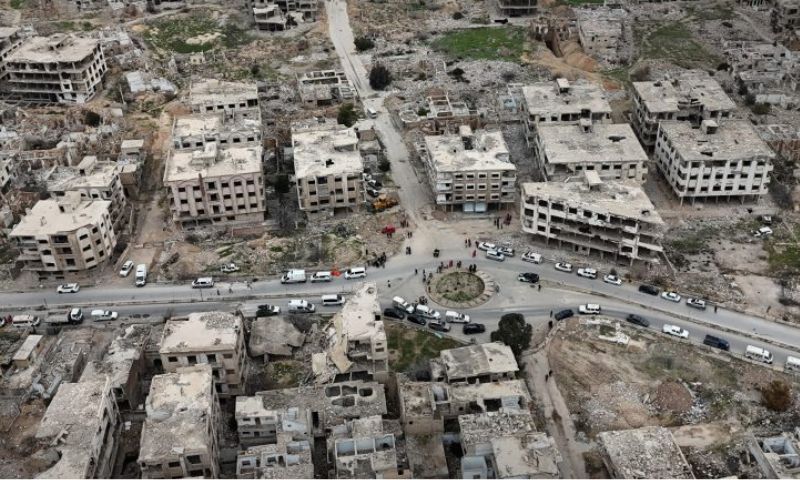

The Syrian Engineers Syndicate announced that a structural safety report must be obtained before repair work begins on damaged buildings in Syria.
According to the syndicate, the measure is intended to protect lives and property and ensure that restoration work is carried out in accordance with approved engineering standards and procedures.
The syndicate said on July 31 that damage assessments must follow the approved engineering and technical standards it developed in cooperation with the Ministry of Public Works and Housing.
Malek Haj Ali, head of the Syrian Engineers Syndicate, stressed the importance of obtaining a structural safety report from the relevant authorities before beginning any restoration work. The report is intended to determine the extent of the damage and identify the appropriate measures.
The procedures come amid extensive damage to residential buildings in different parts of Syria. The scale of the destruction has prompted the development of an engineering mechanism to ensure accurate damage assessments, determine risk levels, and prioritize intervention, whether through repair, structural reinforcement, or demolition.
Raseen Ismat, secretary of the Syrian Engineers Syndicate, told Enab Baladi that the syndicate, under the supervision of the Ministry of Public Works and Housing, has adopted a comprehensive national methodology for accurately assessing structures damaged by disasters. This includes damage caused by military operations carried out by the former regime, as well as earthquake damage.
The syndicate has also issued several supporting technical manuals, including a guide for preparing technical reports, a guide for assessing buildings, and a detailed explanation of different types of structural defects and how to address them, Ismat said.
Three Main Assessment Stages
Ismat said the methodology follows a progressive assessment system consisting of three main stages:
- Stage One, S1: This is the rapid inspection stage. Committees consisting of three engineers conduct an initial inspection of a building, usually lasting between 10 and 15 minutes, to classify it within one of three main categories:
- Green building: A structurally sound and safe building. It may have minor finishing defects but remains suitable for use.
2. Yellow or orange building: A building with visible defects that require a more detailed structural assessment during the second stage.
3. Red building: A building that is uninhabitable, at risk of collapse, or requires removal or demolition, as is the case in some heavily damaged areas.
Ismat explained that the first stage produces a rapid descriptive report on the building’s condition, while the second stage requires a more detailed engineering study.
- Stage Two, S2: This stage involves preparing the structural safety report and conducting specialized engineering tests. These include the use of a concrete rebound hammer to measure concrete strength, ultrasonic testing, and devices that detect reinforcing steel.
Preparing the final report during this stage may take an entire day.
Ismat said the results of the second stage may lead to some buildings being reclassified from yellow to green after their safety has been confirmed. The findings may also indicate that the building must proceed to the third stage.
- Stage Three, S3: This stage involves preparing structural reinforcement studies. It includes identifying the structural elements that require strengthening, developing detailed engineering plans, and preparing the implementation files for the reinforcement work. Depending on the building’s condition, this stage may take approximately seven to ten days.
Assistance and Fee Exemptions
Ismat also said the syndicate is cooperating with government bodies to inspect all buildings according to the standards established under the national methodology. Priority will be given to buildings that pose a threat to residents and require urgent reinforcement. These priorities will be determined in coordination with government bodies, particularly local administrative units.
According to Ismat, training and qualification programs will be prepared for engineers working in administrative units, as well as engineers who operate private offices. The programs will train them in inspection procedures and the application of approved technical standards.
The application process begins when an affected resident visits the relevant administrative unit and submits a request documenting the extent of damage to their home. The property must be residential, and its total area must not exceed the area specified in its building permit, Ismat said. The administrative unit will then document the extent of the damage and confirm that it resulted from military operations carried out by the former regime.
Regarding assistance for affected residents, Ismat said there will be a full exemption from engineers’ fees and syndicate charges during the first stage, which covers the initial inspection. The exemption during the second stage will reach 50%.
About 1.5 Million Homes Damaged
Estimates of the number of damaged homes vary, and no precise statistics are available that classify them according to the degree of damage.
According to Ismat, the average estimate indicates that approximately 1.5 million homes have sustained some form of damage.
The syndicate secretary estimated that between 700,000 and 750,000 homes may be completely damaged and require demolition or rebuilding. Other homes require structural reinforcement, while approximately 500,000 homes may need minor repairs.