
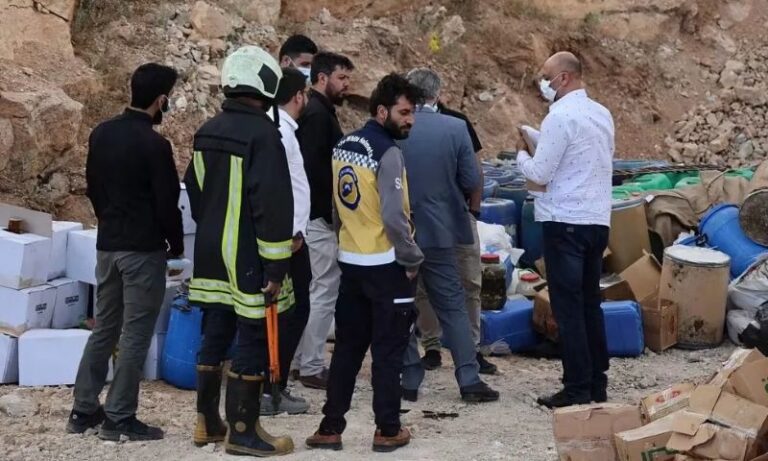

Syria’s Anti-Narcotics Department said on Sunday, November 22, that it had destroyed what it described as “large quantities” of narcotics and psychotropic substances seized in separate security operations. The department destroyed the substances in batches under the supervision of a joint committee representing the ministries of interior, justice, and health, in accordance with approved legal and environmental procedures.
The materials destroyed included 400 million Captagon pills, 12.2 metric tons of hashish, 2.3 metric tons of cannabis plants, six kilograms of heroin, and 5.4 million other narcotic pills. The department also destroyed equipment associated with smuggling, concealing, and transporting the drugs, as well as with manufacturing them from chemicals.
The department said the operation reflected coordination among national agencies to curb drug production, smuggling, and distribution and protect public health and safety.
Security Operations Continue
Syrian security authorities continue to foil attempts to smuggle and distribute drugs in several governorates and border areas.
On November 21, Syrian Internal Security Forces foiled two attempts to smuggle drug shipments through the southern Syrian desert. The forces seized more than 142,000 Captagon pills intended for neighboring countries, according to Syria’s Interior Ministry.
Security operations targeting drug smuggling and distribution networks in Syria led to seizures of crystal methamphetamine and arrests in Deir Ezzor (eastern Syria), al-Hasakah (northeastern Syria), and Homs (central Syria) in November.
Authorities had previously foiled attempts to smuggle drugs toward Jordan using balloons, a method smugglers have used to move shipments across border and desert areas.
On October 11, authorities seized more than 100,000 Captagon pills hidden inside the spare tire of a refrigerated truck headed to Saudi Arabia via the Nasib border crossing (Daraa governorate, southern Syria).
Results of Previous Operations
In late June, Khaled Eid, director of Syria’s Anti-Narcotics Department, said the department had carried out 1,550 operations to seize drugs or foil smuggling attempts. He said those operations had dismantled 90 organized international smuggling networks, shut down 17 Captagon factories, and seized 20 storage warehouses.
The department seized 697 million Captagon pills, 15 metric tons of hashish, 10 million pills containing narcotic drugs, 180 kilograms of cocaine, 84.5 kilograms of crystal methamphetamine, seven kilograms of heroin, and 221 metric tons of chemical precursors.
Eid said the figures reflected the economic and geographic conditions that smuggling networks seek to exploit. He said they also showed that the state could curb drug trafficking through cooperation between communities and the agencies involved.
Eid said achieving a “Drug-Free Syria” would require a national effort based on “scientific” and “carefully designed” plans that extend beyond awareness events.
He said the new approach balanced deterrence and treatment. People who use drugs would be treated as victims in need of care, while those who distribute or smuggle drugs would face punishment.
Eid said the ministry had encountered local drug production sites and distribution networks targeting young people in recent months. In response, it stepped up enforcement, tightened controls at border crossings, equipped anti-narcotics units with tracking technology, and built a comprehensive database of active networks.