
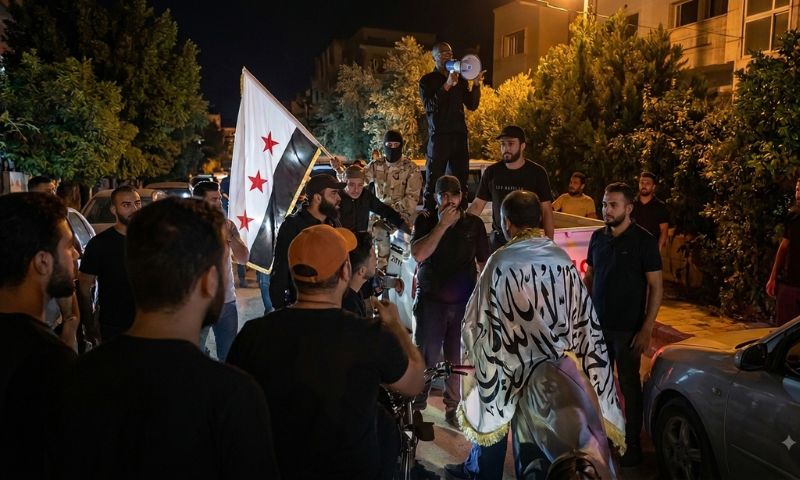

Dozens of protesters gathered on Tuesday evening, August 11, outside the villa of businessman Mohammad Hamsho, who was close to the former Syrian regime, in Qura al-Sham, formerly Qura al-Assad, near al-Sabboura in the Damascus countryside.
The protesters chanted slogans demanding that Mohammad Hamsho be held accountable and put on trial, including, “Hamsho is the thief who stole my country,” and, “The people want the criminals put on trial.” They also described Hamsho as “the iron thief.”
During the protest, one demonstrator said Hamsho was responsible for the displacement of hundreds of thousands of Syrians and for stealing iron from their homes after they were destroyed by the former regime. He said Hamsho “is still sitting comfortably in his home,” while Syrians remain displaced, their homes destroyed and their iron stolen.
The protesters also called on the Syrian government to hold Hamsho and others like him accountable, as well as everyone who, in their words, “profited from the blood of Syrians.”
Enab Baladi attempted to contact several activists involved in the campaign against Hamsho and sent them questions about their demands, but received no response by the time of publication.
Campaign to Boycott Hamsho Products
A number of activists launched a campaign to boycott products made by businesses owned by Mohammad Hamsho. Posters were distributed at the entrance to and inside Hamsho Company, at the entrance to the Qura al-Sham residential area where Hamsho lives, and along several streets and neighborhoods near al-Sabboura and Qura al-Sham in the Damascus countryside.
The posters were titled, “Boycott Mohammad Hamsho’s Products,” and listed companies that activists said are owned by Hamsho:
- Sama al-Sham Holding.
- Sama al-Sham Tourism and Travel.
- Saif al-Sham Equestrian Club.
- Yaafour Hotel and Resort.
- Sinalco carbonated drinks.
- Trivio electrical tools.
- Aram Soft Technology.
- RUNNET Internet Service Provider.
- Etisal Mobile Distributor.
- Tatweer Technology.
- Isnad Metal Structures.
- Asas Development and Construction.
- Contracting and Building Supplies.
- Syrian Air Liquefaction Company.
- Dak Food Foodstuffs.
- Al-Ittihad Cables.
- Al-Ittihad Transformers.
- Al-Ittihad Plastics.
- Al-Ittihad Solar Energy.
- Al-Ittihad Electricity.
- Al-Ittihad Copper.
- Al-Ittihad Bobinage.
- Bintalens Artistic Production.
- Sham Design and Printing.
Hamsho Misses Judicial Summons
The protests come days after the Public Prosecution referred a “death threats” complaint filed by citizens Abdul Hamid Assaf and Abboud Diab against Mohammad Saber Hamsho, a Syrian businessman close to the former regime, to the Cybercrime Court of First Instance in the Damascus countryside.
Enab Baladi learned from judicial sources that the Cybercrime Court of First Instance recorded Hamsho’s failure to attend a hearing that was partly scheduled to hear his statements regarding the complaint accusing him of making death threats against several citizens.
According to a judicial summons addressed to Mohammad Saber Hamsho, he was scheduled to appear on August 10 before a judge at the Cybercrime Court of First Instance at the Justice Palace in the Damascus countryside.
Assaf told Enab Baladi that the complaint filed by him and a number of activists concerns “death threats through social media pages.”
Mohammad Hamsho had filed a lawsuit against Abdul Hamid Assaf in May 2025 on charges of “online insult and defamation,” after Assaf and a group of activists published posts and videos calling for Hamsho to be held accountable, for an investigation into his wealth, and for inquiries into the alleged theft of iron from areas destroyed by the former regime.
Criminal Report Filed Against Hamsho
Assaf told Enab Baladi that he and a group of activists had previously submitted a roughly 70-page report to the Public Prosecution detailing alleged crimes committed by Mohammad Hamsho, including the theft of iron and metals from areas destroyed by the former regime in the Damascus countryside and the demolition of partially damaged buildings to remove steel reinforcement bars.
According to Assaf, the activists also informed the Public Prosecution of death threats they allegedly received indirectly from Hamsho through people close to him or individuals working for him. Assaf said the threats were made through platforms or fake social media pages and unknown phone numbers, while activists’ Facebook accounts were also hacked in an effort to conceal information and deter them from demanding Hamsho’s prosecution.
Assaf said the pressure against him and several other activists went as far as publishing photographs of them and members of their families on Facebook and other social media platforms as a form of intimidation intended to pressure them and make them fear for their families’ lives. He added that at the beginning of the activists’ campaign, Hamsho had tried to win them over and sent intermediaries in an attempt to persuade them to stop their campaign.
Despite the alleged threats and pressure, Assaf said he and other “activists” in Syria would continue their campaign against Hamsho “to expose him and reveal his crimes against the Syrian people, which everyone in Syria knows about, until he is put behind bars and justice is achieved for all Syrians whose property was violated by Hamsho,” according to Assaf.
Could Mohammad Hamsho Be Detained?
A judge at the Cybercrime Court of First Instance in the Damascus countryside may order the detention of the defendant, Mohammad Hamsho, immediately after questioning if the legally established conditions are met.
Article 126 of Syria’s Code of Criminal Procedure states that if, after questioning the defendant, it becomes clear that the alleged act is punishable by imprisonment or a more severe penalty and that there is sufficient evidence to accuse the defendant, the judge may issue a detention warrant.
Detention following questioning is not automatic and remains at the discretion of the Cybercrime Court of First Instance judge. Hamsho could be detained in circumstances including:
- If the alleged offense is punishable by more than one year in prison.
- If the judge determines that the defendant does not have a fixed or known residence inside Syria and there is concern that he may flee justice.
- If leaving the defendant, Hamsho, at liberty could threaten the integrity of digital evidence, including by deleting accounts or data or threatening witnesses and affected individuals.
If the judge orders his detention, a detention warrant would be issued and Hamsho would be transferred to Damascus Central Prison in Adra. A detained defendant may apply for release at any stage of the trial, with or without financial bail, and the court may accept or reject the request after seeking the Public Prosecution’s opinion.
Hamsho Lawsuits Against Hassan Akkad
After being detained for five days and then released, activist and filmmaker Hassan Akkad disclosed details of his detention in the Syrian capital, Damascus, saying that other lawsuits filed against him by businessman Mohammad Hamsho, who was close to the former Syrian regime, remain pending.
Akkad said Syrian media figure Mousa al-Omar withdrew the complaint he had filed against him, while two other lawsuits filed by Hamsho remained pending.
He said Hamsho filed the lawsuits through the companies “Al-Muttahida and Ritengo” in connection with a media campaign in which Akkad targeted the Sinalco soft drink brand and a hotel in the Yaafour area of the Damascus countryside.
Damascus Judicial Authority, for its part, published a video in June during Akkad’s detention in which Damascus Attorney General Judge Hossam Khattab explained the circumstances surrounding the detention.
The attorney general said at the time that a review of Akkad’s records showed a search notice issued against him by the Public Prosecution, along with several review notices linked to other complaints filed by citizens concerning online insult, defamation, and reputational harm. He did not identify those citizens.