


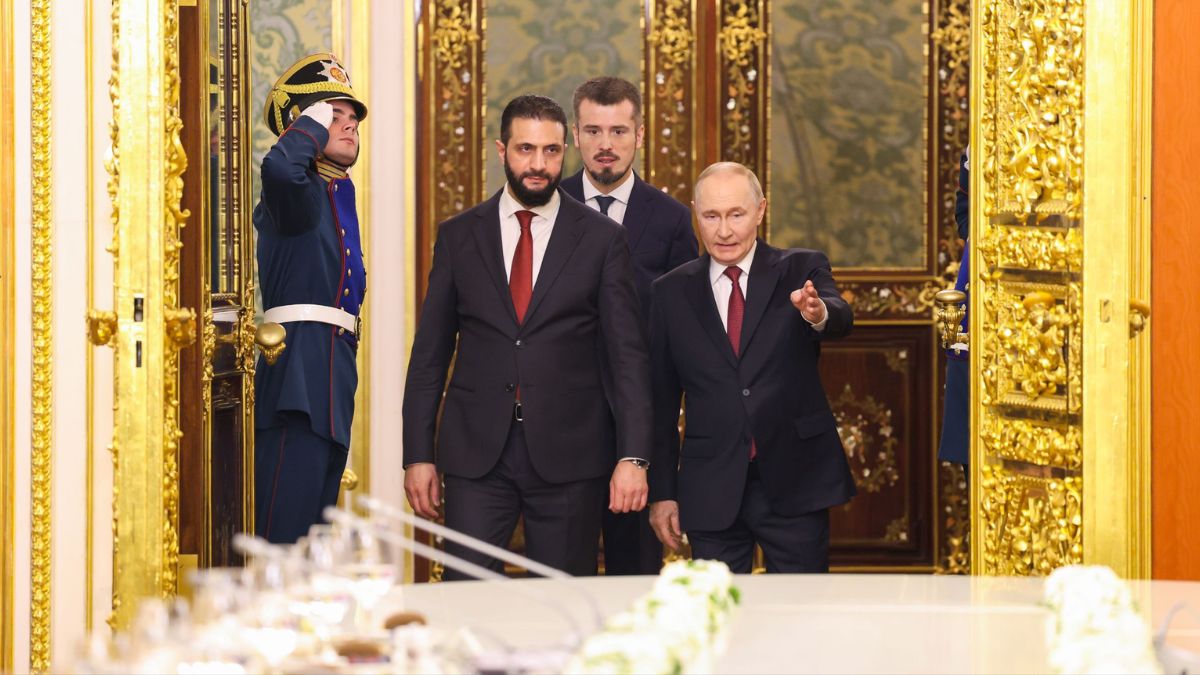
 Syrian President Ahmed al-Sharaa with his Russian counterpart, Vladimir Putin, October 15, 2025. (TASS)
Syrian President Ahmed al-Sharaa with his Russian counterpart, Vladimir Putin, October 15, 2025. (TASS)
In a move reflecting Moscow’s desire to reset its relations with Damascus, Russian President Vladimir Putin dismissed Alexander Efimov as ambassador to Syria and appointed Dmitry Dogadkin as his successor. The change appears to go beyond a routine diplomatic measure, signaling a shift in Russia’s approach to the Syrian file.
The Federal Assembly of the Russian Federation published the relevant decrees on the official legal information website on August 3. They relieved Efimov of his duties as the Russian president’s special representative for developing relations with Syria and appointed Dogadkin as “ambassador extraordinary and plenipotentiary of the Russian Federation to the Syrian Arab Republic.”
The appointment comes at a pivotal moment, as Syria undergoes rapid regional and international changes. It raises questions about the significance of the decision, the messages conveyed by the new ambassador’s background and its potential effect on Russia’s future political, military and economic presence in Syria.
International relations experts believe the choice of Dogadkin was not random. Instead, it sends a clear message that Moscow wants to open a new chapter with Syria, one that differs from its relationship with the country under the former regime.
Amer Fakhoury, an academic, professor of public international law and international relations researcher, said the new diplomat knows Syria well. Dogadkin previously worked at the Russian Embassy in Damascus, speaks Arabic and has extensive diplomatic experience in the Gulf region after serving as ambassador to Oman and Qatar.
Fakhoury told Enab Baladi that through this appointment, Russia had sent a diplomat who knows Syrians, understands the region and can communicate with both Damascus and Gulf capitals. This has become necessary as relations between Russia and Syria have evolved from a bilateral issue into a complex network of interests, he added.
Dogadkin served as Russia’s ambassador to Qatar from November 2021 until July 2026. He also headed the Middle East and North Africa Department at the Russian Foreign Ministry between 2013 and 2017, indicating his long accumulated experience with the region’s most contentious issues.

Dmitry Dogadkin, Russia’s newly appointed ambassador to Syria. (RUWIKI)
Fakhoury believes the new ambassador will face a difficult and sensitive mission. Syria is currently opening up significantly to Arab and Gulf countries, as well as to the United States and Western states, meaning Moscow needs a figure capable of navigating this complex network of relationships.
Dogadkin will be required not only to preserve Russian interests, but also to build trust with Syria’s new leadership and address the reality that Russia is no longer the only influential actor in Damascus. Syria now has broader Arab and Western options than were available in the past, Fakhoury said.
The greatest challenge will be redefining Russia’s role in Syria through new tools, according to Fakhoury. Moscow is now compelled to rely more heavily on diplomacy, negotiations and economic engagement after previously depending primarily on military force and support for the former regime.
The appointment cannot be separated from the future of Russia’s military presence in Syria, particularly at the Hmeimim and Tartous bases.
Fakhoury said Russia certainly does not want to lose its presence in Syria because it provides Moscow with an important strategic position on the Mediterranean Sea and supports its activities toward Africa. Negotiations over the future of the two bases will therefore be among the most prominent issues on the new ambassador’s agenda.
Dogadkin’s mission will include efforts to secure this military presence within a new political and legal framework that accommodates the changes taking place in Damascus and its regional and international relations, Fakhoury said.
Alongside the political and military issues, the change has a clear economic dimension. According to Fakhoury, Russia is attempting to prevent its relationship with Syria from remaining confined to military affairs and is seeking involvement in ports, energy, trade and reconstruction.
He warned, however, that competition in these sectors has intensified because Damascus now has multiple Arab and Western options. This will require Moscow to present competitive offers and build genuine economic partnerships rather than relying solely on political and military influence.
Fakhoury concluded that Russia is not leaving Syria, but is changing its methods. Dogadkin’s appointment clearly reflects a transition from reliance on military force toward diplomacy, negotiations and economic engagement, in an effort to preserve Russian influence in the period following the former regime.
The appointment also comes as Washington presses to limit Moscow’s influence in Syria. Damascus agreed to significantly reduce imports of Russian oil as part of ongoing discussions with the United States over lifting the last major sanctions imposed on Syria.
Reuters reported on August 4 that senior Syrian officials had told the United States in recent months that they were prepared to reduce Russian oil imports while discussing Washington’s removal of Syria from its list of state sponsors of terrorism. The report cited a Syrian source familiar with the talks, a US official and another source briefed on the matter.
During discussions over removing the designation, Washington requested and secured a Syrian commitment to significantly reduce Russian oil imports, according to the US official and the source familiar with the matter.
if you think the article contain wrong information or you have additional details Send Correction


 A
A
A
A
A
A




 More Politics