


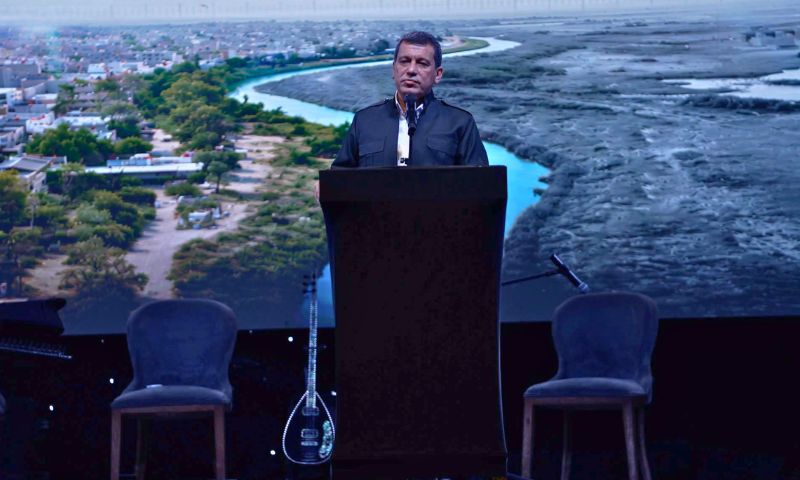
 SDF commander Mazloum Abdi, August 20, 2026. (Ronahi)
SDF commander Mazloum Abdi, August 20, 2026. (Ronahi)
Mazloum Abdi, commander of the Syrian Democratic Forces (SDF), said the process of military, security, and administrative integration into Syrian state institutions has been completed, announcing the start of a new stage that he said will focus on continued political work to secure Kurdish rights in the Syrian constitution.
Abdi made the remarks on the evening of Thursday, August 20, during a celebration organized in Qamishli (Hasakah, northeastern Syria) to mark 100 years since the city’s establishment. The event was attended by Hasakah’s deputy governor and the spokesperson for the presidential team overseeing implementation of the January 29 agreement between the Syrian government and the SDF, Ahmed al-Hilali, as well as Qamishli district director Jihan Hissam and deputy commander of the Internal Security Forces in Hasakah province Mahmoud Khalil.
“Today, with the completion of the integration phase with the government, we announce that we are entering a new stage and a new process,” Abdi said, adding that “the next battle will be political” and that the SDF will continue working to secure the rights of the Kurdish people in the Syrian constitution.
The SDF commander said his forces had “fought an existential battle” over the past years, saying that thousands of fighters “gave their lives defending their land and their people.” He also thanked those who supported the Kurdish forces during previous years.
He added that Kurdish fighters had come to Syria from “the three other parts of Kurdistan” to help protect the region before leaving, according to him, “with our thanks” following a request from the SDF.
Abdi focused in his speech on the coming political phase, saying the main task after completion of the integration process is to guarantee the political and cultural rights of Kurds within the Syrian state.
“Kurdish rights will be written into the constitution,” he said, calling for efforts to make “the rights of the Kurdish people and their constitutional recognition a permanent part of Syria’s future.”
He said the political struggle would continue “more strongly” to achieve that goal, adding that “the martyrs did not sacrifice themselves for a temporary phase, but for a better future for their people.” He said the current responsibility is to preserve what has been achieved and continue the political path “with full strength and unity.”
Abdi also expressed hope that Qamishli would become “a center of culture and politics in Syria” and enjoy lasting peace, saying the country’s future should be based on recognition of linguistic and cultural diversity.
He said the new Syria should be free of “chauvinist policies,” adding that children in the future Syria “will learn and speak in their languages” and that the identity of all peoples of the Jazira region should be preserved.
Abdi defended the SDF’s record over the past years, saying it had “protected the region for 15 years,” while also acknowledging “mistakes and shortcomings” during its experience.
Despite those mistakes, he said, the forces “protected the region and its people under the most difficult circumstances,” adding that the region’s communities preserved their presence in the face of what he described as “fierce attacks.”
Abdi also discussed the role of the Autonomous Administration in confronting what he described as attempts to alter the region’s identity. He said “the Baathist regime tried to change the identity of the region,” while the administration “thwarted attempts to change the region’s identity.”
The remarks come as areas of northeastern Syria enter a new phase of restructuring their military, security and administrative systems following understandings reached between the Syrian government and the SDF this year.
Hasakah province saw changes on the ground in early 2026, as the Syrian army took control of large areas of the southern and eastern countryside, as well as parts of the western countryside, while the SDF withdrew toward the main cities, particularly Hasakah and Qamishli.
This created a divided administrative and security situation in the province before the Syrian government and the SDF reached an agreement on January 29 to begin integrating the military, security and service institutions affiliated with the Autonomous Administration into Syrian state institutions.
The integration process began gradually in February and covered administrative, security, military and service sectors as part of implementing the agreement signed by the two sides.
Integration has been one of the main issues in relations between Damascus and the SDF, alongside the future of the group’s military forces, local administration arrangements and the status of civilian and security institutions in northeastern Syria.
Abdi’s latest remarks indicate that the SDF leadership considers the transition from the military phase to political action the defining feature of the next stage, with particular emphasis on including Kurdish rights in the Syrian constitution.
At the end of his speech, Abdi called for protecting and developing institutions, stressing that the coming phase requires joint work. He said the goal is to preserve what has been achieved over the past years while continuing political efforts to guarantee Kurdish rights within Syria’s future.
if you think the article contain wrong information or you have additional details Send Correction


 A
A
A
A
A
A





 More Politics