


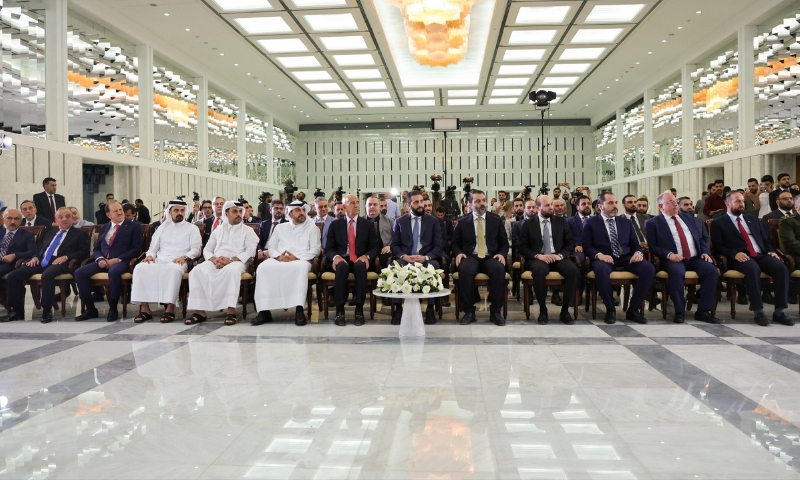
 Signing ceremony for a memorandum of understanding between Syria’s Ministry of Energy and UCC International Group to develop Syria’s energy sector at the Presidential Palace in Damascus, May 29, 2025. (Syrian Presidency)
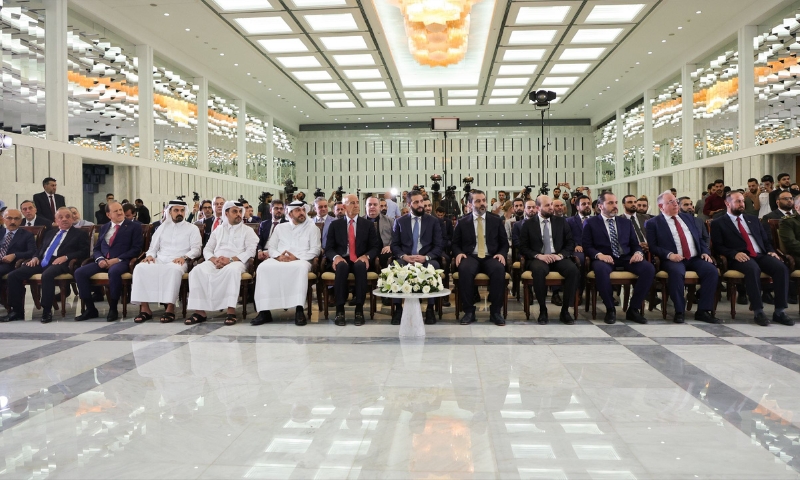
Signing ceremony for a memorandum of understanding between Syria’s Ministry of Energy and UCC International Group to develop Syria’s energy sector at the Presidential Palace in Damascus, May 29, 2025. (Syrian Presidency)


 A
A
A
A
A
A
In a move drawing intense attention from economic and political circles across the Middle East, Bloomberg recently reported that a foreign banking consortium is arranging a massive $7 billion loan led by US banking giant JPMorgan Chase, with the participation of major Gulf financial institutions, including Qatar National Bank (QNB) and Abu Dhabi Commercial Bank.
What makes the deal particularly notable is that the borrower carrying out the projects is Qatar’s Power International Holding, part of the group led by Moataz and Ramez al-Khayyat. The deal, implemented in Syria under unclear circumstances and through unusual investment mechanisms, culminated in a loan that was not registered in the name of the Syrian state and received a direct, absolute, and unconditional guarantee from Qatar National Bank.
This complex financial engineering raises a series of difficult questions: How can a US bank the size of JPMorgan enter into exposure connected to Syria? Why would Qatar National Bank assume the full risk by providing the guarantee? And how are interest rates and financial flows calculated in a country experiencing exchange-rate volatility and a deteriorating currency?
Syrian economist and financial expert Dr. Mahmoud Abdul Karim examines the details of the deal, using figures and direct explanations to outline what took place behind closed doors and how the “Syrian risk” was transformed on paper into a Gulf credit transaction protected by a tightly structured Western legal framework.
JPMorgan Chase:
JPMorgan is lending to Qatar’s Power International Holding, which was founded in Qatar in 2011 by the al-Khayyat brothers.
The objective is to implement a major program in Syria worth more than $7 billion to generate 5,000 megawatts of electricity through a contract signed by the group’s subsidiary, UCC Holding.
The project includes:
Dr. Mahmoud Abdul Karim begins by breaking down the technical figures used to price the interest on the US loan. He estimates that about 70% of the pricing reflects the guarantor’s credit rating, while the remaining 30% represents a premium for the complexity of Syria’s operating environment and procedures, rather than the risk of financial default.
To explain the figure, Abdul Karim said the loan is priced at 3.7% above the Secured Overnight Financing Rate (SOFR), the benchmark reflecting the actual rate at which banks borrow in the United States, currently at about 3.66%.
In absolute figures calculated on the $7 billion loan:
Explaining why the interest rate reflects the “guarantor” rather than the “borrower,” Abdul Karim said Qatar National Bank has an excellent credit rating and, under normal conditions, can borrow at between 0.90% and 1.20% above the benchmark rate. Such pricing, he said, does not remotely reflect the risks associated with a country emerging from war.
He added that if the pricing were based directly on risks in the Syrian market, with Syria lacking a sovereign credit rating altogether, the interest rate would range between 9% and 15%. In that case, he said, JPMorgan would most likely not have financed the deal at all.
The gap between rates of 3.70% and 15%, therefore, represents the value of the Qatari guarantee. In monetary terms, Abdul Karim said, it saves the project about $580 million annually, or nearly $3 billion over the life of the loan. In other words, the US market did not price Syrian risk at all. It priced Qatar National Bank’s risk, adding only a limited premium for operational complications and regulatory compliance.
Asked why Qatar National Bank provided the guarantee instead of Power International Holding, the company implementing the projects, Abdul Karim said that despite its size and strength, Power International is a privately owned family company with no international credit rating, no publicly traded debt, and no audited financial statements available to the public. “No global bank lends $7 billion to a company with these characteristics, regardless of its reputation,” he said.
Abdul Karim also explained the regulatory dimension of bank accounting, known as risk weighting:
In monetary terms, if a bank lent $7 billion to an unrated company, it would have to set aside about $600 million of its own capital as a safety reserve. With a bank guarantee in place, the amount of capital tied up falls to between $120 million and $180 million at most. The guarantee therefore reduces the lending banks’ capital requirements by between 70% and 80%.
The financial expert added that readers seeing the headlines might assume three banks are sharing the Syrian risk. In reality, he said, Qatar National Bank alone assumes 100% of that risk through its absolute guarantee, while JPMorgan and Abu Dhabi Commercial Bank provide liquidity and earn a high return in exchange for very limited Qatari credit risk.
Abdul Karim does not believe the loan will pass through the Central Bank of Syria. Legally, he said, Syria is not a party to the contract. The borrower is a Qatari company, the guarantor is a Qatari bank, the governing law is most likely English law, and arbitration would likely take place in London or Dubai. Syria does not appear in any of these legal roles.
Regarding dollar transfers through the US Federal Reserve system, Abdul Karim said every dollar transaction in the world technically passes through a correspondent bank in New York for automated clearing. That does not mean the Central Bank of Syria is involved, nor does it involve any Syrian account at the Federal Reserve or give Damascus any role or control over the flow of funds.
Abdul Karim described how guarantees between the parties to the US loan would be structured:
The expert added that the deal was deliberately structured to keep Syria outside every legal and financial category involved, protecting the financing from sovereign or regulatory complications. Syria, in this structure, is merely the location where the project is implemented.
Explaining how guarantees would be enforced if an operational default occurred inside Syria, Abdul Karim said the banks would not pursue assets in Syria. Instead, they would demand payment from Qatar National Bank, which would immediately pay in dollars. The entire legal complexity would then shift to the Qatari bank as it sought to recover its funds from assets inside Syria.
He identified three obstacles:
Effects of the US loan to the Qatari company on Syria:
For the Syrian state, the challenge lies in annual power-purchase obligations of about $1.8 billion, which would create a cumulative burden on the treasury.
For citizens, the project could deliver a major technical improvement by increasing electricity supply hours and creating thousands of jobs. At the same time, however, the government would be forced to raise electricity tariffs to between 850 and 1,300 Syrian pounds per kilowatt-hour to cover the actual cost.
Dr. Mahmoud Abdul Karim
Syrian economist and financial expert
Abdul Karim outlined the flow of funds and the banks’ respective shares:
Regarding the division of the financing, the Syrian expert said the syndicated loan would proceed in two stages:
Abdul Karim concluded his assessment of the US loan’s final impact:
if you think the article contain wrong information or you have additional details Send Correction






 More Economic Reports