
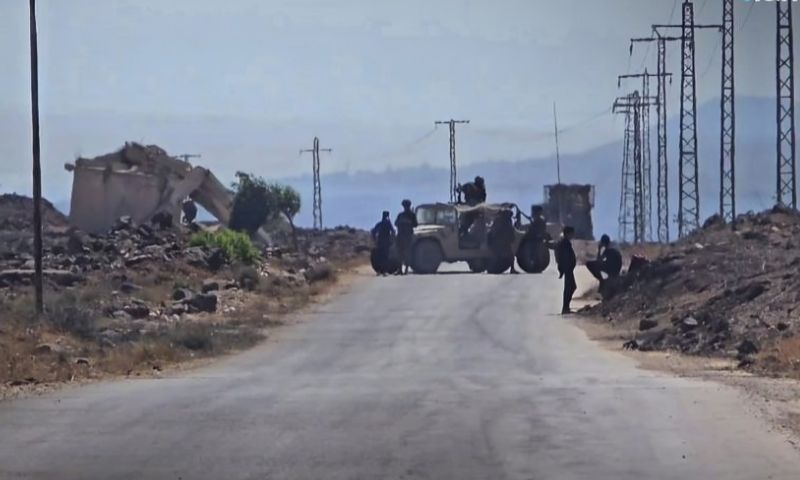

Israeli incursions continue in Quneitra governorate, southern Syria, despite a Syrian-Israeli meeting hosted by Jordan and mediated by the United States on August 23.
Repeated incursions were recorded after the Jordan meeting, with Israeli patrols entering the towns of Rafid, Asha and Sida Golan, as well as the Umm al-Azam area. Israeli forces also detained a shepherd before releasing him later.
Southern Countryside Sees Most Incursions
Southern Quneitra countryside has recorded the largest number of Israeli incursions since the beginning of August. Villages and towns across the governorate have witnessed movements by Israeli army patrols, some accompanied by searches and the detention of young men.
Around 20 incursions have been recorded in the governorate, according to monitoring by Enab Baladi’s correspondent. The patrols consisted of several vehicles and dozens of soldiers moving through villages and towns along the ceasefire line.
Rafid, Sida Golan and the western and eastern parts of Al-Samdaniyah have faced the most frequent Israeli patrol incursions, followed by the villages of al-Malaqa, Kudna, Tal Abu Qubais, al-Hiran and Asha.
Some of the incursions were accompanied by searches of homes and the establishment of temporary checkpoints to search residents.
In northern Quneitra countryside, specifically in Jubata al-Khashab, Israeli forces carried out an incursion and raid and detained two people. One of them was later released.
Artillery Shelling
Artillery shelling was also recorded during August. On August 6, Israeli army artillery fired several shells at the area surrounding the Mantara Dam in the Quneitra countryside from the “Hamidiyah” base.
On August 17, agricultural land between eastern and western Al-Samdaniyah came under artillery fire.
No casualties were recorded as a result of the shelling, but residents experienced fear and anxiety, particularly in the absence of any stated justification for the attacks.
Jordan Meeting
A Syrian delegation from the Ministry of Foreign Affairs and Expatriates, headed by Foreign Minister Asaad al-Shaibani, met an Israeli delegation led by Mossad chief Roman Gofman on August 23. The meeting was mediated by the United States and hosted by Jordan.
The meeting was held in an attempt to reduce tensions between Damascus and Tel Aviv following an Israeli strike that targeted Abu al-Duhur Airport in the Idlib countryside, according to Axios.
According to the Syrian Arab News Agency, SANA, the discussions focused on establishing practical mechanisms to halt Israeli attacks, arrests and targeting operations, and on reviving negotiations with the aim of reaching a security agreement that could form the basis for a more comprehensive future agreement.
The discussions also addressed the importance of supporting Syria’s stability and preserving regional security, including efforts to bring the positions of Turkey and Israel closer together and ensure that existing tensions between the two countries do not spill over onto Syrian territory.
According to the source, the meeting focused on taking practical steps to reduce escalation while discussing ways to return to negotiations. Syria stressed that any security arrangements must respect its sovereignty, territorial integrity and sovereign rights.
An unnamed diplomatic source quoted by SANA said the Syrian side stressed during the meeting that Syria is a sovereign state with the full right to rebuild and develop its national army and determine its alliances and partnerships in accordance with its national interests. The source said Syria rejected any arrangements or mechanisms that would restrict those sovereign rights.
The Syrian side also reiterated its position that the occupied Golan is Syrian territory, noting that discussing its final status and the path toward resolving it remains premature at the current stage.
It also said the immediate priority is the withdrawal of Israeli forces to the lines they held before December 8, 2024, and the full reactivation and implementation of the 1974 Disengagement Agreement.
Israel’s Channel 12 quoted a source familiar with the details of the meeting as saying the talks between the two sides “were productive,” marking the first publicly announced Israeli assessment of the meeting.