


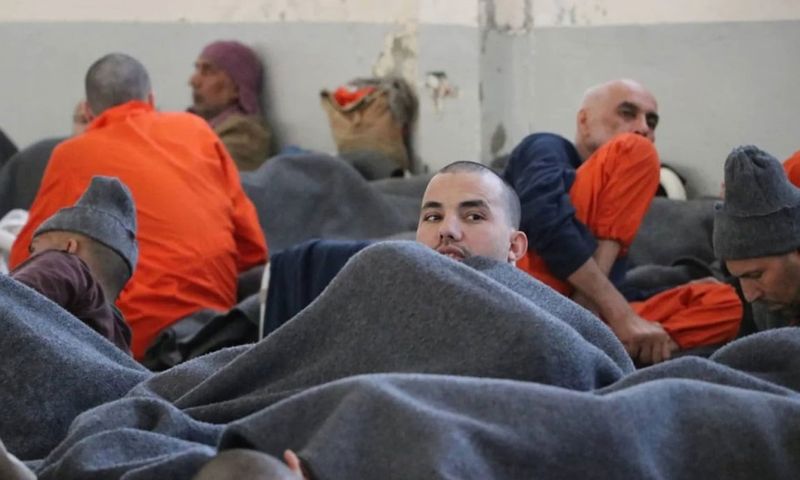
 Foreign detainees inside Iraqi prisons, August 22, 2026 (Alsumaria)
Foreign detainees inside Iraqi prisons, August 22, 2026 (Alsumaria)
Iraq’s Ministry of Justice has launched diplomatic procedures to transfer around 6,000 prisoners from 61 nationalities to their home countries to complete their sentences, excluding those sentenced to death. The move comes as Syrian detainees in Iraq have become a central issue in judicial discussions between Baghdad and Damascus.
Ahmed Luaibi, spokesperson for the Iraqi Ministry of Justice, said in remarks carried by Iraqi media on Sunday, August 23, that the ministry is working with the relevant authorities to establish communication channels with the prisoners’ countries, paving the way for agreements and memoranda of understanding that would allow them to be transferred home to complete their sentences.
Luaibi said transfers could take place under the principle of reciprocity or based on new agreements and memoranda of understanding between Iraq and the countries concerned. He added that the ministry had obtained a decision from Iraq’s National Security Council authorizing it to pursue the process through legal and diplomatic channels.
According to the Iraqi spokesperson, the measures cover Arab and foreign prisoners held in Iraqi correctional facilities, not only people transferred from detention facilities in northeastern Syria. Prisoners sentenced to death are excluded from the transfer procedures.
The measures target around 6,000 prisoners from 61 nationalities, with Syrians representing the largest nationality, alongside other Arab and foreign nationals, including Moroccans, Americans, Canadians, Russians, Tunisians, and Turks, according to the Iraqi statements.
The new Iraqi announcement overlaps with the case of Syrian detainees transferred this year from detention facilities in northeastern Syria to Iraq, but it does not mean that all 6,000 prisoners targeted for transfer are among those previously moved from Syria.
This distinction separates two interconnected tracks. In its latest announcement, the Iraqi Ministry of Justice referred to Arab and foreign prisoners and convicts already held in Iraqi correctional institutions, while Iraq had previously received thousands of people accused of belonging to the Islamic State group from prisons in northeastern Syria during January and February.
On February 13, Iraq’s National Center for International Judicial Cooperation announced that 5,704 people accused of offenses had been transferred from Syrian prisons. They came from 61 countries and included 3,543 Syrians and 467 Iraqis. The total also included 4,253 Arabs and 983 non-Arab foreigners.
In February, the US Central Command, CENTCOM, announced the completion of an operation transferring more than 5,700 detainees from detention facilities in northeastern Syria to Iraq after a 23-day operation, according to multiple sources at the time.
The Karkh First Investigation Court, which specializes in terrorism cases, began interrogation procedures for the transferred detainees after their arrival in Iraq, according to the National Center for International Judicial Cooperation.
In earlier statements, the Iraqi Ministry of Justice spokesperson said the detainees had been transferred at the request of, and in coordination with, the international coalition. He said some were wanted by the Iraqi government or had already been the subject of judicial rulings, adding that they were being dealt with under Iraqi law.
Iraq’s announcement on transferring foreign prisoners came days after Faiq Zaidan, president of Iraq’s Supreme Judicial Council, visited Damascus on August 13 and met Syrian officials, including President Ahmed al-Sharaa and Justice Minister Mazhar al-Wais.
The detainees transferred from northeastern Syria to Iraq were among the main issues discussed by the Iraqi judicial delegation in Damascus. Laith Jabr, head of Iraq’s Judicial Supervision Authority, said Zaidan discussed with the Syrian side the situation of Syrian detainees received by Iraq from al-Hol prison, adding that the two sides agreed to form joint judicial committees to resolve issues related to their trials.
Jabr said the detainees had undergone judicial investigations in Iraq and that the procedures taken against them were carried out, according to the Iraqi side, with judicial guarantees provided under the law. The two sides also agreed to hold ongoing meetings of the joint committees and exchange information and documents related to the cases.
Syrian Justice Minister Mazhar al-Wais also announced after the talks that the two sides had agreed to establish technical and specialized teams to examine the case of Islamic State detainees and seek solutions in accordance with standards of justice and international law. He also said they would begin exchanging information in preparation for judicial and legal agreements and memoranda of understanding between the two countries.
The Syrian Ministry of Justice said Zaidan’s visit was part of efforts to strengthen judicial and legal cooperation between the two countries, while Iraqi sources said the case of Syrian detainees was among the most prominent issues discussed by the delegation during the visit.
The developments come amid growing rapprochement between Damascus and Baghdad involving security, economic, and judicial issues. Syrian Foreign Minister Asaad al-Shaibani met his Iraqi counterpart, Fuad Hussein, in Damascus in June as part of efforts to develop coordination mechanisms between the two countries.
Syrians hold a central place in the case of detainees transferred from northeastern Syria to Iraq. Iraqi data recorded 3,543 Syrians among the 5,704 people accused of offenses who were transferred from Syrian prisons in February.
Iraqi authorities say the detainees are accused of belonging to the Islamic State group and that some are wanted by the Iraqi judiciary in terrorism-related cases. The Iraqi Ministry of Justice previously said all those transferred would be subject to Iraqi legal and judicial procedures, with the possibility of later using memoranda of understanding, cooperation agreements, or reciprocal arrangements to transfer some prisoners to their countries after judicial procedures are completed.
Syrian families, meanwhile, say some of their relatives were detained on the basis of suspicions or accusations whose details remain unknown to them. They are calling for disclosure of their relatives’ places of detention and the charges against them, as well as guarantees of their right to a defense and a trial under clear legal procedures.
Areas of rural Hasakah (northeastern Syria) have seen demonstrations and other actions in recent months by relatives of Syrian detainees transferred to Iraq, demanding information about their fate and the ability to communicate with them. Families have also called for the return to Syria of those against whom no criminal charges are proven.
These demands have gained greater significance as the issue moves to the level of official coordination between Damascus and Baghdad, particularly after the agreement to establish joint judicial committees to follow up on the situation of Syrian detainees.
The Iraqi move is not solely linked to diplomatic considerations or the detainees transferred from Syria. The Iraqi Ministry of Justice also tied the procedures for transferring foreign prisoners to growing pressure on the capacity of correctional institutions.
Luaibi said the increase in the number of foreign convicts had put additional pressure on Iraqi prisons, particularly after Iraqi prisoners were redistributed among different correctional facilities.
According to Iraqi statements, Karkh Central Prison was designated to receive around 6,000 Arab and foreign convicts as part of a reorganization of detention facilities. This increased the need to pursue arrangements that would allow some prisoners to be transferred to their home countries to complete their sentences.
Iraq’s plan relies on communication with the diplomatic missions of the countries concerned to determine the legal frameworks that would permit the transfer of their citizens, either through existing agreements or by concluding new ones.
The new process carries particular significance for Syrians held in Iraqi prisons, especially those transferred from northeastern Syria. Bilateral agreements between Iraq and the countries concerned could eventually allow some prisoners to be transferred home to complete their sentences, but this would depend on the nature of their sentences and judicial cases, as well as the agreements Baghdad reaches with each country.
For Syrians specifically, the development coincides with the process launched by Damascus and Baghdad to form joint judicial committees. This could allow detainees’ cases to be examined individually, according to each person’s legal status, the charges against them, and any rulings issued in their cases.
No details have yet been announced about a mechanism for returning Syrians to Syria or the number of people who could be covered by any agreement between the two countries. Iraq’s announcement concerning the transfer of around 6,000 prisoners to their home countries also does not correspond directly to the number of detainees transferred from northeastern Syria, although the two issues overlap.
if you think the article contain wrong information or you have additional details Send Correction


 A
A
A
A
A
A







 More Politics