


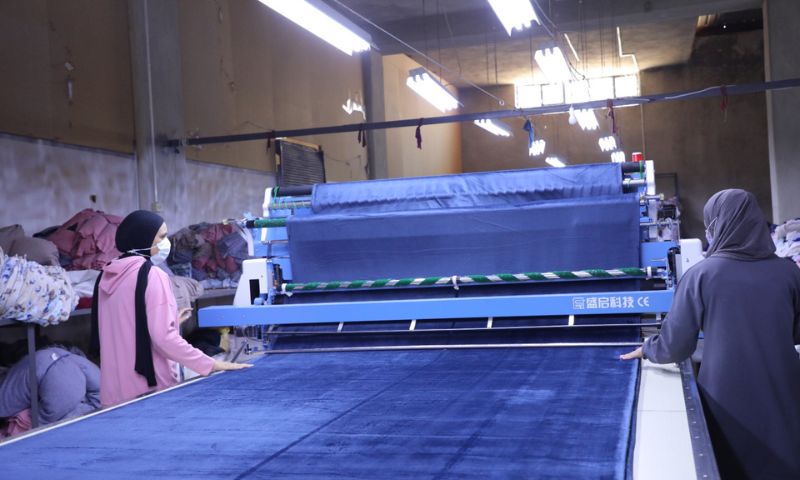
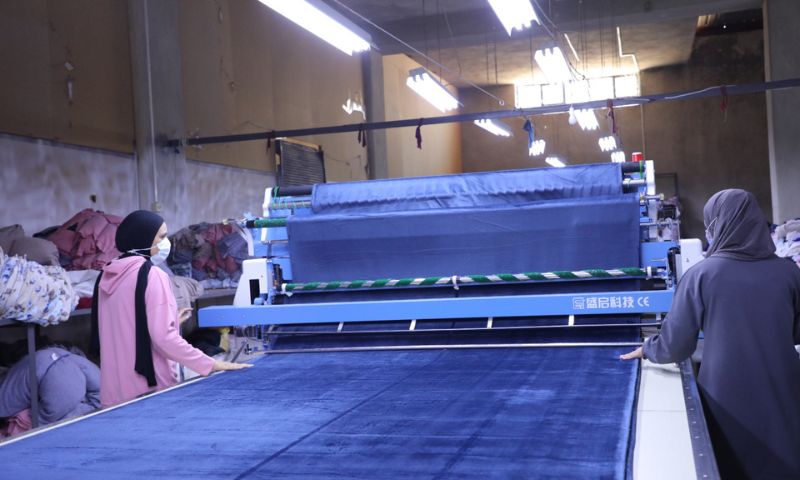
 Two female workers at a textile factory in Damascus, July 21, 2026. (Enab Baladi)
Two female workers at a textile factory in Damascus, July 21, 2026. (Enab Baladi)
Syria’s textile sector is no longer contending only with the effects of war. It is now caught between high production costs, customs duties on raw materials, and the broad opening of the market to imported ready-made clothing.
For decades, the sector was one of the pillars of national industry and a source of employment for hundreds of thousands of people. Today, manufacturers and experts say urgent decisions are needed to protect local products before factory owners turn into importers.
Syria’s textile sector is considered one of the main pillars of national industry, with a history stretching back thousands of years.
It is also a labor-intensive sector, providing jobs for hundreds of thousands of workers, craftspeople, and owners of small and medium-sized workshops, in addition to its links with other sectors, including agriculture, transportation, trade, and exports.
According to previous data, exports by Syria’s public-sector General Organization for Textile Industries were valued at about $194.8 million in 2010. Textile export volumes fell significantly after 2011 because of declining raw cotton production, damage to a number of factories, and rising energy and production costs.
In 2013, the General Organization for Textile Industries announced that losses in the public textile sector had reached about $135 million. No precise, updated statistics are available on the sector’s contribution to gross domestic product or the value of its exports since then.
The textile sector now faces both longstanding and emerging challenges. Manufacturers and experts complain of weak direct support and continued duties on raw materials used in production, while tariffs on imported ready-made clothing remain comparatively low.
Industrialist Muhannad Dadoush told Enab Baladi that the biggest challenge currently facing Syrian manufacturers is the wide opening of the market to imported ready-made clothing while the tariffs imposed on those imports remain low.
He said a tariff of $4 per kilogram of imported clothing is low and does not help protect national industry, compared with an earlier period when imports of ready-made clothing were prohibited.
Dadoush said this policy places local manufacturers in unequal competition because importers do not bear the same burdens as factory owners, including workers’ wages, energy costs, machinery maintenance, production risks, and fluctuations in prices and exchange rates.
Dadoush compared Syria’s approach to imported ready-made clothing with those of Egypt and Lebanon. According to him, Egypt does not allow ready-made clothing imports from outside Arab countries, while imports from some Arab countries are permitted under conditions and complex paperwork, in addition to high tariffs reaching $8.50 per kilogram.
He said this economic policy in Egypt has contributed to protecting local products there.
In Lebanon, Dadoush said tariffs on ready-made Turkish clothing reach $6.50 per kilogram. He said the policy helped Lebanon restore part of its domestic production after the textile sector was damaged by broad exposure to foreign markets during earlier periods.
According to Dadoush, the problem is not limited to low tariffs on imported ready-made clothing. It also includes high duties imposed on raw materials needed by the industry, such as buttons, zippers, fabrics, and other inputs used in clothing production.
He said Lebanon exempts these materials from customs duties, while Egypt imposes low tariffs of about $0.50 per kilogram. In Syria, duties reach about $1.10 per kilogram of textile raw materials.
Dadoush said these differences in customs policies directly affect the cost of the finished product and make Syrian manufacturers less competitive in both domestic and foreign markets.
According to data from Egypt’s Ready Made Garments Export Council, Egyptian ready-made garment exports rose by 15% during the first half of 2026, reaching about $1.78 billion.
Dadoush said weak support for Syria’s textile industries has prompted some Syrian factory owners operating in Egypt to send ready-made clothing to the Syrian market instead of manufacturing it locally, even though they own factories inside Syria.
He attributed this to higher production costs in Syria compared with Egypt, making manufacturing abroad, or importing directly, more commercially viable.
Production costs in Syria were about 30% lower than in Egypt in 2022, but in 2025 and 2026 they became about 30% higher than production costs in Egypt, according to Dadoush.
He linked the shift to several factors, most notably exchange rate fluctuations, higher wages, energy costs, taxes, and an unstable economic environment.
The Syrian government, meanwhile, has recently announced some measures aimed at manufacturers, including tax reductions and exemptions related to electricity bills, along with plans under the new tax system.
In October 2025, the finance minister announced that taxes on industrialists would be set at 10% under the new tax system. He also said 25% of revenue from the planned sales tax, which is to replace the consumer spending tax, would be allocated to supporting industry and exports.
Regarding the impact of these measures, Dadoush explained that traders and manufacturers are currently paying taxes for 2022 and 2023. He said paying taxes two or three years later is common practice in many countries because financial statements are usually submitted during the first months of the following year and are then audited and reviewed by tax authorities before being accepted or amended.
He noted, however, that the taxes currently being paid relate to the period of the former regime, whose approach to tax assessment he described as being based on “intimidation and unfair collection.”
According to Dadoush, the same approach is not evident under the current administration. However, manufacturers and traders will not feel the impact of the new policies before 2027 or 2028 because of the time gap between the tax year and the actual payment date.
Faced with these challenges, manufacturers and experts have proposed a range of measures to help revive Syria’s textile sector, beginning with easing customs and tax burdens and extending to protecting the domestic market.
Hussam al-Draei, an expert in customs affairs, told Enab Baladi that the first step should be to exempt raw materials used by textile industries from customs duties, similar to a decision issued about a year ago that exempted machinery needed by these industries from such duties.
Al-Draei also called for reducing port fees on imported yarn, particularly from China, noting that port charges have increased by an additional 60 euros per container, whether the container has a capacity of 20 feet or 40 feet.
He said reducing these costs would improve the competitiveness of local products, particularly because Egyptian and Chinese clothing is widely available across global markets.
Dadoush agreed with al-Draei on the need to reduce or completely eliminate duties on raw materials. He also called for higher tariffs on imported ready-made clothing to protect local products from unequal competition.
The accumulated challenges indicate that some textile factories have left the Syrian market in recent years, while some owners have shifted toward importing rather than manufacturing because trading in ready-made clothing is easier than producing it locally.
According to manufacturers, production requires time, effort, capital, and continuous operations, as well as the ability to absorb losses and risks. Importing, by contrast, offers a faster and less complicated commercial cycle, particularly in the absence of sufficient protection for domestic products.
Dadoush said continuing under this model could further weaken the sector and turn some manufacturers into import traders rather than producers capable of employing local workers and exporting Syrian clothing.
Despite the bleak picture, recent signs have suggested renewed government interest in the textile sector, highlighted during the NASTEX 2026 exhibition at the Damascus Fairgrounds.
During the exhibition, Economy and Industry Minister Nidal al-Shaar said the government is working to support and develop the textile sector in partnership with the private sector. He called on sector representatives to submit a unified vision and a clear structure for the stages of textile production and ways to develop the industry, while stressing the need to prepare for changes taking place in the textile industry globally.
if you think the article contain wrong information or you have additional details Send Correction


 A
A
A
A
A
A



 More Economic Reports