
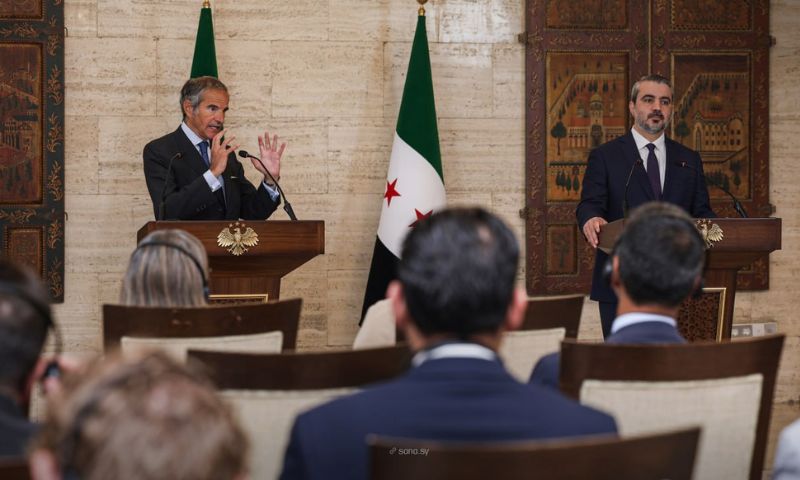

International Atomic Energy Agency Director General Rafael Grossi revealed the presence of tons of natural uranium in Syria and said an IAEA delegation had visited the Deir Ezzor site (eastern Syria) to monitor “ongoing excavation activities in close coordination” with the Syrian government.
In a post on X on Tuesday, August 18, Grossi said, “We confirmed the presence of several tons of natural uranium metal” at an undisclosed site outside Damascus. He added that the agency and the government had agreed that the undeclared material would be verified and subjected to the IAEA’s routine safeguards procedures.
Grossi continued, “We visited a site where large quantities of graphite are stored, which is also associated with previous nuclear activities in Deir Ezzor,” thanking the Syrian government for its “proactive cooperation.”
Grossi said the visit came “in the context of ongoing cooperation with the Syrian government to clarify and resolve outstanding safeguards issues related to the implementation of the safeguards agreement under the Nuclear Non-Proliferation Treaty (NPT) with the International Atomic Energy Agency.”
For his part, Syrian Foreign Minister Asaad al-Shaibani said during a joint press conference with Grossi in Damascus on Tuesday that Syria had granted access to the Deir Ezzor site “after more than 18 years, on its own initiative and by a sovereign decision.” He said Syria was dealing with the legacy of the former regime regarding nuclear activities.
Grossi, according to Syria’s state-run SANA news agency, said the IAEA began working with the new Syrian government 18 months ago, “when it opened to us a secret site in Deir Ezzor dating back to the former regime.” He said the agency was working to address issues that had previously raised concerns within the international community.
“Today is an important day for security, peace and the indispensable efforts in the field of nuclear non-proliferation,” Grossi said. “We began cooperating with the new Syrian government, while the former regime did not cooperate in this area.”
New Chapter, Peaceful Nuclear Energy a “Sovereign Right”
The IAEA director general said Syria had “regained its place in the international community as a state fully compliant with all its legal obligations concerning nuclear weapons,” adding, “Now we are turning the page on the past and beginning a new chapter in nuclear cooperation.”
Grossi added that the next steps would include further cooperation and support from the IAEA for Syria, noting that cooperation with the agency “paves the way for Syria to establish new and beneficial international relations and partnerships in the field of nuclear energy.”
Al-Shaibani said cooperation between Syria and the IAEA had “reached advanced stages, and transparency is our choice in dealing with it.” He added that Syria hoped Grossi’s report would reflect the extent of progress achieved in nuclear cooperation.
The Syrian foreign minister stressed that Syria “affirms its full right to possess a peaceful nuclear program and benefit from its applications,” pointing to what he described as the country’s sovereign and legal right to civilian and peaceful uses of atomic energy.
According to Grossi, nuclear technology in Syria “will be linked to energy, health and water management,” referring to the priorities for peaceful applications that Damascus seeks to pursue.
Deir Ezzor Site and Nuclear Material Removal Agreement
The press conference came days after the Syrian Atomic Energy Commission announced on August 11 that Syria was continuing its cooperation with the IAEA, the United States and friendly countries to address the “legacy of the former regime,” activate Syria’s full membership in the agency and receive support in peaceful applications of nuclear energy, including health, food and scientific research.
The commission had said that an IAEA delegation would visit Syria in the coming days and that the progress made by the country in this field would be announced jointly, which was reflected in Tuesday’s joint press conference.
The issue dates back to the secret al-Kibar site in Deir Ezzor, whose facilities were bombed by Israel in 2007 and which was linked to a secret nuclear program developed by the Assad regime.
According to a report published by Axios on August 10, the administration of US President Donald Trump mediated between Syria and Israel, leading to an agreement between the Syrian government and the IAEA to remove nuclear materials stored at the site. These included “yellowcake,” produced through the processing of uranium ore, which can be used in the manufacture of a “dirty bomb.”
According to the Axios report, Israel bombed the entrances to the site after the fall of the Assad regime and threatened to strike it again if the materials were not removed. The Trump administration asked Israel not to take military action and decided to bring the IAEA into the matter.
The report cited US officials as saying that only a very limited number of people in the United States, Israel and Syria knew about the existence of the materials. The officials said the new Syrian government had shown willingness to address the issue, with one US official saying the Syrians had been “good partners” in dealing with several matters.
Grossi’s announcement reflects the closing of this complex file as Syria works to build a new relationship with the IAEA based on transparency and cooperation in the peaceful uses of nuclear energy.